Orthodox Jewish groups have been quiet about ICE. This Minneapolis rabbi wasn’t.
Rabbi Max Davis on bearing witness and making a difference in Minneapolis
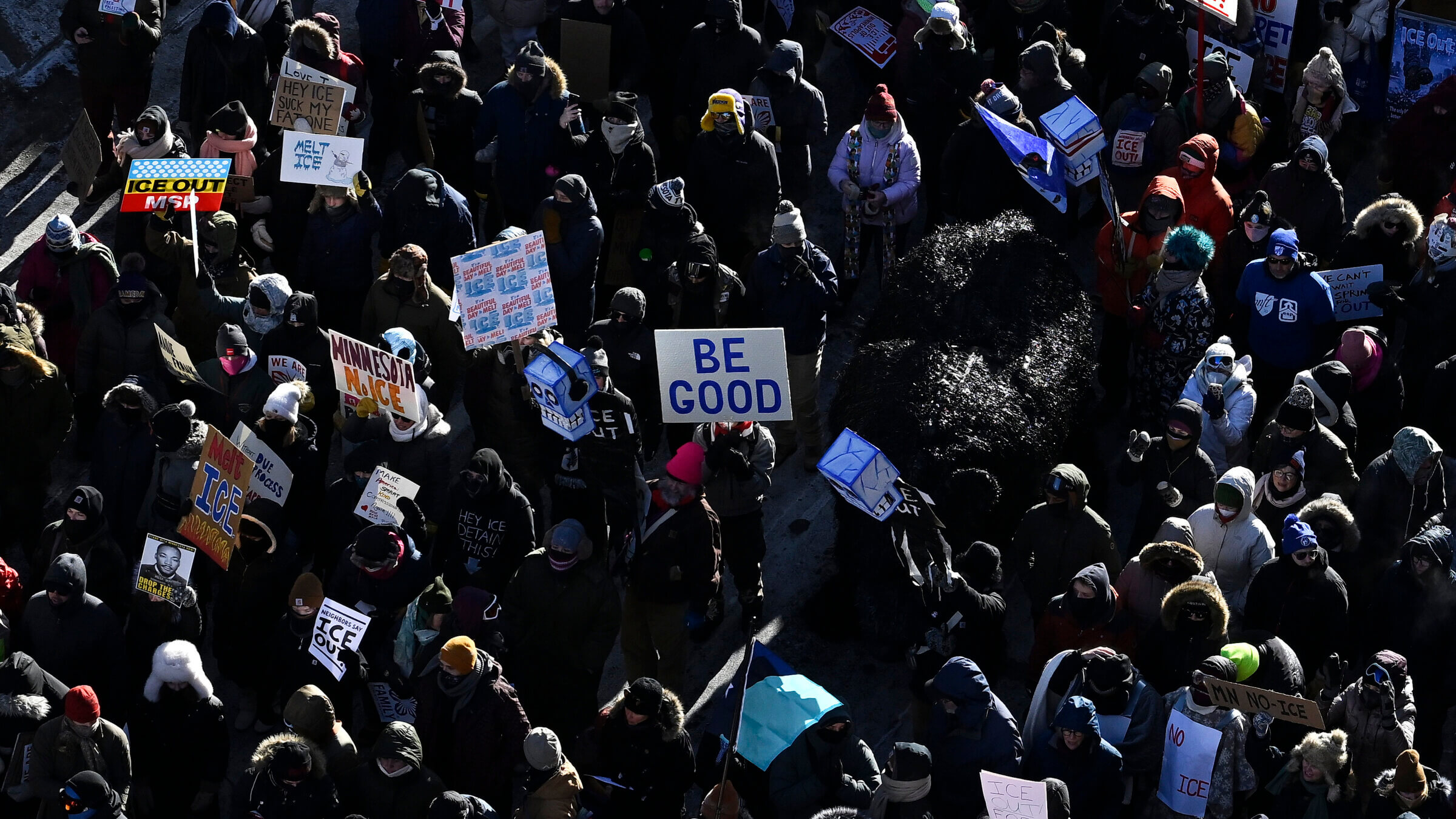
An “ICE OUT” rally in Minneapolis. Leaders from Reform, Conservative and Reconstructionist Judaism have condemned ICE’s conduct in the city, but Orthodox groups have largely remained silent. Photo by Stephen Maturen/Getty Images
By Louis Keene January 27, 2026
When the heads of major Jewish denominations co-signed a letter last week criticizing “in the strongest possible terms” the conduct of U.S. Immigration and Customs Enforcement in Minneapolis, Orthodox Judaism was conspicuously absent. Neither the Orthodox Union nor Agudath Israel of America — the two leading Orthodox umbrella organizations — has commented on the mass deployment of ICE and Border Patrol officers to the city.
There’s a reason Orthodox leaders might be choosing their words carefully — condemning ICE would put them at odds with a sizable chunk of their membership. Unlike members of the Reform, Conservative and Reconstructionist movements, Orthodox Jews — who represent about a tenth of the American Jewish population — lean heavily conservative, with about three-quarters supporting President Donald Trump in the 2024 election. (The Orthodox Union and Agudath Israel did not respond to separate inquiries.)
There was, however, at least one Orthodox rabbi willing to criticize ICE in public. Rabbi Max Davis, who leads the Minneapolis Modern Orthodox synagogue Darchei Noam Congregation, was one of 49 Jewish leaders to sign a Jan. 16 letter from the Minnesota Rabbinical Association, which said ICE was “wreaking havoc across our state” and which resolved to “bear witness and make a difference.”
I called Davis to learn more about why he signed and what he’s seeing on the ground. He also spoke about congregants who have been pepper sprayed or arrested at protests, how he approaches politics at the pulpit of an Orthodox shul, why he rejects the Holocaust comparisons some are making and how he’s tried to make a difference.
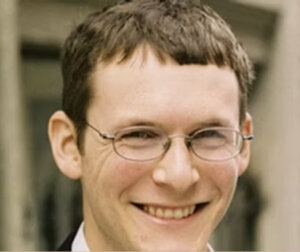
Our interview has been edited for length and clarity.
Why did you sign this letter?
It felt like a very reasonable, very carefully thought out response to the present situation. I know that there are many within the shul who are looking for some leadership in this moment, and signing was a drop in the bucket compared to what some people are doing.
By the same token, I know that there are other perspectives within my own shul and certainly within the broader Orthodox community, and I strongly believe that it’s not the role of a rabbi to police his congregants’ politics. In our shul, we learn from and respect each other, and there’s an incredible amount of wisdom and life experience beyond my own. So I signed with caution, but with quite a feeling of disappointment and anger in the events unfolding downtown, and the loss of life in particular.
I’m probably the only Orthodox rabbi in the Minnesota Rabbinical Association, and there have been statements issued that I have not signed. But this one was an opportunity I was not going to miss.
What’s been the reaction at Darchei Noam to your signing the letter?
I got several yasher koachs (plaudits) privately. Those who may disagree, I think were and are being polite. There’s definitely been some pushback about politics entering our shul. But I haven’t heard much about the letter specifically. I don’t think anyone was terribly surprised that I signed it.
More broadly, what are things like in your community right now?
Within our kehilla (congregation), there’s a diversity of opinion. But mostly what I’m hearing is deep sorrow and frustration and anger and pain — particularly from those who watch the videos, who are acquainted with individuals suffering directly from the ongoing operations, or who have watched what the operations have been doing to our city and to our community.
Have you seen what’s happening firsthand?
There’s someone in our extended community who just got out of jail and called me about 10 minutes ago to give me a heads up. We have a couple of people in the community who have been pepper sprayed. We have people in the community who have been very active in supply drives and driving children to school because their parents are afraid to come out.
Instead of buying stuff at the generic supermarket I thought I might as well make the money count where people are hurting the most. So I went a couple weeks ago to try and pick up some kiddush supplies down at one of the large Latino markets that I know has taken quite a hit. I was pretty much the only customer. It was a very sad place.
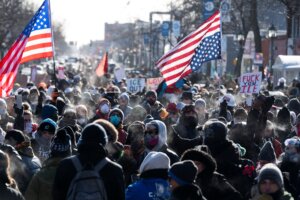
So in those regards, I’ve seen what’s going on. I was down at the march last Erev Shabbos (Jan. 16). It was minus 10 degrees. There were 50,000 people out there in the streets and thousands more in the skyways and in the buildings that we could see. You see banners and signs hanging onto highways. You see people clustered at intersections with signs and upside-down American flags. There’s a tremendous amount of anger out there.
What’s it like to be living through that?
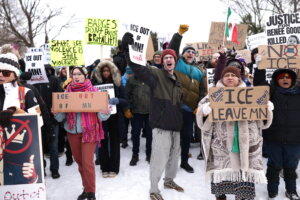
It’s heartening and it’s disheartening. It’s disheartening that it feels necessary; it’s heartening to see community coming together. It’s disheartening to see signs comparing the federal government and ICE to Nazi Germany; I find that, as a Jew, deeply offensive and ignorant. And by the same token, I find all of the messages around community and common decency to be a beautiful sight.
It’s not to say that I have any solutions to the more fundamental politics. I’m not saying that the country doesn’t have an immigration problem. But I do know that you can’t watch the video of Alex Pretti, the ICU nurse from the VA hospital, you can’t watch the video of Renee Good in her car and how that unfolded — shootings on streets and in neighborhoods that I know — you can’t watch that and not be highly disturbed and moved.
Have you addressed this moment at all from the pulpit?
I have definitely mentioned it in a couple of drashos (sermons). A couple of weeks ago, I spoke about ignoring the broader humanity and the plight of our neighbors at our own moral peril. Nechama Leibowitz sees a progression in Moshe’s interventions, first on behalf of another Jew against the Egyptian, then for a Jew against another Jew, and finally, with the daughters of Yitro at the well, between two non-Jewish parties. It was a good base for talking about doing what we can, when we can, to be an ohr l’goyim (a light unto the nations). I don’t think I said the word “ICE,” but there was no mistake about the subject matter — I think Renee Good had been shot like two days earlier.
With drashos, I’ve tried to be a little bit more tempered and restrained, because I think a lot of people come to hear Torah and inspiration and political issues are risky business. I’m also careful because I don’t want to ruin people’s Shabbos in other ways. Everyone has so much of this all week long, and I know some people look forward to Shabbos just to take a break. I’ve been told by some people that I’ve been too pareve, and by others that it’s been too much. So maybe I’m succeeding or failing everybody at the same time.
You mentioned the Nazi comparisons. Why do you take offense to those in this context?
That was industrialized murder, and concentration camps — there’s not a word to describe the evil of what that was. That was just exponentially more horrific. And it disturbs me to no end — although I am not surprised to see people make this comparison and I get where they’re coming from — how lightly the Holocaust and the evils of Nazi Germany seem to be treated when people want to trot out a paradigm of evil.
Why did it feel important to you to patronize the Latino grocery store?
I feel for these communities, where these are honest, legitimate, hard working businesses, and they watch their customer base all but dry up — that includes people who are here legally, employees who are here legally. But there are so many stories of individuals who are being racially profiled or being picked up by mistake.
I was very angry about the story of a Laotian man who, in front of his family and children, was pulled out of the shower into 10-degree weather and bundled off into an ICE vehicle and driven around for an hour before they figured out that he was here legally and had no criminal record. He was let go without so much as an apology. He’s got a wife and small children — and I’ve got a wife and kids, you know? This kind of thing is absolutely unacceptable. And unfortunately, it doesn’t seem like that was such an outlier case. And that’s not an America that I believe in.
This is a moment of great uncertainty. Here’s what you can do about it.
We hope you appreciated this article. Before you go, we’d like to ask you to please support the Forward’s independent Jewish news this Passover. All donations are being matched by the Forward Board - up to $100,000.
This is a moment of great uncertainty for the news media, for the Jewish people, and for our sacred democracy. It is a time of confusion and declining trust in public institutions. An era in which we need humans to report facts, conduct investigations that hold power to account, tell stories that matter and share honest discourse on all that divides us.
With no paywall or subscriptions, the Forward is entirely supported by readers like you. Every dollar you give this Passover is invested in the future of the Forward — and telling the American Jewish story fully and fairly.
The Forward doesn’t rely on funding from institutions like governments or your local Jewish federation. There are thousands of readers like you who give us $18 or $36 or $100 each month or year.
Support our mission to tell the Jewish story fully and fairly.