Iranian Jews caught between frustration and hope as US debates intervention
As unrest erupts in Iran, Iranian American Jews balance hope for change with unease over how U.S. debates on intervention, ‘America First,’ and Israel are shaping the conversation
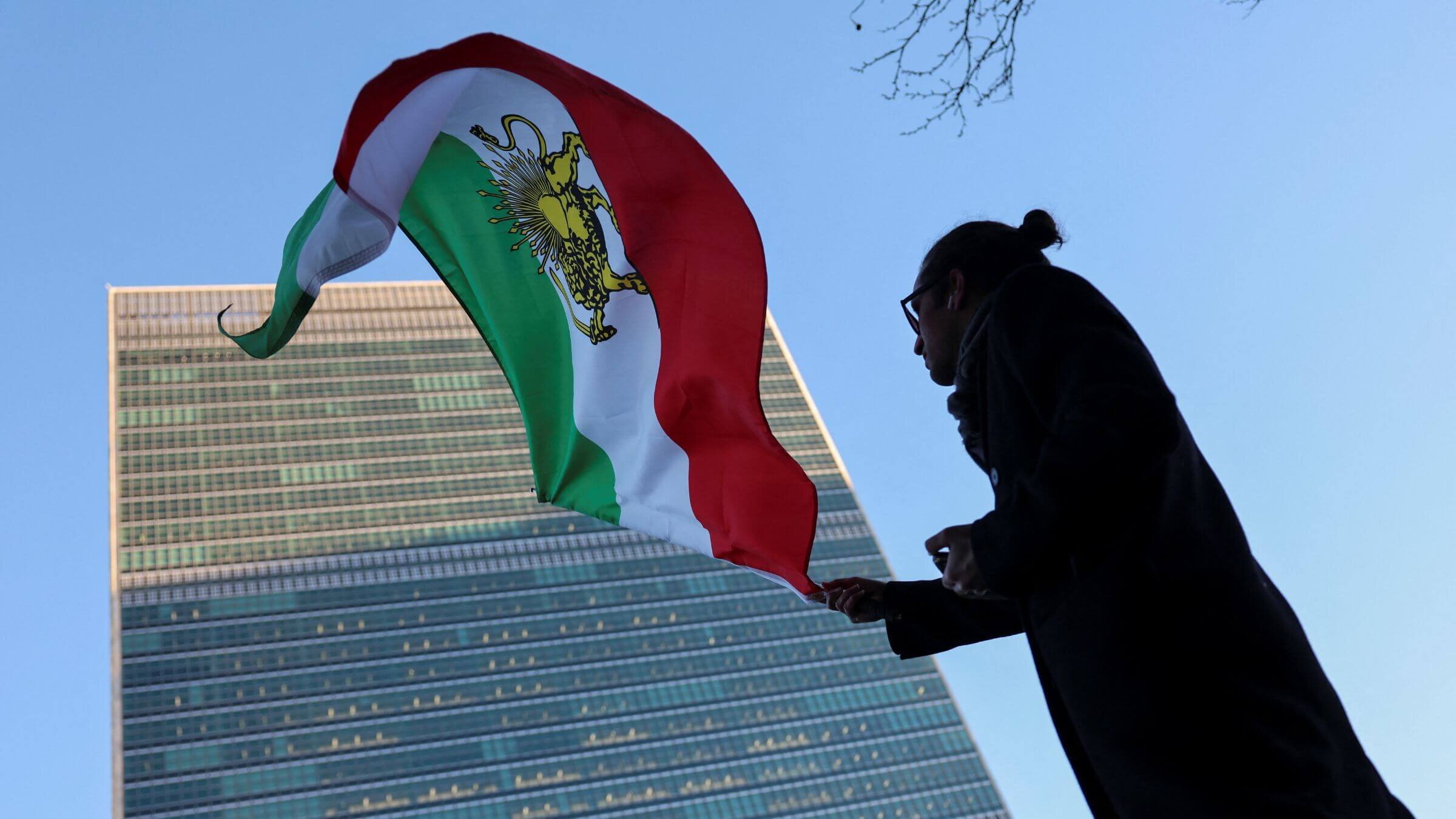
A protester waves the pre-Islamic Revolution Iranian flag outside UN headquarters during a United Nations Security Council meeting on Iran in New York on Jan. 15, 2026. Photo by (Photo by ANGELA WEISS / AFP via Getty Images)
By Simone Saidmehr January 30, 2026
Over the past several weeks, Iranian American Jews have watched a historic uprising unfold in Iran. For many in the diaspora, the protests feel like a potential watershed. But they have also watched with dismay as familiar U.S. discourse over Israel and American power abroad saps the movement of its momentum.
For Iranian Jews, this moment is sharpened by history. Most fled Iran during and after the 1979 Islamic Revolution, when social and political instability became widespread, Sharia law was imposed, and life for religious minorities fundamentally changed. The Jewish population, once estimated at around 100,000, has since dwindled to between 8,000 and 10,000. As Iranian Jewish human rights activist Marjan Keypour told the Forward, “the Jews in Iran were given a one-way ticket right out of the country.”
These protests have unlocked long dormant possibility that Jews might one day return to Iran — if not to live, then at least to visit on their own terms.
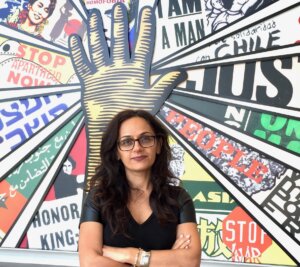
“Every Persian kid is asking their parents, ‘Where would you go first? If we go back to Iran, where will you take me?’” said Moji Pourmoradi, former assistant director of the High School at Temple Israel of Great Neck, a community that is home to one of the largest Persian Jewish populations in the country. “People haven’t asked those questions since they left. They were not allowed that hope.”
America First?
That newfound optimism makes the stakes of the uprising profound for Iranian Jews. “When I’m with my family, we talk about Iran every day,” said Tyler Moshfegh, a 21-year-old Iranian Jew from Los Angeles who still has relatives in the country. Recently, he said, those conversations have been marked by frustration over how many other anti-regime protest movements in Iran since 1979 have been crushed.
“Every time, the U.S. government says they’re going to support the people of Iran,” Moshfegh said, “and then it just gets thrown under the rug after a week.”
Iranian Jews had initially been buoyed by comments from President Donald Trump, who said in a Jan. 14 Truth Social post addressed to Iranian protesters, “KEEP PROTESTING – TAKE OVER YOUR INSTITUTIONS!!!… HELP IS ON ITS WAY.” The U.S. moved major military assets to the Middle East this week, and threatened the use of force unless Iran agreed to a nuclear deal.
But in the time between the message and the military movement, thousands of protesters were reportedly killed by Iranian regime forces, giving some the impression that Trump’s shifting rhetoric had left the protesters defenseless. For them, allowing the regime to evade accountability for the mass killing of demonstrators in exchange for a nuclear deal does not go far enough.
“There are many people who are like, ‘Trump, you better not back down,’” said Rabbi Tarlan Rabizadeh, a vice president at American Jewish University and the daughter of Iranian immigrants. “We believed in you. If you do this, we’re never going to believe in you again. And you’re going to have blood on your hands.”
At the same time, some Iranian American Jews described feeling pressure to defend their concerns as calls grow on the American right to avoid foreign intervention altogether. Former Rep. Marjorie Taylor Greene wrote on X that “President Trump threatening war and sending in troops to Iran is everything we voted against in ’24.”
Anna Hakakian, a community leader and president of the Babylonian Jewish Center Sisterhood in Great Neck, said, “The ‘staying out’ rhetoric feels like abandonment, especially when it translates into silence on human rights or appeasement of the regime.”
Rabizadeh said she struggles to understand how critics ignore the Iranian regime’s broader threat to the U.S. because it is the world’s foremost state sponsor of terrorism, funding groups like Hamas, Hezbollah and the Houthis.
“Forget about Israel,” she said. “What about the Houthis and all of the American ships they keep bombing?”
A deafening silence
Yet even more resistance to the idea of U.S. military action in Iran comes from Democrats — 79% of whom oppose intervention even if protesters are killed while demonstrating, compared to 53% of Republicans.
For Hakakian, the paucity of activism supporting the protesters revealed a double standard.
“Where are all the celebrities who speak loudly about human rights?” Hakakian said. “Where are the feminists? Where are the campus activists? It’s not west versus east, it’s not colonizer versus oppressed, so the suffering is ignored.”
That frustration has been compounded by antisemitic conspiracy theories circulating in some progressive spaces – including one shared by a Columbia University professor – claiming the protests in Iran were instigated by the Mossad to distract from the Israeli-Palestinian conflict.
“In Great Neck, where many families have direct memories of persecution and exile, this framing seems dehumanizing, and it has an antisemitic undertone,” Hakakian said, adding, “It’s very much in line with what the regime narrates and what they want people to believe.”
On social media, some on the left have criticized the Iranian diaspora’s support for opposition figure Reza Pahlavi, who has been widely attacked for being pro-Israel. Pourmoradi said that Iranian Jews are frustrated by the refusal of those on the left who refuse to back U.S. intervention because they believe it is connected to promoting Israeli interests.
“Their ignorance isn’t just ignorance anymore. It’s detrimental. How many of those people that can’t back it have spoken to anybody who lived through it?” she said. “I think that most of my community feels the same way.”
Keypour said involving Israel in the conversation was a cheap way to dismiss the thousands of lives that had already been sacrificed in the Iranian people’s struggle for freedom.
“If we are mixing the conversation about Iran with Israel, Zionism, and Mossad,” said Keypour, “we discredit the agency of the Iranian people that they have exhibited so bravely.”
This is a moment of great uncertainty. Here’s what you can do about it.
We hope you appreciated this article. Before you go, we’d like to ask you to please support the Forward’s independent Jewish news this Passover. All donations are being matched by the Forward Board - up to $100,000.
This is a moment of great uncertainty for the news media, for the Jewish people, and for our sacred democracy. It is a time of confusion and declining trust in public institutions. An era in which we need humans to report facts, conduct investigations that hold power to account, tell stories that matter and share honest discourse on all that divides us.
With no paywall or subscriptions, the Forward is entirely supported by readers like you. Every dollar you give this Passover is invested in the future of the Forward — and telling the American Jewish story fully and fairly.
The Forward doesn’t rely on funding from institutions like governments or your local Jewish federation. There are thousands of readers like you who give us $18 or $36 or $100 each month or year.
Support our mission to tell the Jewish story fully and fairly.