Proposed laws aim to test the Supreme Court’s ban on public school-sponsored prayer
Lawmakers in Tennessee and Florida, as well as Congress, want public schools to set aside time for prayer and Bible study, threatening a milestone decision won by Jews decades ago
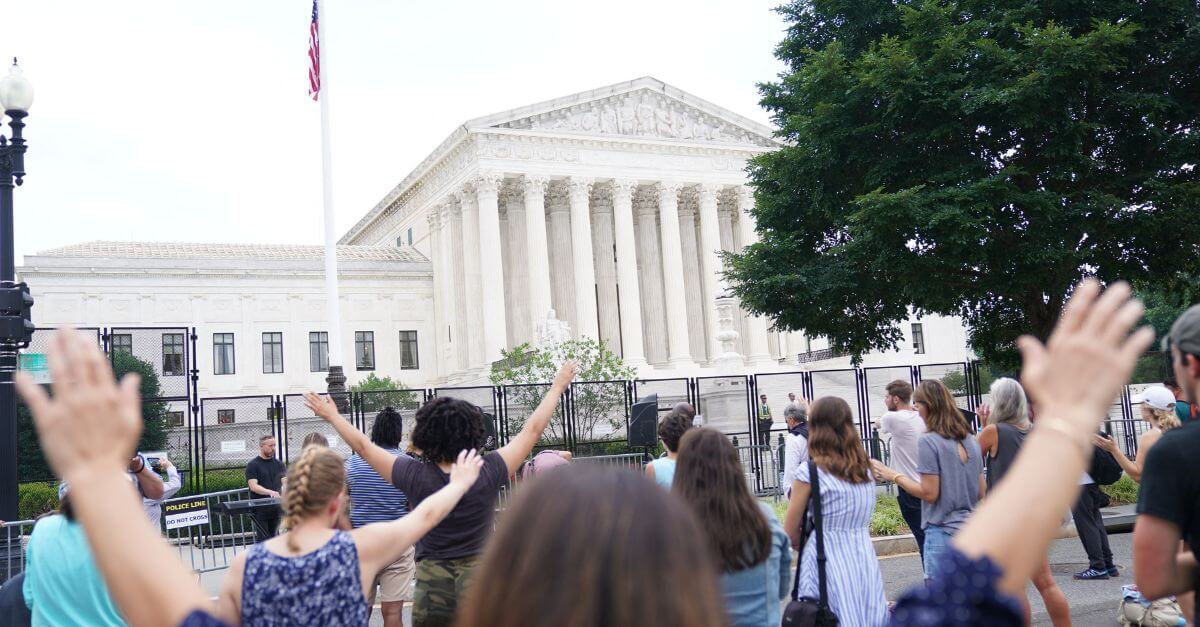
People pray outside the U.S. Supreme Court in June 2022 following its decision in Kennedy v. Bremerton School District. The Supreme Court ruled that a Washington state high school football coach had a right to pray on the field immediately after games. Photo by Stefani Reynolds/AFP via Getty Images

By Hannah Feuer February 9, 2026
Public schools have been barred from sponsoring official prayer since the Supreme Court’s 1962 ruling in Engel v. Vitale, a landmark decision that cemented the principle of church-state separation in American law.
Now, lawmakers in several states are advancing measures that aim to bring prayer back into public schools — with potential to reverse decades of precedent as politicians push for Christian prayer to return as a commonplace part of the school day.
In Tennessee, a bill introduced last month would require public schools to set aside time for voluntary prayer and the reading of “the Bible or other religious text.” Students would opt in to the prayer period by getting their parents to sign a consent form, which also requires participating students to waive their right to sue.
Texas enacted a nearly identical law last year, empowering school boards to institute prayer and Bible-reading periods in schools across their districts by March 1 — a move more than 160 religious leaders urged school boards to reject in an open letter last month.
Texas Attorney General Ken Paxton encouraged students to use the time to recite the Lord’s Prayer “as taught by Jesus Christ.”
In Florida, a proposed amendment to the state constitution would allow students and teachers to lead prayer over a loudspeaker at school-sponsored events — even though the Supreme Court ruled student-led, student-initiated prayer at football games unconstitutional two decades ago.
Meanwhile, a federal bill introduced by Rep. David Rouzer (R-N.C.) last month would withhold federal funding from public schools that “restrict voluntary school prayer,” and new guidance from the Department of Education released last week allows teachers to pray with students.
Nik Nartowicz, lead policy counsel at Americans United for Separation of Church and State, said the Supreme Court’s church-state separation precedents like Engel v. Vitale aren’t in immediate jeopardy — but they are steadily being undermined.
“Teachers have a little bit more right to pray in public schools than they did last time. And then it just kind of slowly builds,” Nartowicz said. “The very principles of religious freedom in public school are very clearly under attack.”
A Jewish plaintiff
In 1951, the Board of Regents of New York proposed that public schools start the day with what it called a “non-denominational” prayer. Students were able to opt out with a parent’s signature.
“Almighty God, we acknowledge our dependence upon Thee, and we beg Thy blessings upon us, our parents, our teachers and our country. Amen,” the prayer read.
Five families sued, arguing that the school-organized prayer violated their constitutional rights. They came from a range of religious backgrounds, including Judaism, atheism, Unitarianism and humanism.
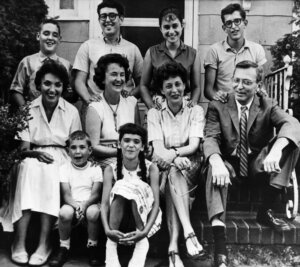
But the case quickly took on a Jewish character, as a Jewish parent named Steven Engel became the lead plaintiff, and a broad cross-section of Jewish organizations became involved with the case. The American Jewish Committee, the Anti-Defamation League of B’nai Brith and the Synagogue Council of America — which represented 70 Jewish organizations spanning Orthodox, Conservative and Reform — all filed briefs urging the court to strike down school-sponsored prayer.
According to Bruce Dierenfield, author of The Battle over School Prayer: How Engel v. Vitale Changed America, when the court released its decision the blowback was intense — and, at times, antisemitic.
The Supreme Court received the largest amount of hate mail in its history. Politicians called to amend the Constitution and impeach the justices, and 15 states refused to immediately discontinue prayer and Bible reading in their schools. An angry protester burned a cross in plaintiff Lawrence Roth’s family driveway.
“Some people say this case produced more of a backlash than almost any other case in American history,” Dierenfield said. “It seemed to be the death knell of ‘Christian America.’”
A changing landscape
In the decades after Engel, the Supreme Court repeatedly reinforced the ban on school-sponsored prayer, controversially ruling that even required moments of silence could be unconstitutional if intended to encourage prayer.
That line shifted in 2022. The court sided with Joe Kennedy, a high school football coach in Washington state who had been placed on leave for praying at midfield immediately after games, sometimes joined by players.
The school district’s actions “rested on a mistaken view that it had a duty to ferret out and suppress religious observances even as it allows comparable secular speech,” Justice Neil Gorsuch wrote in the majority opinion. “The Constitution neither mandates nor tolerates that kind of discrimination.”
The Kennedy ruling “was kind of a slap at the absolutism of Engel,” Dierenfield said. “It epitomizes somewhat of a new day.”
The decision also hinged in part on disputed interpretation of facts: The majority argued that Kennedy had engaged in “short, private, personal prayer,” while the dissent said he prayed with students in a setting where they could feel pressured to participate.
The case highlighted the often-blurry line between voluntary and coercive prayer, a tension made more complicated by peer pressure and the authority teachers and coaches hold over students.
According to Nartowicz, teachers and students are free to pray or read religious texts as long as they don’t disrupt or pressure others — but that boundary is crossed when teachers pray with students. Even though new policies make prayer and Bible-reading periods opt-in, he said, the practice can still feel coercive.
“If a teacher’s praying, because teachers have so much control over students, a student might say, Oh, I need to pray in order to make sure I’m in the good favor of so-and-so to get a good grade in their class,” he said.
Rabbi Michael Shulman of Congregation Ohabai Sholom in Nashville, Tennessee, who wrote an op-ed speaking out against his state’s school prayer bill, shares similar concerns.
He said children at his congregation are often the only Jewish students at their schools, and a school-sponsored period for prayer would only worsen their feelings of alienation.
“Anytime religion and government mix, there’s a danger of signaling that this is what the state is promoting — which beliefs are normal, which ones are not,” Shulman told the Forward. “So when public schools, that are state institutions, promote this, it really changes the meaning of what ‘voluntary’ is.”
‘Exactly the right time’
School prayer advocates are explicit about their goal: They want the Supreme Court, which currently has a 6-3 conservative majority, to take up their case.
It’s unclear if the court will choose to weigh in. In November, the Supreme Court declined to hear an appeal in a case where a lower court had upheld a ban on broadcasting a pregame prayer over the loudspeaker at a high school football game.
But proponents of school prayer aren’t giving up. The Tennessee bill states that “the idea of separation of church and state departs from the religious liberty guaranteed by the Constitution of the State of Tennessee” and lists 11 Supreme Court decisions, including Engel, as examples of rulings that it says conflict.
“I think this is exactly the right time to have this issue brought back into the public square, both because our Supreme Court has, I think, more properly aligned in most recent decisions and because I think we just need to have prayer back in our schools,” Rep. Gino Bulso, the bill’s sponsor, told The Tennessee Conservative.
Meanwhile, Paxton has pledged to defend in court any school district that implements a voluntary prayer period.
For those who remember how fiercely Engel divided the country, a new showdown at the Supreme Court feels almost inevitable.
“I sit on tenterhooks all the time about seeing that somebody’s going to bring a suit saying that they have the right to have organized prayer in public schools. I would not be the least bit surprised to see a case — see the Engel case come up again in the Supreme Court,” Jonathan Engel, Steven Engel’s son, said in a 2023 documentary. “So we may have to fight this battle again.”
This is a moment of great uncertainty. Here’s what you can do about it.
We hope you appreciated this article. Before you go, we’d like to ask you to please support the Forward’s independent Jewish news this Passover. All donations are being matched by the Forward Board - up to $100,000.
This is a moment of great uncertainty for the news media, for the Jewish people, and for our sacred democracy. It is a time of confusion and declining trust in public institutions. An era in which we need humans to report facts, conduct investigations that hold power to account, tell stories that matter and share honest discourse on all that divides us.
With no paywall or subscriptions, the Forward is entirely supported by readers like you. Every dollar you give this Passover is invested in the future of the Forward — and telling the American Jewish story fully and fairly.
The Forward doesn’t rely on funding from institutions like governments or your local Jewish federation. There are thousands of readers like you who give us $18 or $36 or $100 each month or year.
Support our mission to tell the Jewish story fully and fairly.