5 things to know ahead of the Trump-Netanyahu meeting
A potential Iran deal, debate over U.S. military aid to Israel, and Israeli moves in the West Bank are setting the stakes for the talks
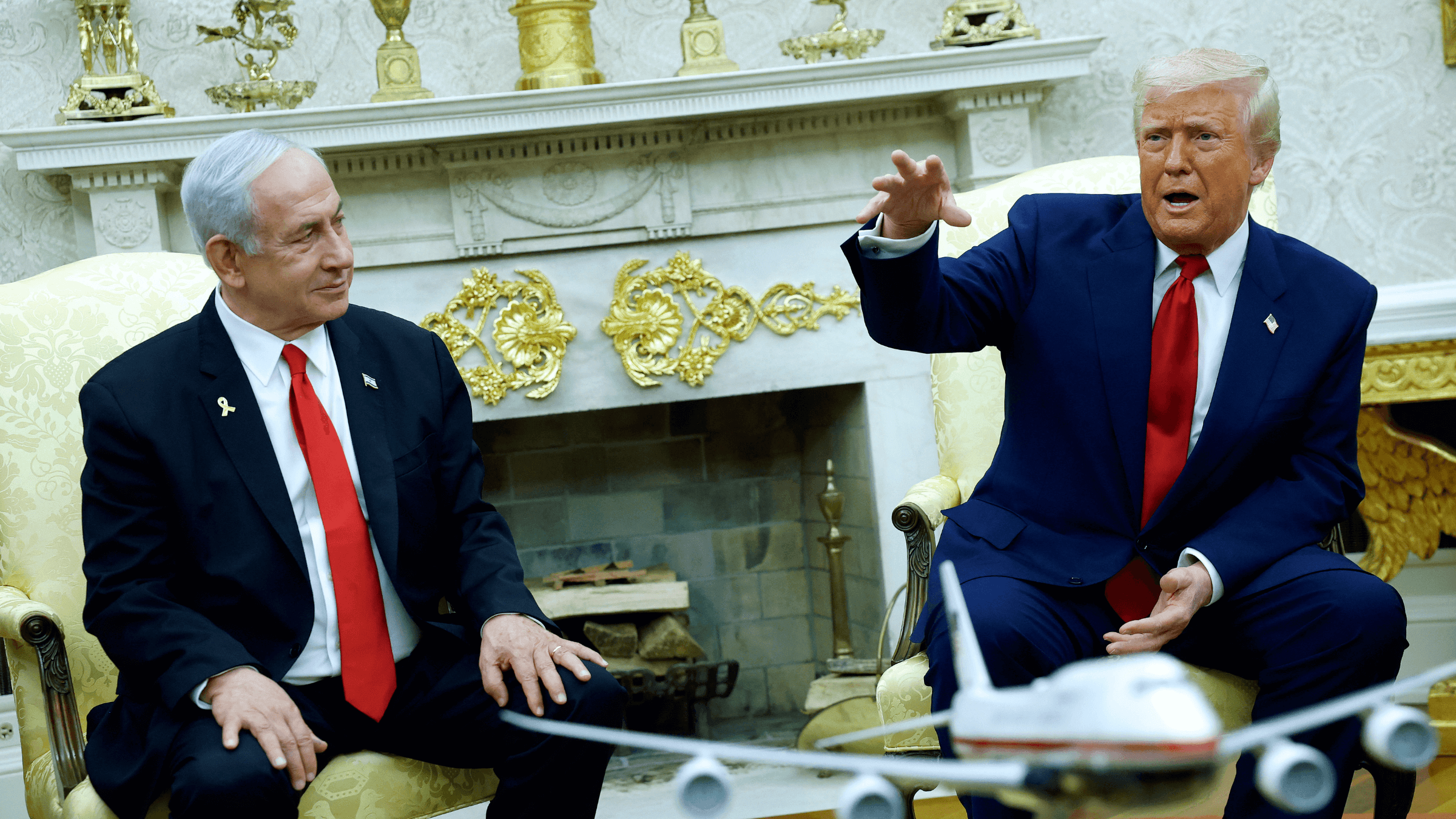
U.S. President Donald Trump (right) speaks alongside Israeli Prime Minister Benjamin Netanyahu, during an April 2025 meeting in the Oval Office. Photo by Kevin Dietsch/Getty Images

By Simone Saidmehr February 11, 2026
President Donald Trump and Israeli Prime Minister Benjamin Netanyahu are set to meet at the White House Wednesday in a highly anticipated discussion. The primary focus of the meeting is expected to be the ongoing negotiations between the United States and Iran, particularly regarding Tehran’s treatment of protesters and the possibility of a renewed agreement on Iran’s nuclear program.
But it also comes amid intensifying debates over U.S. military assistance to Israel, eroding bipartisan support for that aid, and recent controversial Israeli moves in the West Bank, all of which could shape the conversation.
How US military aid to Israel works
U.S. military aid to Israel has long been governed by a 2016 memorandum of understanding under which Washington pledged $38 billion in assistance over a decade — $33 billion in military grants and $5 billion for joint missile defense programs. Israel receives roughly $3.8 billion annually, including approximately $500 million earmarked for missile defense. The agreement is scheduled to be renegotiated in 2028.
Since the outbreak of the Gaza war on Oct. 7, 2023, Congress has authorized at least $16.3 billion in additional aid. The flow of funds is subject to congressional review and measures such as the Leahy Law, which bars assistance to foreign security forces implicated in gross human rights violations.
US aid to Israel no longer enjoys the bipartisan support it once did
Amid the Gaza war and the rise of a U.S. anti-war, pro-Palestinian movement, American public support for Israel has declined significantly across both major parties.
A 2025 Pew Research Center study found that only 24% of Americans under 30 view the Israeli government favorably, compared with roughly half of those over 60. Among Republicans, negative views of Israel increased from 27% in 2022 to 37%, while among Democrats the rise was steeper — from 53% to 69%. Nearly 4 in 10 adults under 30 believe the U.S. provides “too much” aid to Israel, compared with one-third of adults overall.
The debate over U.S. aid to Israel played a significant role in last week’s Democratic congressional primary in New Jersey. A super PAC associated with the pro-Israel lobbying group AIPAC spent more than $2 million on negative ads that helped fuel the defeat of former Rep. Tom Malinowski, who describes himself as pro-Israel but who drew AIPAC’s fire because he is opposed to unconditional aid.
Why Netanyahu wants to reduce U.S. military aid
In recent weeks, Netanyahu and other Israeli officials have publicly expressed a desire to reduce Israel’s dependence on U.S. military assistance. Netanyahu has said he hopes to “taper off” U.S. aid over the next decade and has indicated that he does not intend to seek a full renewal of the 2016 agreement.
This push is rooted in frustrations during the Gaza war, when several allies, including the Biden administration, temporarily halted or delayed certain arms transfers over concerns that specific munitions could be used in ways that might cause excessive harm to Palestinian civilians. Israeli officials argue that these restrictions constrained Israel’s ability to fight at critical moments.
Israeli leaders also see strategic and economic value in redirecting the billions of dollars currently spent on U.S. weapons toward Israel’s own defense industry. At the same time, declining support for U.S. aid to Israel among both “America First” Republicans and Democrats concerned about Gaza casualties has made the Israeli government increasingly wary of relying on Washington for its long-term defense needs.
On Jan. 28, Netanyahu claimed that what he called an arms “embargo” under former President Joe Biden cost Israeli soldiers their lives — a statement former U.S. officials quickly condemned.
“Netanyahu is both not telling the truth and ungrateful to a president that literally saved Israel at its most vulnerable moment,” said Amos Hochstein, a former U.S. diplomat under Biden. Brett McGurk, who served in senior national security roles under presidents George W. Bush, Barack Obama and Trump, as well as Biden, said the claim was “categorically false.” Former U.S. Ambassador to Israel Tom Nides added: “He is wrong. Biden’s support for Israel has been rock solid, and he provided it at enormous political cost.”
For its part, the Trump administration published its 2026 National Defense Strategy at the end of January, which states, “Israel is a model ally, and we have an opportunity now to further empower it to defend itself and promote our shared interests.”
The meeting’s focus: Iran
Discussions regarding Iran are expected to dominate the meeting. Iran and Israel have long been adversaries, with Tehran openly committed to Israel’s destruction. The meeting comes ahead of months of increased tension between the two nations. During the 12-Day War in June 2025, Israel struck key Iranian military assets, and the U.S., buoyed by prior Israeli military successes, attacked major Iranian nuclear facilities. The present condition of Iran’s nuclear and ballistic missile programs after the strikes is unclear, and Israel remains determined to eliminate the security threat posed by Iran.
Following the outbreak of anti-regime protests in Iran in mid-January, Trump encouraged demonstrators in a Jan. 13 Truth Social post, writing: “Iranian Patriots, KEEP PROTESTING—TAKE OVER YOUR INSTITUTIONS!!! … HELP IS ON ITS WAY.”
Shortly after the post, Netanyahu reportedly urged Trump not to strike Iran, citing fears of a major Iranian retaliation against Israel — an outcome Iranian officials have explicitly threatened. While Trump has repeatedly warned Iran of potential military action over Iran’s treatment of protesters, and moved a fleet of aircraft carrier strike groups to the Middle East, he has emphasized his preference for reaching a diplomatic solution with Iran, particularly focused on the country’s nuclear program.
The Trump administration met with Iranian officials in Oman over the weekend in the hopes that a deal might be struck. With talks expected to continue next week, Netanyahu is now seeking to broaden the scope of any potential agreement between the U.S. and Iran. According to a statement from his office, Netanyahu hopes the Trump administration will push for provisions addressing Iran’s ballistic missile program and Iran’s support for regional militant groups, including Hamas, Hezbollah, and the Houthis, as well as ensuring Iran cannot have a nuclear weapon.
On the sidelines, Israel makes controversial moves in the West Bank
Recent Israeli decisions regarding the West Bank may also surface during the meeting, following announcements on Sunday by Israeli Finance Minister Bezalel Smotrich and Defense Minister Israel Katz of new measures expanding Israeli control over territory in the West Bank presently controlled by the Palestinian Authority. The steps will make it easier for Jewish Israelis to purchase land in the West Bank and could allow Israeli police to demolish homes in areas under PA jurisdiction — moves that would violate the Oslo Accords.
The recent Israeli decisions run counter to explicit Trump administration requests that Israel avoid controversial actions in the West Bank, particularly as Arab states have warned that steps toward annexation could jeopardize their willingness to help manage postwar Gaza or normalize relations with Israel.
Trump told Axios on Tuesday, “We have enough things to think about now. We don’t need to be dealing with the West Bank.” U.S. officials also reiterated Trump’s opposition to Israeli annexation of the territory, stating, “A stable West Bank keeps Israel secure and is in line with this administration’s goal to achieve peace in the region.”
With a potential deal with Iran on the table, U.S. military aid to Israel under growing scrutiny, and Israeli actions in the West Bank complicating regional diplomacy, Wednesday’s meeting comes at a unique moment for the U.S.-Israel relationship. But as past meetings between Trump and Netanyahu have shown, there is a very real chance the meeting could veer off script.
This is a moment of great uncertainty. Here’s what you can do about it.
We hope you appreciated this article. Before you go, we’d like to ask you to please support the Forward’s independent Jewish news this Passover. All donations are being matched by the Forward Board - up to $100,000.
This is a moment of great uncertainty for the news media, for the Jewish people, and for our sacred democracy. It is a time of confusion and declining trust in public institutions. An era in which we need humans to report facts, conduct investigations that hold power to account, tell stories that matter and share honest discourse on all that divides us.
With no paywall or subscriptions, the Forward is entirely supported by readers like you. Every dollar you give this Passover is invested in the future of the Forward — and telling the American Jewish story fully and fairly.
The Forward doesn’t rely on funding from institutions like governments or your local Jewish federation. There are thousands of readers like you who give us $18 or $36 or $100 each month or year.
Support our mission to tell the Jewish story fully and fairly.