Young Americans increasingly likely to view Hamas as ‘resistance,’ not terrorists
Polling hints at growing sympathy — but also misses important complexities of views on the Gaza militant group
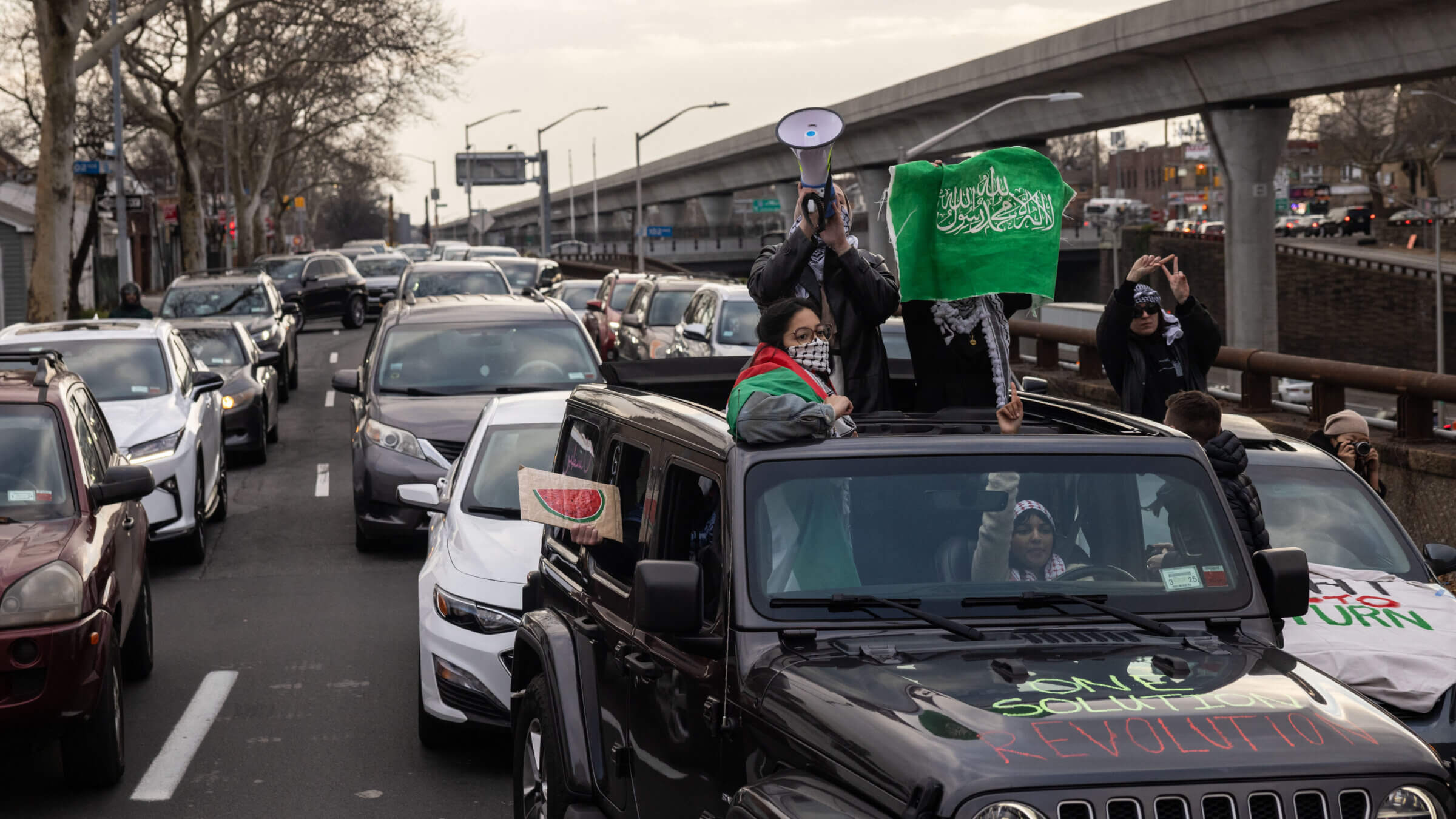
Protesters during the “Global Strike for Gaza!” in Brooklyn on Jan. 1, 2024, wave a green flag used by Hamas. Photo by Yuki Iwamura/AFP via Getty Images

By Arno Rosenfeld February 23, 2026
American adults under the age of 30 increasingly view Hamas as “militant resistance” operating on behalf of the Palestinian people, rather than a self-interested terrorist organization, according to data gathered by the American Jewish Committee.
In a poll conducted one year after the Oct. 7 Hamas attack against Southern Israel, 33% of 18- to 29-year-olds described Hamas as a “resistance group” — nearly double the 17% of Americans over 30 who used that label — and that figure jumped to 43% this past fall.
The findings, shared with the Forward this month, track with another survey last summer that found 60% of 18- to 24-year-olds sided with Hamas over Israel in the Gaza war. It suggests the support that young Americans express for the Palestinians, and the same cohort’s deeply negative views toward Israel, are breaking through what was long a taboo: sympathy for an organization classified as a terrorist organization by the United States, and which has engaged in decades of violence against Israeli civilians.
Tariq Kenney-Shawa, a fellow at the pro-Palestinian think tank Al-Shabaka, attributed this shift to a broader disillusionment with mainstream media and the political establishment that has long presented Israel as a close U.S. ally with shared values.
“Americans have come to not trust these traditional narratives,” he said in an interview. “That spills over into thinking, ‘If we’ve been lied to about Israel’s true nature, maybe that means we’re also being lied to about Oct. 7 and groups like Hamas.’”
Open support for Hamas has been relatively rare among the protesters demonstrating against Israel’s prosecution of the war in Gaza. But constant demands for activists to condemn Hamas after Oct. 7 quickly became a source of derision on the left, while slogans and iconography celebrating Hamas violence became more common as the conflict dragged on and Israel killed tens of thousands of Palestinians, destroyed the vast majority of Gaza’s infrastructure and restricted aid shipments as experts warned of famine and raised the specter of genocide.
But many Jewish leaders and other critics of Hamas say young people are misinformed about the nature of the group — including its lukewarm support among Palestinians living in Gaza — and the war.
They also say apparent support for Hamas, especially in a public opinion poll that offers limited response options, may be less about genuine support for the organization and its political platform and more about picking the answer that aligns with their support for Palestinians.
“There’s a tendency in our very polarized society to find a camp and stay in the camp and whatever words the camp is using become your words,” said Julie Fishman Rayman, vice president for policy at the American Jewish Committee.
Complex — and incomplete — views on Hamas
In the immediate aftermath of Oct. 7, a core of activists sympathetic to Hamas made their presence known. Demonstrations in major cities celebrated the attacks, while the coordinating body of Students for Justice in Palestine approvingly referred to Hamas militants as “the resistance.”
But as a broader protest movement calling for an immediate ceasefire in Gaza grew — drawing in Jews and others who simultaneously condemned Hamas violence on Oct. 7 and called for Israeli hostages to be released — some leading Jewish organizations and pundits continued to paint the demonstrators as terror supporters.
What data was available painted a more complex picture.
A study conducted by Eitan Hersh, a Tufts University professor, found that 5% of self-identified leftist college students — those who were generally organizing and participating in the campus protests against Israel — believed that “all Israeli civilians should be considered legitimate targets for Hamas,” compared to 17% of conservative students.
And since the Israel-Hamas war began, the Harvard/Harris poll, a collaboration between the school’s Center for American Political Studies and a private polling firm, has consistently found that between 40% and 50% of the youngest American adults — those aged 18 to 24 years old — side with Hamas over Israel when forced to choose. The monthly poll’s August edition made headlines when that figure briefly jumped to 60% support for Hamas.
A member of the Democratic Socialists of America’s New York City chapter pointed to that statistic while pressing Shahana Hanif, a progressive member of City Council, during an endorsement meeting on why she had condemned local protesters who had chanted in favor of Hamas. “With 60% of Gen Z supporting Hamas against Israel, many of us are realizing now that we’ve been lied to all our lives,” the person said, according to a recording obtained by Jewish Insider. (A NYC-DSA spokesperson said that members do not reflect the organization’s position.)
But most coverage overlooked the poll’s other findings, including that 61% of that age group believed “Hamas must release all remaining hostages without any conditions or face serious consequences” and that 63% disapproved of Hamas’ conduct in the war.
The Harvard/Harris survey has been criticized for being unreliable and at times producing results about antisemitism and the Israeli-Palestinian conflict that are “bizarre and difficult to account for,” in the words of a Harvard Crimson columnist.
But some observers say that people expressing sympathy for Hamas may have nuanced views.
“I speak to a lot of Palestinians who have supported Hamas not because they support terrorism but because they support action to oppose the occupation,” said Roei Eisenberg, chair of the young adults network at Israel Policy Forum, a dovish Zionist think tank. “They have a Palestinian Authority that’s broken and corrupt and not actually standing up for them — and they see Hamas in Gaza at least putting up a fight.”
Ahmed Moor, a Palestinian-American writer and fellow at the Foundation for Middle East Peace, said that supporters of the Palestinians in the United States are following a similar logic as they see evidence of devastation and Israeli brutality in Gaza. “Why are Zionists so resistant to the idea of Palestinian resistance?” he asked. “Any normal person would look and say, ‘Of course these people have a right to resist.’”
That sentiment has circulated on social media, often among anonymous creators.
After Israel killed Yahwa Sinwar, the military leader of Hamas in Gaza, many users on TikTok created videos praising the bravery of his final moments, in which he is recorded throwing a stick at an Israeli drone.
“In a million years, you would never see Joe Biden, you would never see Ben-Gvir, you would never see any of these people die for anyone but themselves,” a Jewish user who goes by Dirty Alex told his 23,000 followers.
He added an ambivalent caveat: “It’s weird because I think — because of Oct. 7, the people who perpetuated it should be held accountable — and I think they would agree, actually — but at the same time I will always support righteous struggle.”
That tendency to equivocate when it comes to Hamas’ most egregious atrocities is common even among those in the U.S. who otherwise express support for the group. Many have sought to downplay the Oct. 7 attack as primarily an assault on Israeli military positions and claimed that atrocities committed against civilians were exaggerated or completely fabricated.
On social media, many users have rushed to highlight any evidence that Israeli hostages were treated well by Hamas during captivity. For example, several large accounts claimed that Israeli Maya “Bengi” had refused to meet with Israeli Prime Minister Benjamin Netanyahu because his “hands are stained with the blood of children in Gaza.”
But the real hostage, named Maya Regev, did meet with Netanyahu and said she had been abused by sadistic doctors in Gaza.
The most popular symbol associated with Hamas among Israel’s opponents in the U.S. is also connected with attacks on the Israeli military rather than civilians: the inverted triangle, which comes from grainy propaganda videos that use the red arrow to point out Israeli military units operating in Gaza immediately before Hamas militants fire at them.
Kenney-Shawa, the Al-Shabaka fellow, said the growing support for Hamas among young Americans suggests that “more people are vibing with the idea of Palestinian resistance” rather than aligning with the organization’s specific tactics or policies.
Others acknowledge that while Hamas has engaged in war crimes and violations of international law, Israel stands accused of engaging in similar behavior. “Palestinian resistance has always been armed — and that’s always been in line with international law — and the violation of international law has also occurred both by Zionist groups and Palestinians,” Moor said. “Everyone has committed crimes.”
Hamas officials have also sought to present positions to Western audiences that are palatable to progressives, emphasizing measured political positions and portraying Israel as the more radical and intransigent party.
“We are politically realistic,” Khaled Meshaal, a senior Hamas leader, told Drop Site News in December. “We are ready to engage with any serious project to establish a Palestinian state along the 1967 borders even though I realize, unfortunately, that this is impossible because of Israeli policy.”
Hamas as symbol of resistance
Hamas coming to represent the strongest resistance to Israel among young people in the U.S. is frustrating for some Palestinians, who say it sanitizes what Hamas actually represents and overlooks the preferences of Palestinians in Gaza.
Khalil Sayegh, a politician analyst and director of the Agora Initiative, which advocates for Palestinian rights in Israel, the West Bank and Gaza, said he appreciated that Americans were turning away from an uncritical pro-Israel narrative but worried about polarization in the opposite direction.
“Resistance has become basically equal to Hamas and Hamas equal to resistance,” Sayegh said. “That’s a very toxic and wrong thing.”
He said that “Israeli apartheid and genocide” was the main problem in Gaza but that Hamas also stood in the way of establishing a “secular, democratic Palestine.”
While around half of Palestinians in Gaza said they were satisfied with Hamas’ performance in the war, according to an October survey, the poll also suggested that the organization would be soundly defeated if open parliamentary or presidential elections were held across the West Bank and Gaza.
Around 33% of voters in Gaza would support a Hamas candidate for president, while most of the remainder would either vote for Marwan Barghouti, a leader of secular rival Fatah who is currently imprisoned by Israel, or not participate, according to Palestinian Center for Policy and Survey Research. Respondents were roughly split on whether negotiations and peaceful protest or “armed struggle” were the best method to establish a Palestinian state.
Throughout the 1980s and 1990s there were robust debates in the Palestinian diaspora over which political factions to support. But Sayegh said those faded from public view as Israel eliminated most credible alternatives and fears grew that open critique of Hamas would be weaponized by pro-Israel groups to weaken the pro-Palestinian movement.
Additionally, he said, activists in the U.S. who support Hamas have intimidated its critics within the Palestinian community. “There is still a debate but there is no public debate,” Sayegh said. “The masses that are supportive of Hamas have scared the people who oppose Hamas into silence.”
Ahmed Fouad Alkhabtib, who moved from Gaza to the U.S. in high school, has become one of the most prominent Palestinian critics of Hamas and now positions himself in opposition to most of the pro-Palestinian movement.
Alkhabtib, the founder of an initiative called Realign for Palestine at the Atlantic Council, attributed the rise in support for Hamas to a combination of ignorance and malice within the “pro-Palestine industrial complex” composed of “far-left meets far-right meets the Islamists meets the Taliban and al-Qaeda meets the idiot Jewish kids who said they were lied to about Israel at summer camp.”
But he said that some Palestinians had told him during the war that they shared his antipathy toward Hamas — especially as some blamed the group for contributing to aid shortages over the summer — but that they would speak out once Israel ended its military operations. “I did pick up on notes of the pro-Hamas euphoria dying down,” Alkhabtib said.
And yet both Palestinian and Jewish observers said that leading pro-Israel organizations have also contributed to polarization around the Israeli-Palestinian conflict that drives some people toward Hamas or makes them reluctant to criticize the group.
Eisenberg, with the Israel Policy Forum, said that many Jewish groups have refused to acknowledge Israeli atrocities in Gaza and rushed to paint the country’s critics as terror supporters. “It’s coming from a place of being unable to hold complexity,” he said.
Alkhabtib said he has experienced this firsthand. Despite being an unequivocal critic of Hamas and maintaining close ties to many Jewish organizations, he has found little tolerance for also critiquing the Israeli far right.
“The pro-Palestinian people are watching me — the pro-Hamas people are watching me — and saying, ‘Well what incentive do I have if you’ve been Mr. Dialogue and Engagement and they turn on you the second you criticize Israel,” Alkhabtib said. “There’s something to be said about the role of Jewish communities to reverse these problematic trends.”
This is a moment of great uncertainty. Here’s what you can do about it.
We hope you appreciated this article. Before you go, we’d like to ask you to please support the Forward’s independent Jewish news this Passover. All donations are being matched by the Forward Board - up to $100,000.
This is a moment of great uncertainty for the news media, for the Jewish people, and for our sacred democracy. It is a time of confusion and declining trust in public institutions. An era in which we need humans to report facts, conduct investigations that hold power to account, tell stories that matter and share honest discourse on all that divides us.
With no paywall or subscriptions, the Forward is entirely supported by readers like you. Every dollar you give this Passover is invested in the future of the Forward — and telling the American Jewish story fully and fairly.
The Forward doesn’t rely on funding from institutions like governments or your local Jewish federation. There are thousands of readers like you who give us $18 or $36 or $100 each month or year.
Support our mission to tell the Jewish story fully and fairly.