Reza Pahlavi, Iran’s exiled crown prince, has a plan for his people’s future — if they’ll have him
The exiled son of the Shah is closely allied with Israel — and leaves Iranians divided over his offer to be the nation’s transitional leader
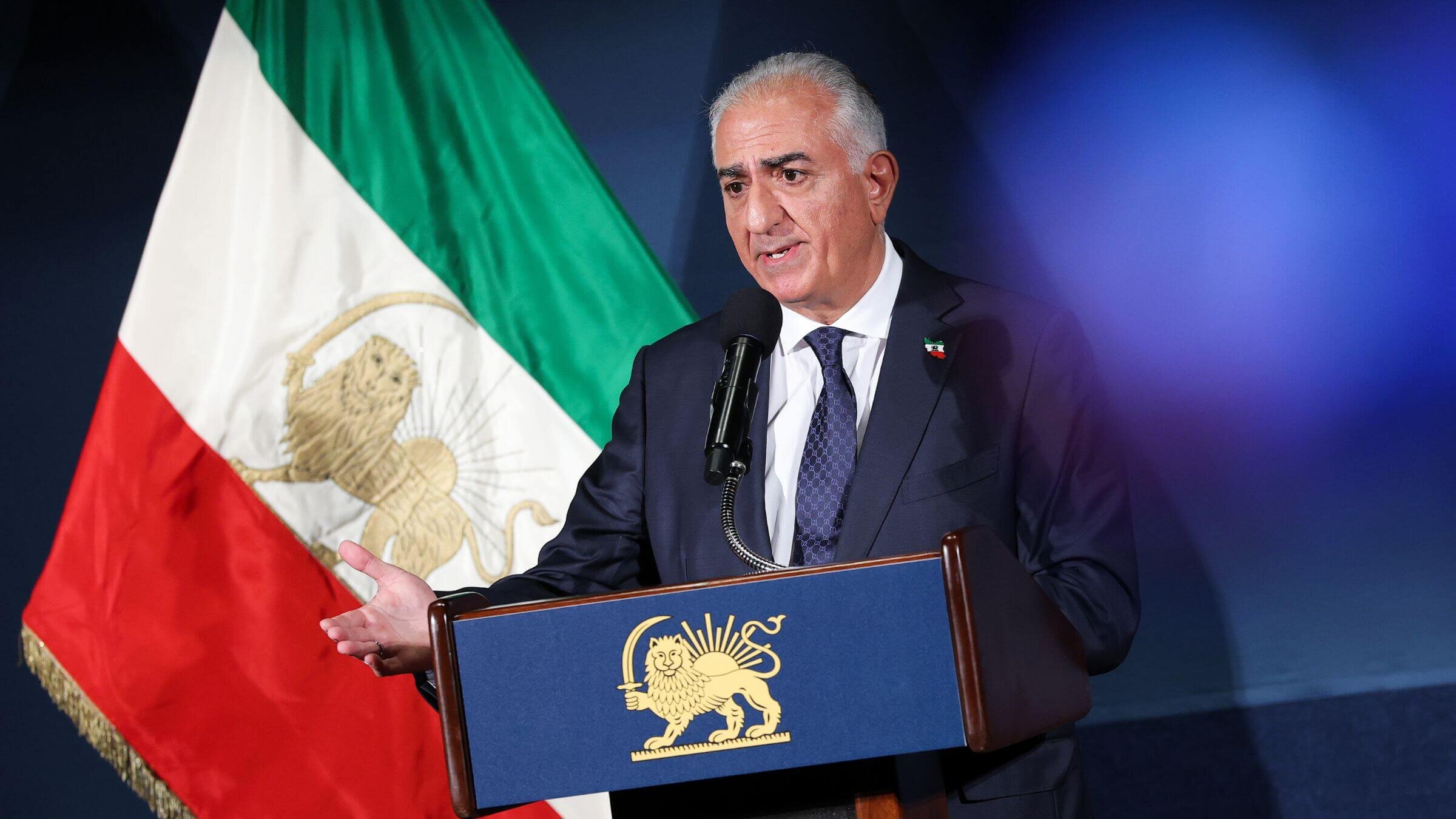
Iranian Democratic Opposition Leader Reza Pahlavi speaks during a news conference at the National Press Club in Washington, D.C., Jan. 16. Photo by Kevin Dietsch/Getty Images

By Simone Saidmehr February 28, 2026
With a U.S.-Israel bombardment underway and President Donald Trump and Prime Minister Benjamin Netanyahu openly pressing for regime change, related questions now loom large: What are the Iranian people prepared for — and who, exactly, is positioned to lead them if the Islamic Republic falls?
Since late 2025, anti-regime protests have spread across Iran, resulting in mass arrests, imprisonments, and thousands killed in crackdowns by regime forces. On Jan. 14, following massive demonstrations, Trump posted on Truth Social, addressing Iranian protesters: “KEEP PROTESTING – TAKE OVER YOUR INSTITUTIONS!!!… HELP IS ON ITS WAY.” At the time, expectations were high for a U.S. strike on Iran, and thousands of protesters were killed in the streets, hoping that help would come. Now, over a month later, Trump appears to have made good on that promise.
Early on Feb. 28, U.S. and Israeli forces began operating across Iran in what the IDF described as a “close and unprecedented cooperation between the IDF and the U.S. military.” Trump and Netanyahu both made statements indicating that the objective of the joint operation extends beyond military deterrence and toward regime change.
Since the start of the operation, the U.S. and Israel have targeted several sites that go far beyond the aims of the 12-Day War, which primarily focused on degrading Iran’s nuclear and ballistic missile capabilities. In this round of strikes, regime assets and figures have been targeted, including Supreme Leader Ali Khamenei, who was killed by an Israeli strike. During the 12-Day War, the U.S. reportedly instructed Israel not to target the supreme leader.
Israeli officials said they killed several other top officials, including the commander of the Islamic Revolutionary Guard Corps, the commander of the Iranian Armed Forces, the Iranian Minister of Defense, and the head of Iranian Intelligence.
Videos have circulated on social media showing Iranians cheering on the attacks, even as reports indicate that the regime has shut down the internet and is jamming satellite signals from diaspora news channels that would otherwise provide critical information about the strikes.
Chants heard across Iranian cities have included “death to Khamenei” and “long live the Shah.” Other videos display Iranians honking their cars and chanting “Azadi,” the Farsi word for freedom, dancing in the streets, and gleefully laughing while watching a plume of smoke rise from Khamenei’s residence.
Still, the killing of senior officials — even the supreme leader — does not automatically translate into regime change. Even if Ali Khamanei’s death and that of other senior Iranian officials destabilize the clerical regime, there remain 1 million members of the Revolutionary Guard militia and 200,000 members of the IRGC who play a vital role in propping up the government.
Reza Pahlavi, potential leader?
Former Iranian Crown Prince Reza Pahlavi, who lives in the United States, has emerged as one of the most visible opposition figures.
Since January, videos have surfaced on social media showing Iranian protesters calling for the return of the Pahlavi dynasty, which ruled Iran until the 1979 Islamic Revolution. Videos show demonstrators chanting pro-monarchy slogans or displaying the pre-revolutionary Iranian flag. After Pahlavi publicly called for mass mobilization of protestors earlier this year, the demonstrations escalated, with some protestors holding up photos of him in the streets.
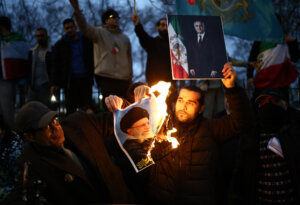
The son of the former Shah, Pahlavi was born in Tehran in 1960. He was formally named crown prince at age 7 during his father’s coronation. At 17, he became one of the youngest licensed pilots in Iran before leaving for the U.S. to pursue advanced flight training. While he was abroad, the 1979 Islamic Revolution overthrew his father and abolished the monarchy, turning what was meant to be a temporary study into permanent exile. He has not returned to Iran since.
Today, Pahlavi lives in Maryland with his wife and three daughters, one of whom married a Jewish businessman last summer. He has positioned himself not as a monarch-in-waiting, but as a potential transitional leader. He has repeatedly stated that he does not seek to restore the monarchy, instead advocating for a secular, democratic system. U.S. officials have taken notice: Following renewed unrest in January, he reportedly met with Steve Witkoff, top Middle East adviser to Trump.
Behind Pahlavi is a network of advisers drawn largely from the Iranian diaspora, including academics, private-sector executives, and professionals with experience in U.S. government institutions. Some serve in formal roles, while others function as informal advisers. His main organizational platform is the National Union for Democracy in Iran, a Washington-based organization that has for years promoted regime change in Iran with Pahlavi’s support. Under NUFDI, Pahlavi and his team developed the Iran Prosperity Project, a governance blueprint intended to guide the country through a post-Islamic Republic transition.
On the eve of the joint U.S.-Israeli operation, Pahlavi unveiled an updated version of his transitional plan. The document outlines Iran’s urgent priorities during the first six months following a potential regime collapse.
About two hours after the initial strikes in Iran, Pahlavi posted a video to X, encouraging Iranian forces to abandon the regime and telling the Iranian people that he will “announce to you precisely” when they “can return to the streets for the final action.”
His prospects remain contested. Analysts have long questioned whether a figure who has lived outside Iran for nearly five decades can command broad domestic legitimacy. Reliable polling inside Iran is difficult, but Dutch pollster Ammar Maleki has found that roughly one in three Iranians expresses confidence in Pahlavi based on large-sample surveys conducted in recent years. At the same time, a similar proportion strongly oppose him. Nonetheless, Maleki asserts, no other opposition figure approaches his level of name recognition.
Pahlavi is also openly pro-Israel. He has traveled to Israel, prayed at the Western Wall, met with Netanyahu, and advocates for expanding the Abraham Accords into what he calls “Cyrus Accords” between Israel and a future Iran, describing the two nations as the “only two countries on this planet that can claim to have a biblical relationship.” Because of his pro-Israel stance, some detractors frame his potential leadership as aligned more with Western and Israeli interests than with those of the Iranian people.
However, in recent months, experts have increasingly framed him as a viable option — or at least as an integral part of the current protest movement that should not be ignored.
This is a moment of great uncertainty. Here’s what you can do about it.
We hope you appreciated this article. Before you go, we’d like to ask you to please support the Forward’s independent Jewish news this Passover. All donations are being matched by the Forward Board - up to $100,000.
This is a moment of great uncertainty for the news media, for the Jewish people, and for our sacred democracy. It is a time of confusion and declining trust in public institutions. An era in which we need humans to report facts, conduct investigations that hold power to account, tell stories that matter and share honest discourse on all that divides us.
With no paywall or subscriptions, the Forward is entirely supported by readers like you. Every dollar you give this Passover is invested in the future of the Forward — and telling the American Jewish story fully and fairly.
The Forward doesn’t rely on funding from institutions like governments or your local Jewish federation. There are thousands of readers like you who give us $18 or $36 or $100 each month or year.
Support our mission to tell the Jewish story fully and fairly.