‘Auschwitz’ is a hit Iranian protest anthem, part of a music genre rebelling against official antisemitism
A defiant song, whose lyricist is in prison for snubbing the ayatollah, plays on Jewish themes to confront authoritarian rule
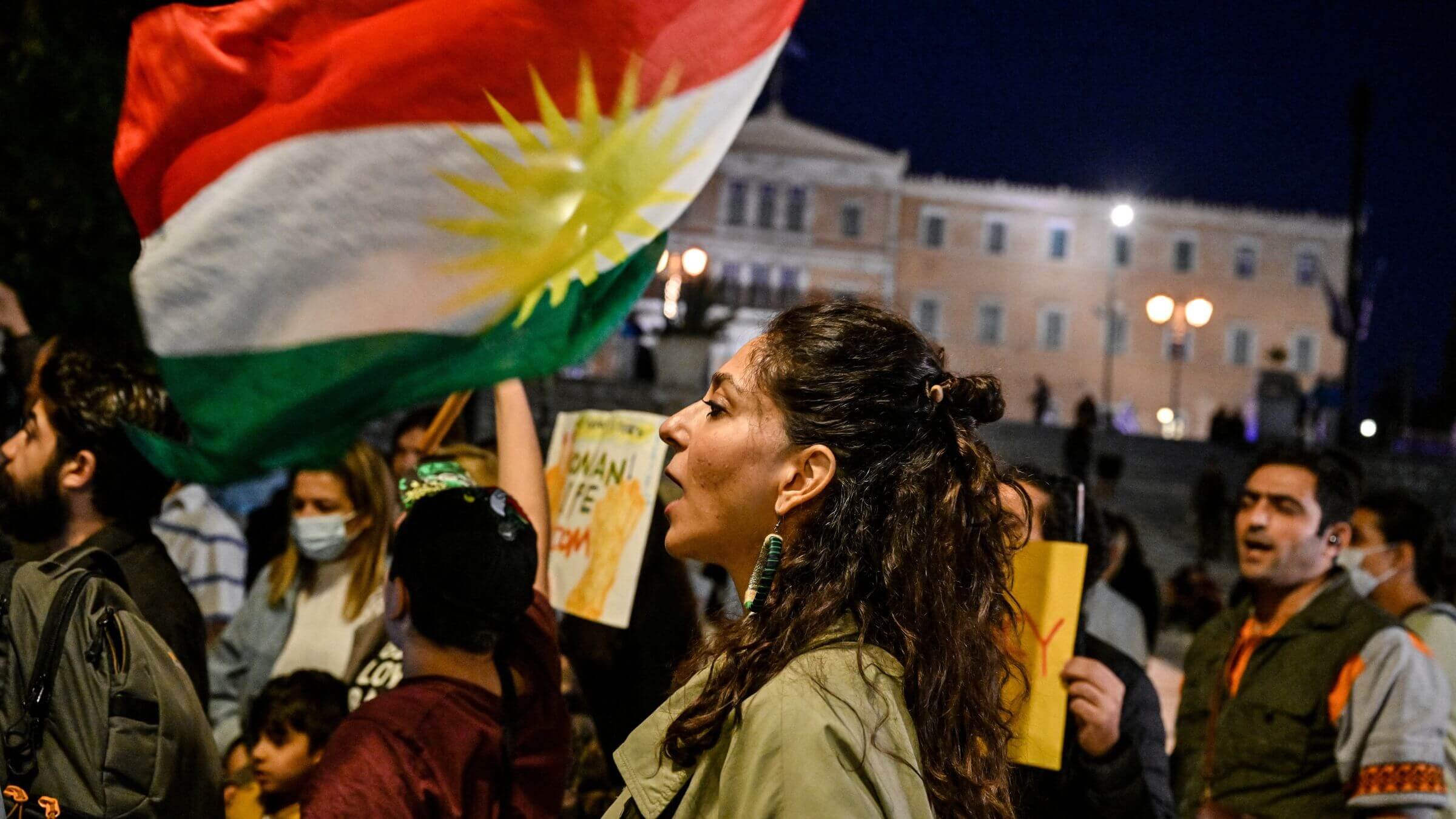
Iranian refugees and Iranians living in Greece wave a Kurdish flag while singing the Iranian protest song of Shervin Hajipour during a demonstration in central Athens to commemorate 40 days from the death of Iranian Mahsa Amini while in police custody in Iran, Oct. 29, 2022. Photo by Louisa Gouliamaki/AFP Getty Images

By Simone Saidmehr March 8, 2026
Last month, well-known Iranian singer Mehdi Yarrahi released a song titled “Auschwitz,” about the regime’s brutal crackdown on protesters earlier this winter, which estimates suggest killed between 7,000 and 30,000 people over the course of a few days. The song quickly gained traction online, drawing around 10 million views on the singer’s Instagram account.
The choice of Auschwitz as a historical touchstone was not accidental; it is a direct answer to the Iranian regime’s persistent mockery and denial of the Holocaust, and a point of identification for Iranians who may see an echo of the atrocities committed by the Nazis in their own government’s brutality.
Yarrahi, who lives in Iran, released “Auschwitz” after reports emerged of thousands of Iranian protesters being gunned down in the streets for protesting the regime. The song compares their fate to that of people who endured the Nazi death camps. Its opening line declares: “I come from Auschwitz, of night transfers. I come from a killing field of youth.” The music video accompanying the song features footage of protestors being beaten by regime forces in the streets, as well as photographs of those who were killed.
Yarrahi knows the price one can pay for making anti-regime music. In March 2025, he received 74 lashes as a part of his sentencing for the release of his song “Rousarieto” (“Your Headscarf”), which criticized the regime’s requirement that women cover their hair and dress modestly.
The lyricist behind “Auschwitz,” Hossein Shanbehzadeh, has also faced the regime’s wrath. In 2024, he was sentenced to 12 years in prison after he commented with a single dot in response to a post on X (formerly Twitter) from the Supreme Leader Ayatollah Khamenei — a reply that received more likes than Khamenei’s original post. Iranian authorities accused him of being an Israeli spy and of spreading anti-regime propaganda. While Shanbehzadeh languishes in prison, through the lyrics of “Auschwitz,” his words have now been heard by millions both inside and outside Iran.
View this post on Instagram
The Holocaust metaphor in “Auschwitz” is especially subversive because it invokes a history the Iranian regime refuses to recognize — just as it refuses to acknowledge its own brutality. Many high-ranking members of the Iranian regime have publicly denied, minimized or questioned the Holocaust, including former Supreme Leader Ali Khamenei, who was killed on the first day of the fighting on Feb. 28. The regime has also hosted state-sponsored cartoon competitions mocking the Holocaust — most recently in 2021 — and was the only country to reject a 2022 United Nations resolution condemning Holocaust denial.
By comparing the regime’s violence against protesters to Nazi brutality — atrocities that Iranian leaders do not acknowledge — Yarrahi’s song challenges both political repression and the antisemitic narratives promoted by the state that have made it a global pariah.
The soundtrack to the revolution
In Iran, where culture is steeped in poetry, protest music has become a central part of the anti-regime movement.
An Iranian activist who was arrested and jailed for his involvement in the protest movement told the Forward, “These songs push people forward. They give you the energy to keep going.” Now living in the United States, he said the music also connects diaspora Iranians to the movement back home. “When we get together with friends in the community, we play these songs,” he said. “We start talking, and the music is playing in the background.”
Music streaming platforms like Spotify and Apple Music are difficult to access in Iran because of payment sanctions and bans. While protest songs are censored on social media, many Iranians download music using VPNs through Telegram — an encrypted messaging app that has 45 million Iranian users despite being banned — as well as other websites. Many Iranian singers have their own Telegram channels where they share their music.
During the 2022 Women, Life, Freedom protests, the song “Baraye” (“For the Sake Of”) went viral and became an anthem for demonstrators mobilizing against the regime. It garnered 40 million views in its first two days of being released and later won a Grammy.
The singer Shervin Hajipour wrote the lyrics based on responses from Iranians on X to a simple question: “What are you protesting for?” One line references the regime’s “meaningless slogans” — “Death to America” and “Death to Israel.”
According to Thamar E. Gindin, a research fellow at Haifa University’s Ezri Center for Iran and Persian Gulf Research, music has been a meaningful part of the protest movement. “Baraye,” particularly, was sung “from balconies and windows when they didn’t want to go out to the streets and be killed. They sang it at the end of ceremonies.” She compared it to the way many Israelis and other Jews sing “Hatikvah” as an expression of collective hope.
Polling suggests that Iranian public opinion diverges from official rhetoric.
One survey from last September found that 69% of Iranians believe their country should stop calling for the destruction of Israel. When respondents were asked about their views of foreign countries, the United States received the highest favorability rating, with 53% expressing a positive view. Israel ranked second. A 2014 survey conducted by the Anti-Defamation League found that Iranians held the lowest levels of antisemitic attitudes in the Middle East and North Africa outside Israel, despite decades of state-sponsored antisemitic narratives.
Invoking Iran’s pluralistic past
For many Iranians, protest music has become a way to reclaim their national identity. While the regime defines itself through external struggle with Israel and the West, many protestors prefer to define Iran through its culture and history. One figure frequently invoked in protest discourse and music is Cyrus the Great.
King Cyrus, the founder of the Achaemenid Empire, created one of the largest empires of the ancient world. After conquering Babylon in 539 B.C.E., he issued a decree allowing exiled peoples — including Jews taken captive by the Babylonians — to return to their homelands. In the Bible, he is remembered for permitting Jews to return to Jerusalem and rebuild the Temple.
According to the activist, “Cyrus to Iranians is like the Founding Fathers to Americans,” adding: “Cyrus is a symbol of peace among nations, and also a person who respects human rights and your beliefs regardless of who you are.” He is viewed as particularly “important for what he did for the Jewish people” and other minorities, which, for many anti-regime Iranians, represents an Iran rooted in human rights.
London-based Iranian artist Amin Big A’s 2018 song “Be Name Iran” (“In the Name of Iran”) channels this sentiment. The song gained massive popularity, especially among the Iranian diaspora, during the 2022 protest movement in Iran and has since been widely shared on social media alongside videos of the current protests. The song opens with a tribute to Cyrus: “In the name of Cyrus, that King of Kings — the one who taught us to be good to our friends and companions.”
Iranians invoke Cyrus, he said, to remind themselves and the world of that history. They want to “signal to the world, especially to non-Iranians,” that “if you want to understand how Iranians think, you can look at our history.” For protestors, it is a way to demonstrate that “the current regime in Iran is not representative of Iranians.”
Another song, “Dictator,” released in January by Iranian artists Shaayn and Moonshid during the height of the protests, contrasts Iran’s current authoritarian system with the nation’s ancient past. “It’s basically saying: We had Cyrus, and Cyrus was not a dictator,” said the activist. “Our history is not all about dictators.” One line in the song reads, contrasting Cyrus with a Turkish conqueror: “One gives freedom to the people, another kills and oppresses … One becomes like Cyrus the Great, another becomes like Timur.”
Over the years, several anti-regime protests have been held at Cyrus’ tomb in Iran. In response, the regime has restricted access to the site and deployed security forces to discourage protestors from gathering there.
According to Beni Sabti, an Iran expert from the Institute for National Security Studies, Cyrus’ pluralistic legacy makes him recognized as “the best King that Iranians had. It’s another reason to love Jews, or to re-love them,” he said, adding: “They don’t believe the state’s propaganda.”
This is a moment of great uncertainty. Here’s what you can do about it.
We hope you appreciated this article. Before you go, we’d like to ask you to please support the Forward’s independent Jewish news this Passover.
This is a moment of great uncertainty for the news media, for the Jewish people, and for our sacred democracy. It is a time of confusion and declining trust in public institutions. An era in which we need humans to report facts, conduct investigations that hold power to account, tell stories that matter and share honest discourse on all that divides us.
With no paywall or subscriptions, the Forward is entirely supported by readers like you. Every dollar you give this Passover is invested in the future of the Forward — and telling the American Jewish story fully and fairly.
The Forward doesn’t rely on funding from institutions like governments or your local Jewish federation. There are thousands of readers like you who give us $18 or $36 or $100 each month or year.
Support our mission to tell the Jewish story fully and fairly.