Illinois primary pits Jewish candidate with deep Israel ties against AIPAC spending
Daniel Biss speaks Hebrew and spent summers in Israel — but his quest for conditions on U.S. aid have made him a target, part of a larger campaign to keep moderates out of Congress
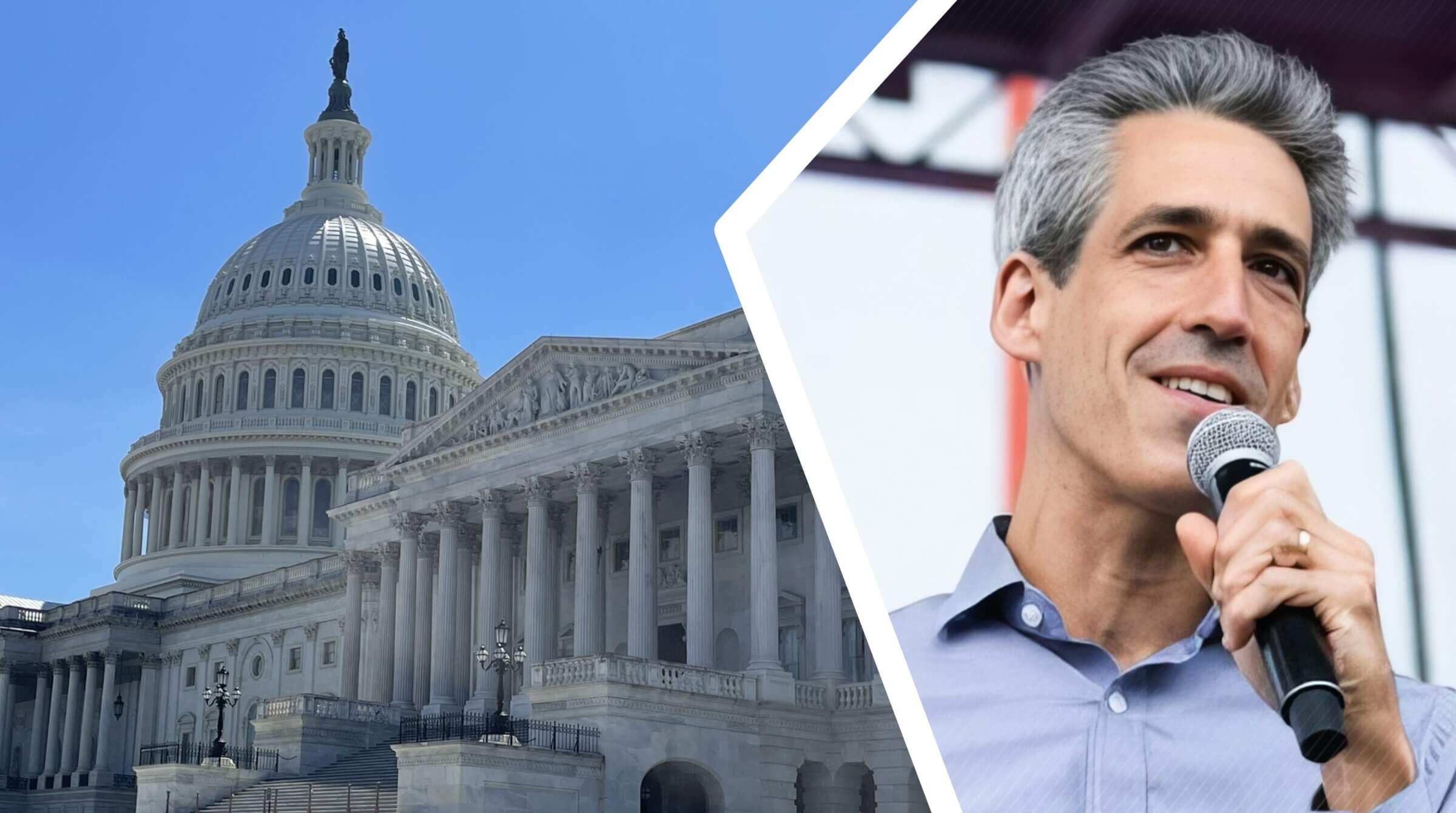
Daniel Biss, mayor of Evanston and congressional candidate. Photo by Daniel Biss for Congress / Jacob Kornbluh

By Jacob Kornbluh March 16, 2026
Daniel Biss might seem like the kind of candidate the American Israel Public Affairs Committee could live with. The two-term Evanston mayor grew up partly in Israel, where his family spent summers. His mother is Israeli. He speaks Hebrew. And in his political career, he regularly engaged with pro-Israel groups, including AIPAC.
But with voters going to the polls Tuesday in Illinois for a closely watched Democratic congressional primary, Biss, 48, finds himself in the unusual position of defending himself against nearly $6 million in spending from an AIPAC-aligned super PAC. His district includes Evanston and Chicago’s North Shore suburbs, with one of the largest Jewish populations in the Midwest and a history of Jewish representation. An estimated 11% of the electorate is Jewish.
Speaking with the Forward, Biss acknowledged that the barrage of negative ads has been unpleasant. But he said the outside spending has become central to his campaign, as he seeks to highlight who is behind the attacks. Once voters learn about AIPAC’s role, he said, “they are repelled.”
Biss is the latest target of the major Israel lobby group’s campaign to eliminate candidates for Congress who have substantial engagement on Israel aimed at taking a more moderate path for U.S. policy — even if that means helping get far-left candidates who denounce Israel nominated instead.
That’s what happened in AIPAC’s first intervention in Democratic primaries this year, in a New Jersey special election for a House seat. There, progressive candidate Analilia Mejia — who described Israel’s military campaign in Gaza as a genocide — prevailed after an AIPAC-associated super PAC spent more than $2 million targeting former Democratic Rep. Tom Malinowski.
Elect Chicago Women, a super PAC aligned with AIPAC, has invested more than $5.7 million in attacking Biss and boosting State Sen. Laura Fine, who is also Jewish.
Recent polling, however, showed the spending has not necessarily reshaped the race in Fine’s favor. Kat Abughazaleh, a young Palestinian-American progressive candidate, has risen to second place in recent weeks. She is backed by Justice Democrats and a newer pro-Palestinian political group called Peace, Accountability, Leadership PAC. Her surge has fueled concerns among some Democrats that the race could produce another member of the progressive “Squad” in Congress and make it harder to win the general election.
Biss had tried to get into AIPAC’s good graces. He acknowledged that he had previously engaged with local AIPAC representatives in “good faith,” even submitting a position paper outlining his views on Israel. But he now believes the organization’s approach has become too inflexible to allow for meaningful dialogue.
He called “absurd” AIPAC’s stance opposing any conditions on U.S. military aid to Israel. “And then try to enforce it with millions of dollars of dark money, is certainly bad for democracy and bad for our politics here in America,” Biss added.
Biss said he supports a pair of measures that would restrict certain offensive arms sales to Israel and increase oversight of Israel’s policies in the occupied West Bank and in Gaza. Current Rep. Jan Schakowsky, who is Jewish and has held the seat for nearly three decades, is a co-sponsor of both the Block the Bombs Act and the Ceasefire Compliance Act.
Biss’ views on Israel are shaped in part by his own family’s history. All four of his grandparents were born in Europe. His father’s parents fled Nazi-era Europe in the late 1930s, settling in Decatur, Illinois, where his grandfather established a medical practice.
His mother’s family had a more harrowing journey. Ethnic Hungarians living in what was then Romanian-controlled Transylvania, they were deported to Auschwitz in 1944. Biss’ grandmother, her sister and one brother survived, while her parents and two other siblings were killed. After the war, the surviving members of the family returned to their hometown before immigrating to Israel, where Biss’ mother was raised. Much of his extended family still lives there today.
He said he visited Israel nearly every year from childhood through his early adulthood and speaks Hebrew, which he learned as a child from his mother.
“My connection to Israel is very deep, real and personal,” Biss said. “This is not some political position I take for a questionnaire.”
At the same time, he said, his Jewish upbringing also shaped how he thinks about the Israeli-Palestinian conflict.
If elected to Congress, Biss said, he would push the United States to bring diplomatic and economic pressure to bear on Israel, measures backed by J Street, a more liberal alternative to AIPAC. “I think that it’s important to have people in Congress who advocate for that kind of position, from a standpoint of supporting Israel’s right to exist as a Jewish democratic state, understanding Israel’s need to defend itself, and advocating for a vision of Israeli defense and security that is not inconsistent with basic humanitarian principles, and with the Jewish values of treating every life as equally sacred,” he said.
Steve Sheffey, a longtime Chicago Democratic activist who writes an insider politics newsletter, said that AIPAC’s attacks on Biss seem perplexing — until understood as targeting someone who poses a threat to uncritical U.S. backing. “Biss’ background on Israel is so much deeper and more extensive than almost any member of Congress in either party,” Sheffey said. “When Daniel Biss says something about Israel, it comes with authority.”
Sheffey suggested that independent thinking may be exactly what worries AIPAC.
“AIPAC sees me as a threat because they know that in Congress, I can’t be dismissed,” Biss said in a recent statement.
More districts, more division
The contest is not the only Illinois primary where hardline Israel advocacy groups are playing a major role.
In the 2nd District, a crowded race to replace Rep. Robin Kelly — who is running for the U.S. Senate — has drawn attention after Schakowsky withdrew her endorsement of Cook County Commissioner Donna Miller over her ties to AIPAC-aligned donors. One of Miller’s chief rivals is State Sen. Robert Peters, a Black Jew who has been endorsed by Vermont Sen. Bernie Sanders, accused Israel of genocide and signed on to the Block the Bombs Act. Peters wrote in an op-ed for the Forward that AIPAC’s opposition to him is driven by concern that outspoken Jewish critics of Israeli policy like himself will prompt “others who may have been nervously hanging back…feel like they can take bolder action as well.”
In the crowded race to replace retiring Rep. Danny Davis in the 7th District, the campaign of Chicago City Treasurer Melissa Conyears-Ervin has received about $5 million in spending from AIPAC’s United Democracy Project and an endorsement from Democratic Majority for Israel. Jason Friedman, who is Jewish and previously got AIPAC support, has been “approved” in the primary by J Street.
AIPAC is also boosting former Rep. Melissa Bean, vying to replace incumbent Rep. Raja Krishnamoorthi, who is running in a Senate primary. Elect Chicago Women spent $3.9 in the race. Bean’s campaign also received more than $400,000 in donations from AIPAC donors. Her chief rival is Junaid Ahmed, a critic of Israel who supports an arms embargo on the Jewish state. Chicago Progressive Partnership, a group that shares vendors and donors with other AIPAC-affiliated PACs, aired an attack ad against Ahmed, attacking his personal wealth and investments in Tesla.
In an email to its supporters, AIPAC attempted to frame the races as a fight against potential “Squad” members. It listed Abughazaleh, Peters and Ahmed, along with an additional three progressive lower-tier candidates, as people with “dangerous visions for America,” who need to be stopped. “The pro-Israel community is taking the political fight to them, and we are not backing down,” Jake Braunstein, AIPAC senior director, wrote.
Biss, the candidate most heavily targeted by AIPAC-aligned spending, was not mentioned.
“AIPAC is backing a candidate who has almost no chance of winning,” Sheffey said, referring to Fine.
Joe Rubin, a Democratic commentator and foreign policy expert, said the Biss-Fine-Abughazaleh race differs from AIPAC’s earlier intervention in New Jersey in ways that could prove more embarrassing for the group. In the New Jersey election, AIPAC sought to defeat Malinowski without backing a clear favorite and was willing to take that risk. In Illinois, however, the group is investing heavily to elect Fine — so far unsuccessfully.
“I don’t believe AIPAC is necessarily heartbroken” if they empower a far-left candidate, Rubin said. “But I do think that they’re trying to defeat who they feel will be a very strong opponent.”