Ben Gurion airport shutdowns leave already disrupted passengers desperate
An already heated scramble to join family for Passover has come to a near halt, leaving thousands with worthless tickets
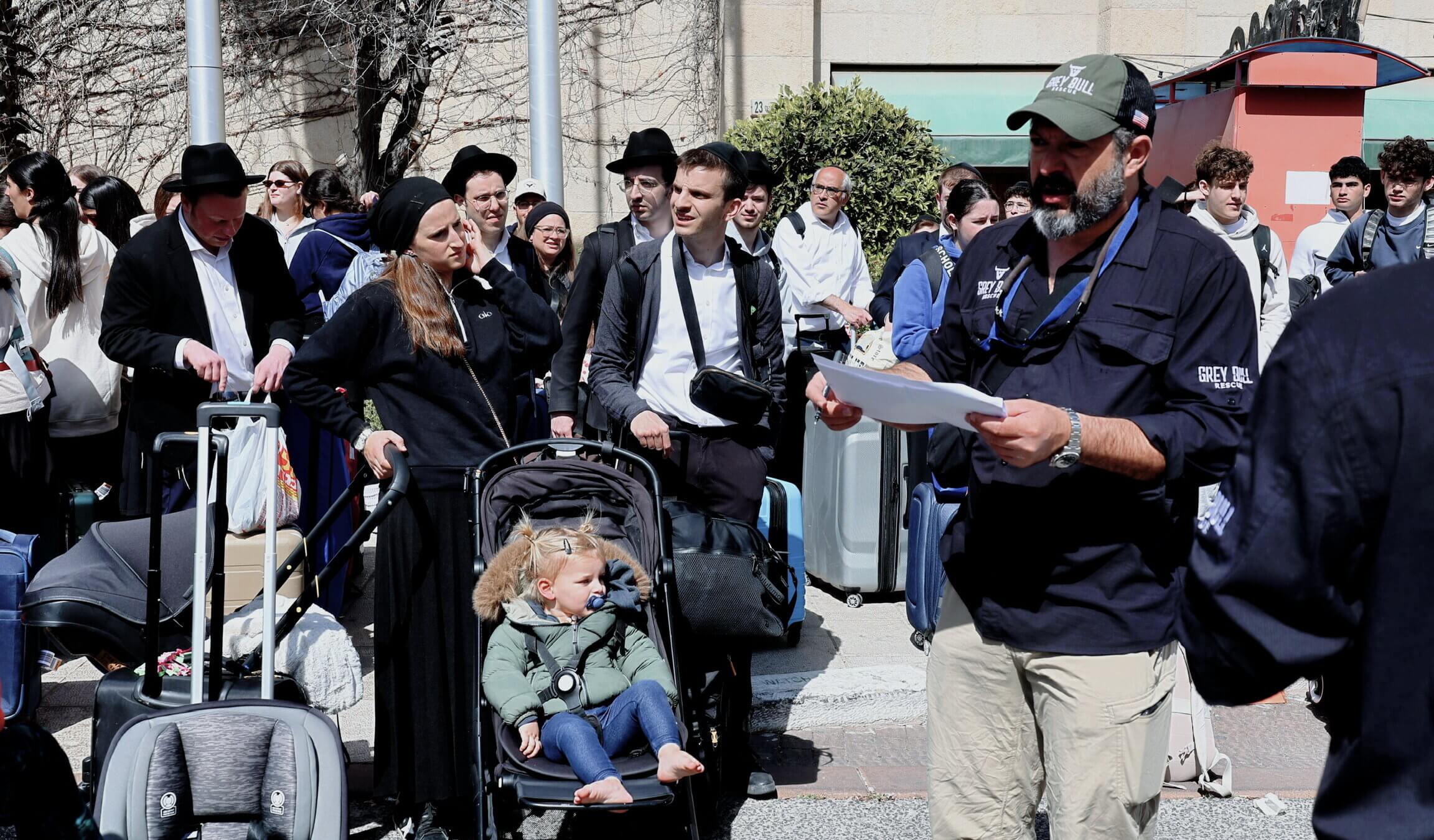
Travelers scramble for an exit from Israel. Courtesy of Grey Bull Rescue

By Rachel Fink March 19, 2026
Disruptions to air travel have become the new normal in post-Oct. 7 Israel, locked in military conflict on multiple fronts. But the current war with Iran has brought the battle for commercial airspace to new heights, with prolonged service cancellations leaving would-be passengers stranded — and with a growing sense that they’ve been left to figure things out on their own.
The decision to launch pre-emptive strikes just before Passover has left people hoped to fly to join family — in Israel or elsewhere — with dashed hopes for the holiday. They include thousands of gap-year students — many studying in Orthodox yeshivot and seminaries — who were planning to fly home and have been left with unusable tickets.
As Israel has battled Hamas, Hezbollah, the Houthis and Iran since October 2023, foreign carriers have repeatedly suspended and resumed service as security conditions shifted, leaving travelers with limited options and soaring ticket prices.
Israel’s flagship airline, El Al, has been among the only carriers to continue flying consistently, earning praise for getting reserve soldiers home while also facing criticism, including accusations of price gouging and a class-action lawsuit alleging it took advantage of limited competition.
Now Ben Gurion is allowing only extremely limited passenger travel. Meanwhile, just days into what the U.S. Embassy had announced as a “historic partnership” with El Al to operate nonstop flights to the United States for Americans, priced at $900 for economy and $2,000 for premium seats, those have also come to a sudden halt.
As of March 19, El Al said it was suspending repatriation flights “for the foreseeable future,” after shrapnel hit private planes, and the State Department said it “does not anticipate arranging additional charter flights from Israel.”
As flights were canceled and rebooked, then canceled again, official information became as valuable as a plane seat itself — and just as rare. Travelers began sharing updates — airline messages, rumors of available flights and alternate routes — across text chains and social media. One Facebook group, DansDeals, has more than 50,000 members posting questions, advice and urgent pleas for help.
Daniel Eleff, who founded the group more than 20 years ago as an offshoot of his travel deals website, said that after Oct. 7 it took on a new role, tracking flights and sharing strategies that became a lifeline each time the airspace closed. What began as a forum for bargain-hunting has evolved into a crowdsourced information hub — and, at times, a place to vent frustration and grapple with what it means to encounter a war up close that many had previously followed from afar.
According to Eleff, the unique conditions of this war help explain the challenges. “The U.S. Air Force has based some of their planes out of Ben Gurion,” he said. “We’ve never had a situation like this — running both military and commercial operations out of the same airport in the middle of a war.”
That dynamic, along with limits on flights and passenger numbers amid ongoing missile fire, sharply reduced available seats. With protocols constantly changing, airlines were forced to reshuffle manifests and cancel seats, sometimes at the last minute.
“They would open up more seats, rebook everyone, and then suddenly have to cut it back,” Eleff said. “It created complete chaos.”

The State Department’s response also shifted repeatedly — from purchasing blocks of seats, to briefly organizing free charters, to directing citizens to book independently — adding to the confusion.
As options out of Tel Aviv dwindled, some began looking elsewhere — across the border into Jordan and Egypt. But for many, especially students traveling alone, it felt risky. In online forums, unverified reports of mistreatment at border crossings circulated widely, adding to the uncertainty.
Into that vacuum stepped Grey Bull Rescue, a U.S.-based nonprofit founded by military veteran Bryan Stern, which evacuates Americans from high-risk environments. Within days, the group began organizing overland routes through Jordan, transporting passengers by bus and flying them onward to Europe.
But operating outside official channels comes with risks — and scrutiny. Stern said he was prepared for the former; the latter caught him off guard.
In a widely circulated video, one American parent whose daughter was on a Grey Bull evacuation accused the organization of mismanagement and of “extorting” money from families. The video quickly gained traction, though many — including some on the same trip — pushed back, describing the journey as arduous but worth it and criticizing her as ungrateful.
In a conversation with The Forward, Stern rejected the allegations, attributing delays to missile fire, airspace restrictions and accommodations for religious passengers who could not travel on Shabbat. He also denied participation was ever contingent on payment, though he acknowledged encouraging evacuees to support fundraising.
“Airplanes don’t fly themselves. Buses don’t drive themselves. Someone has to pay for it,” Stern said. “We don’t charge people — but we do ask for help.”
“We’ve had a demonstrable decrease in donations for this operation,” he added, saying the shortfall — compounded by the viral video — has left the organization scrambling to secure funding for future flights.
Departure from a war zone
If the logistics of leaving Israel were complicated, the emotions even more so.
Amid the constant stream of updates, a fierce debate took hold over whether Americans were truly “stuck” — and whether they had the right to complain at all.
For some, the chaos and stress gave way to something unexpectedly meaningful. Raquefette Chertok of New York and Paul Bardack of Maryland were both visiting family when they found themselves sheltering from missile fire while scrambling to get home.
Their journeys followed a familiar pattern: repeated cancellations, scarce information and last-minute rerouting. Eventually, they made it home — Chertok, her husband and three young children via Prague and London, and Bardack and his wife via Athens, Reykjavik and Stockholm.
“We weren’t exactly stuck,” Chertok said, describing the experience as something closer to a rite of passage than a crisis. “It certainly made me feel more connected to this place.”
“I’m also aware that I am very spoiled,” she continued. “I’m talking to you right now from the comfort of my home in Long Island where there are no missiles flying overhead. My heart breaks that my cousins are still dealing with this.”
Bardack and his wife also chose to come despite the risks, wanting to be with their children and grandson if war broke out.
What stayed with him most was how quickly life could shift. “One moment we’re playing chess with our grandson; the next, we’re rushing into the safe room,” he said.
That reality crystallized when he overheard the seven year old asking calmly, “Mommy, is this the day I’m going to die?”
“His tone was so matter-of-fact,” Bardack recalled.
At the same time, he was struck by what he described as the resilience of Israelis — the way, once the all-clear sounded, life resumed almost immediately.
“These are things you read about, you see videos,” he said. “But until you live it, you don’t really get it.”
After a 42-hour journey home, the entire experience has left Bardack with complex feelings about the war, somewhere between full-throated Israeli support and outright American opposition. “I think we are still processing all of this … but right now, we plan to just get some sleep.”
This is a moment of great uncertainty. Here’s what you can do about it.
We hope you appreciated this article. Before you go, we’d like to ask you to please support the Forward’s independent Jewish news this Passover. All donations are being matched by the Forward Board - up to $100,000.
This is a moment of great uncertainty for the news media, for the Jewish people, and for our sacred democracy. It is a time of confusion and declining trust in public institutions. An era in which we need humans to report facts, conduct investigations that hold power to account, tell stories that matter and share honest discourse on all that divides us.
With no paywall or subscriptions, the Forward is entirely supported by readers like you. Every dollar you give this Passover is invested in the future of the Forward — and telling the American Jewish story fully and fairly.
The Forward doesn’t rely on funding from institutions like governments or your local Jewish federation. There are thousands of readers like you who give us $18 or $36 or $100 each month or year.

Support our mission to tell the Jewish story fully and fairly.