Ceasefire and political pressure test U.S.-Israel Iran war pact
Mideast security analysts point to diverging agendas and public interest in continuing military action
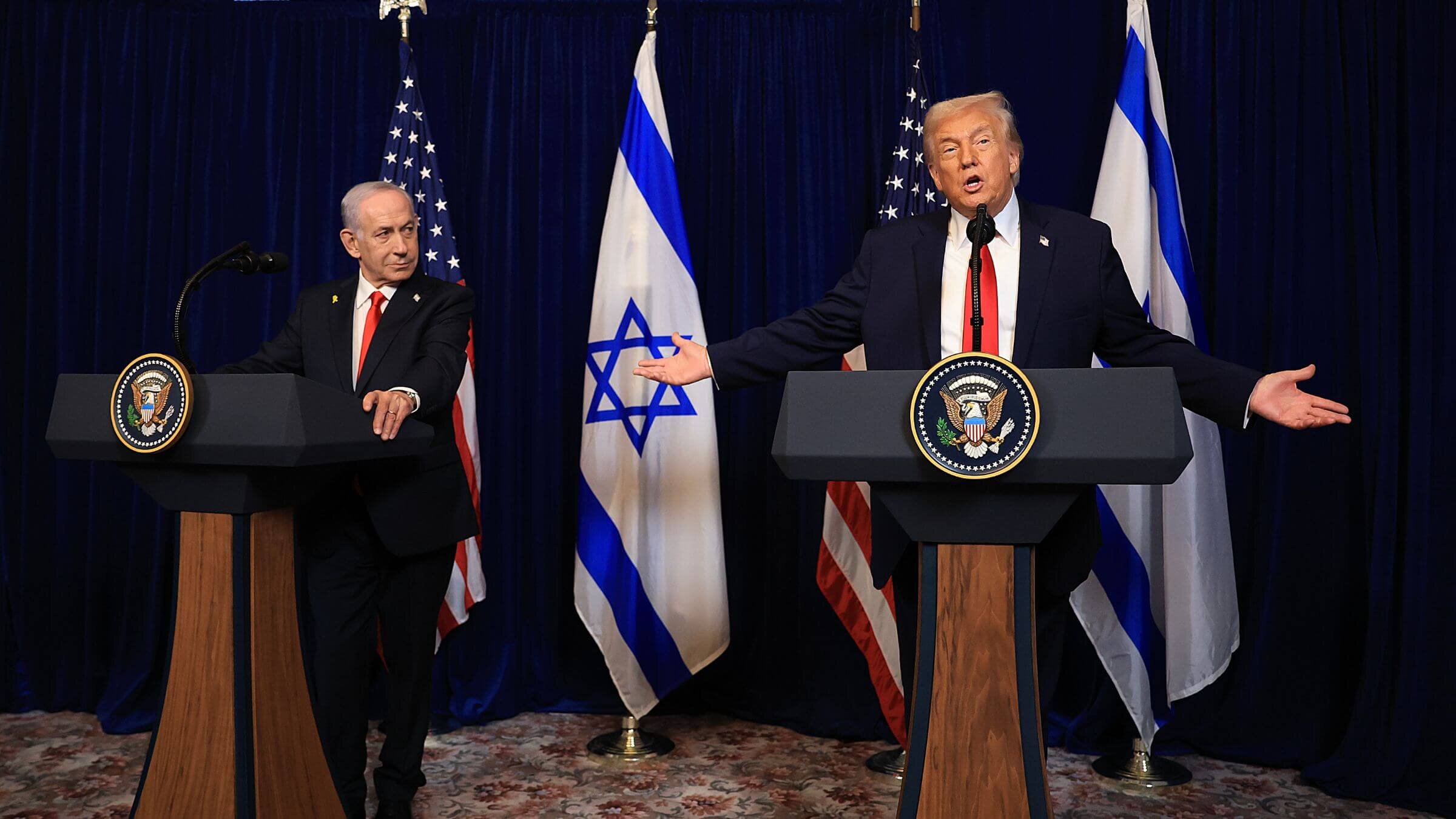
PALM BEACH, FLORIDA – DECEMBER 29: U.S. President Donald Trump holds a press conference with Israeli Prime Minister Benjamin Netanyahu at his Mar-a-Lago club on December 29, 2025 in Palm Beach, Florida. Photo by Joe Raedle/Getty Images

By Simone Saidmehr April 8, 2026
Israel is now in a precarious position following President Donald Trump’s sudden declaration of a ceasefire in the Iran war, say experts on security and the Middle East.
On Tuesday evening, President Trump announced in a Truth Social post that he would declare a two-week pause to the war that began on February 28, just an hour and a half before his ultimatum to Iran was set to expire. He had demanded that Tehran reopen the Strait of Hormuz — which had been closed for weeks, choking global energy markets — or face a catastrophic military assault, warning that “a whole civilization will die tonight.”
The Pakistani Prime Minister, who had mediated between the U.S. and Iran, announced that the truce was “effective immediately” and would apply not only to the U.S. and Iran, but also to “their allies” — namely Israel and Lebanon, both of which had been involved in recent exchanges of fire.
But Israel had other ideas. Prime Minister Benjamin Netanyahu — while stating that the U.S. had coordinated with Israel before agreeing to the ceasefire — disputed the Pakistani claim that the ceasefire included Lebanon. Israel has continued to strike its northern neighbor hard in the wake of the announcement.
Netanyahu maintains the U.S. had assured him it would continue to press on issues critical to Israeli security — namely seeking to ensure that “Iran no longer poses a nuclear, missile and terror threat to America, Israel, Iran’s Arab neighbors and the world.” So far, Iran has resisted such demands.
Despite the ceasefire announcement, Iran struck Israel and Gulf countries well into the evening, and Israel, too, carried out several strikes in the immediate aftermath of the announcement.
Split support
The ceasefire has underscored growing differences between Washington and Jerusalem over both the conduct and goals of the war.
According to Jonathan Panikoff, the director of the Scowcroft Middle East Security Initiative at the Atlantic Council and a former U.S. intelligence official, Israeli and U.S. objectives were misaligned from the outset. Israel sought not only to degrade Iran’s military capabilities but also to pursue regime change.
For the U.S., “it was always less clear … the regime change question was always much more up in the air, and even on the nuclear program, you haven’t seen nearly as much effort against it in the same way as obviously happened during June,” said Panikoff, referring to the 12-Day-War during which the U.S. targeting Iranian nuclear infrastructure with unprecedented force.
Panikoff also said that coordination between Israel and the U.S. on the ceasefire agreement itself was somewhat dubious. “The U.S. almost certainly talked to Israel about the potential ceasefire, but it’s unlikely that Israel played a meaningful role in the decision,” said Panikoff, who believes Israel would have preferred to continue the war to “get through the remainder of the target list.”
Misaligned public opinion in the two countries regarding the war is likely driving the divergence. While the majority of Americans do not support the war, with 61% saying they do not approve of Trump’s handling of the conflict, Israeli support has remained broad across the political spectrum, even amid sustained missile attacks. For Israelis, confronting Iran is viewed as existential. “Iran is a fundamental thing. On the American side, it just is not the same threat,” Panikoff said.
According to Dana Stroul, the Director of Research at the Washington Institute and a former deputy assistant secretary of defense for the Middle East in the Pentagon, Israel’s actions in the immediate aftermath of the ceasefire reflect that gap. She noted that Israel carried out additional strikes in Iran, “which indicates that they still had more targets on their strike list that they wanted to work through, and they were willing to risk, for a brief moment in time, not complying with the ceasefire to do more.”
Stroul said the U.S.-Iran peace talks scheduled to take place on Friday in Islamabad have exposed further tensions. Disputes over whether Israeli operations in Lebanon should halt have already complicated talks between Washington and Tehran. “The Iranians are saying, ‘if Israel doesn’t stop in Lebanon, we won’t go to Islamabad.’”
As a result, she said, “the issue of Israeli behavior and Israeli military action will become a hinge of whether these negotiations proceed on the ceasefire.”
“Within less than 24 hours, the debate shifted from whether or not the parameters for the talks on Friday in Islamabad are acceptable for U.S. national security interests, to where Israel is within this framework,” said Stroul.
Stroul said that this could also create a moment of “peak vulnerability for Netanyahu,” who tied his political future to his alignment with Trump.
Israeli opposition leader Yair Lapid has already taken a swing at Netanyahu in a post on X, stating: “Netanyahu led us to a strategic collapse. There was here a disgraceful combination of arrogance, irresponsibility, negligent staff work, lies sold to the Americans that damaged the trust between the countries. A military success that turned into a diplomatic disaster.”
He added, “Israel had no influence whatsoever on the agreement signed tonight between the United States and Iran. Netanyahu turned us into a protectorate state that receives instructions over the phone on matters concerning the core of our national security.”
Finger-pointing at Israel
The ceasefire coincided with revelations published in the New York Times on internal White House deliberations as Trump weighed military intervention in Iran earlier this year. According to the Times, Netanyahu used a private meeting with Trump and key U.S. officials at White House to present a plan outlining how the U.S. and Israel could work together to bring down the Islamic Republic, including a montage featuring potential alternative leaders for Iran.
While the presentation appeared to have impressed Trump, the report indicates that the President did not completely buy Netanyahu’s argument that regime change was a viable outcome. Instead, he relied on U.S. intelligence assessments that concluded the U.S. had the capacity to decapitate Iran’s leadership and dismantle its military capabilities, but that hopes for regime change were “detached from reality.”
Based on those assessments, Trump moved forward with a strategy focused on more limited and easily achievable objectives, though working in lockstep with Israel.
The report is unlikely to quell criticism from those who argue that Israel pushed the U.S. toward confrontation with Iran at the expense of U.S. interests.
Panikoff warned of potentially broad political consequences for the longtime allies depending on the outcome of the peace talks and any future fighting. “If this war ends with Iran being in a stronger strategic position regionally.… I think you’re going to get a lot of Republicans, especially in the MAGA wing of the Republican Party, who are going to start to question how this relationship has gone forth. When you combine that with where the Democratic Party is and with Democratic bases right now, I think it portends some real future challenges for the U.S.-Israel relationship.”
This is a moment of great uncertainty. Here’s what you can do about it.
We hope you appreciated this article. Before you go, we’d like to ask you to please support the Forward’s independent Jewish news this Passover. All donations are being matched by the Forward Board - up to $100,000.
This is a moment of great uncertainty for the news media, for the Jewish people, and for our sacred democracy. It is a time of confusion and declining trust in public institutions. An era in which we need humans to report facts, conduct investigations that hold power to account, tell stories that matter and share honest discourse on all that divides us.
With no paywall or subscriptions, the Forward is entirely supported by readers like you. Every dollar you give this Passover is invested in the future of the Forward — and telling the American Jewish story fully and fairly.
The Forward doesn’t rely on funding from institutions like governments or your local Jewish federation. There are thousands of readers like you who give us $18 or $36 or $100 each month or year.

Support our mission to tell the Jewish story fully and fairly.