New Jersey Town Wants Probe of Lakewood Ultra-Orthodox ‘Blockbusting’
Graphic by Angelie Zaslavsky
— A New Jersey township is calling on the U.S. Department of Justice to investigate haredi Orthodox community leaders for alleged “blockbusting,” or trying to pressure large numbers of longtime homeowners into selling their property to Orthodox Jews.
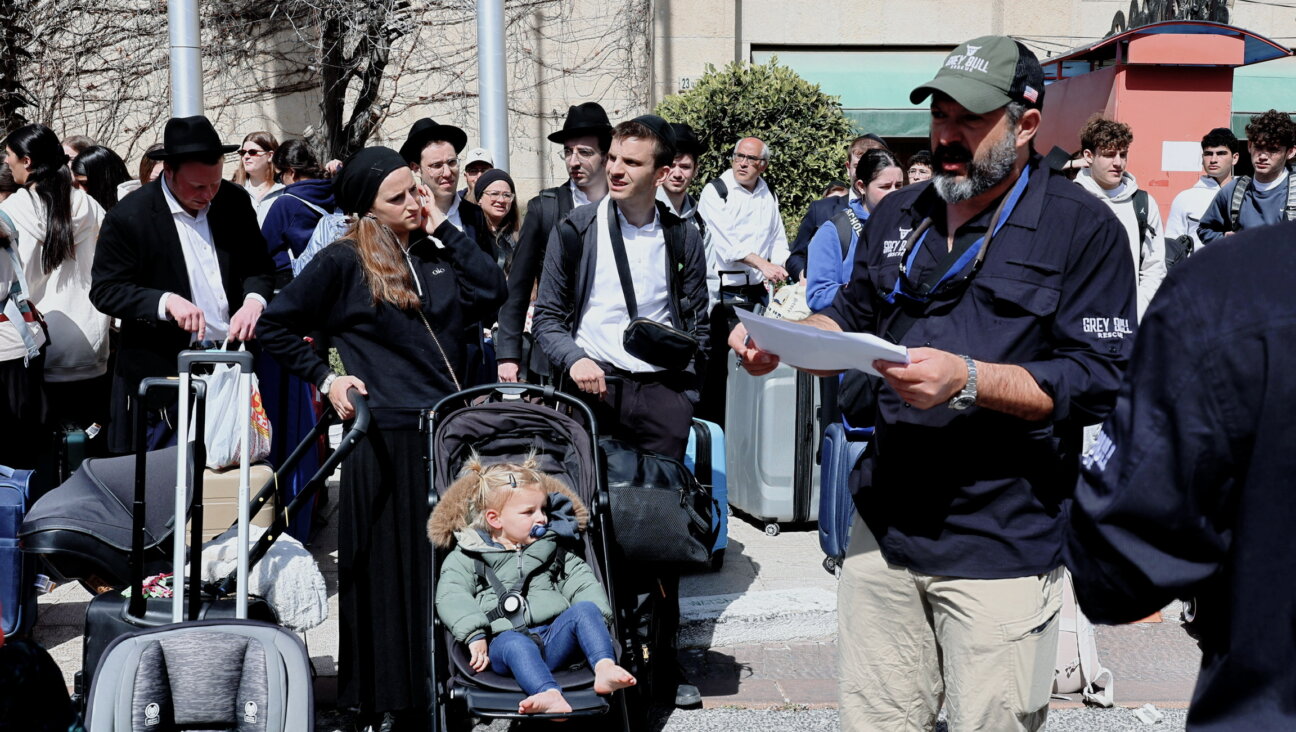
The incident is the latest example of tensions between a large and growing haredi Orthodox community in the Lakewood area and its non-Orthodox and non-Jewish neighbors.
For months, numerous residents in communities near Lakewood, in southern New Jersey, have accused real estate agents representing haredi Orthodox clients of aggressively pressing non-Orthodox homeowners to put their property on the market. Members of the Orthodox community have denied the claim.
On Tuesday, the Jackson Township Council said it was alarmed by videos circulating in which Orthodox leaders at the haredi Agudath Israel of America’s November convention encouraged Orthodox Jews to buy property in communities near Lakewood, the Asbury Park Press reported.
“Those videos very strongly indicated what I think many of us had feared or have attempted to prove, and that is there seems to be a cohesive attempt to blockbust our neighborhoods, to look at Jackson as a place to be taken over,” Rob Nixon, the council president, told the newspaper.
However, Orthodox leaders disputed the council’s claims and said that they were based on misinterpretations of Yiddish phrases.
In one video Rabbi Shmuel Lefkowitz, vice president for community services of Agudath Israel of America, a national advocacy organization representing haredim, urged would-be Orthodox home buyers to “keep pushing the envelope” and consider buying property in non-Jewish neighborhoods in surrounding towns.
“Someone who takes it upon themselves … they could turn it around,” he said, according to the Press.
However, the Press said the video does not urge people to intimidate homeowners, the behavior generally associated with “blockbusting.”
In one controversial segment of the video, Lefkowitz called on members of the Orthodox community to become “schtickle pioneers” willing to settle in outlying areas that don’t currently have the Orthodox amenities of established Orthodox communities.
In reporting on the video, the community news website Shore News Network defined “shtickle” as a pejorative Hebrew term that means “second class.”
Avi Schnall, the state director of Agudath Israel for New Jersey, said that by “shtickle,” the speaker meant “little” and not “second class.”
“It’s the most ridiculous thing in the world that they would construe it to mean something negative,” he told the Press.
In a letter sent to the Justice Department, Michael Nagurka, an attorney for the township council, wrote, “While the Township takes no position on who buys property within its borders, some individuals have sought to purchase all homes on entire blocks of certain neighborhoods. Furthermore, at several public meetings, many residents have indicated that these individuals have used intimidation and fear in an attempt to accomplish these legal aims.”
This is a moment of great uncertainty. Here’s what you can do about it.
We hope you appreciated this article. Before you go, we’d like to ask you to please support the Forward’s independent Jewish news this Passover.
This is a moment of great uncertainty for the news media, for the Jewish people, and for our sacred democracy. It is a time of confusion and declining trust in public institutions. An era in which we need humans to report facts, conduct investigations that hold power to account, tell stories that matter and share honest discourse on all that divides us.
With no paywall or subscriptions, the Forward is entirely supported by readers like you. Every dollar you give this Passover is invested in the future of the Forward — and telling the American Jewish story fully and fairly.
The Forward doesn’t rely on funding from institutions like governments or your local Jewish federation. There are thousands of readers like you who give us $18 or $36 or $100 each month or year.
Support our mission to tell the Jewish story fully and fairly.