The NFL rookie with the name Jews cannot say aloud. (Or can they?)
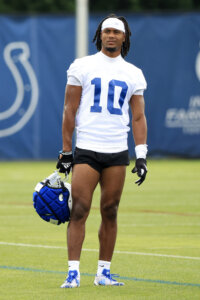
Adonai Mitchell might start for the Indianapolis Colts. What’s a Jewish fan to do?
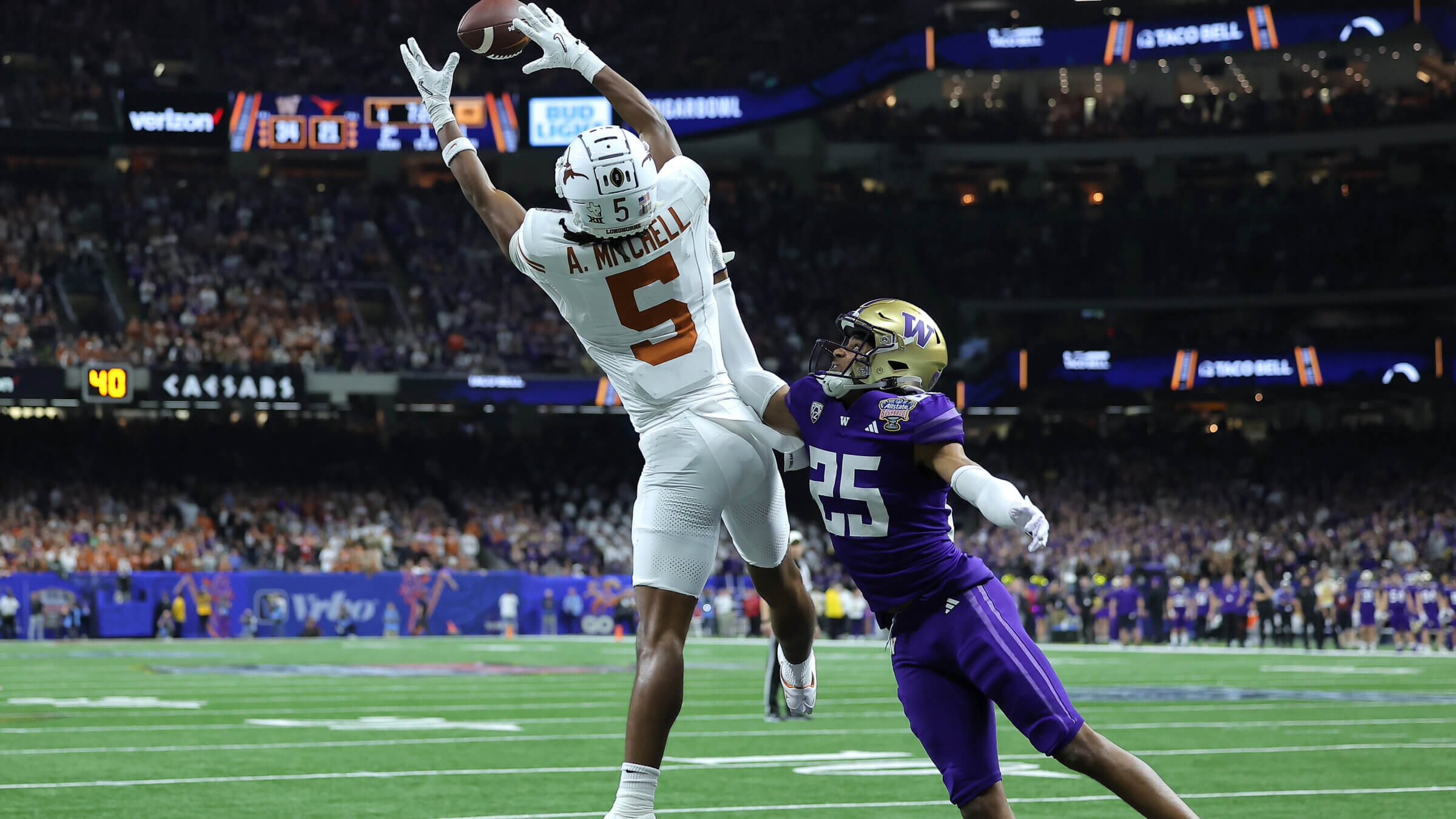
Colts fans hope Adonai Mitchell (left) is the, uh, answer to their prayers at wide receiver. Photo by Jonathan Bachman/Getty Images

By Louis Keene June 6, 2024
Thou shalt not take the Lord’s name in vain, the Ten Commandments tell us. But what if the Lord’s name is lining up at wide receiver?
It’s a conundrum Jewish football fans could face this year: The Indianapolis Colts signed a contract on Thursday with a rookie named Adonai Mitchell.
Adonai is a Hebrew name for God that Jews use during worship; halacha, or Jewish law, forbids its use outside of ritual contexts. (Hashem, which means “the name,” is generally substituted.) So what do you say when Adonai catches a pass — or drops one?
Fortunately, Mitchell gave the world a fallback option: his nickname, “AD.”
That’s one way Judah Fortgang, an Orthodox Jew who writes and podcasts about the NFL for Pro Football Focus, might handle the situation. More likely, Fortgang told me, he’ll just refer to Mitchell by his last name, which is in any case common with professional athletes: One other active pass-catcher shares that surname — the Lions’ James Mitchell — but he rarely plays.
Adonai Mitchell, on the other hand, is a highly touted prospect who won two NCAA championships before Indianapolis drafted him in the second round (52nd pick overall). ESPN ranks him third on the Colts’ depth chart at wide receiver.
Jori Epstein, an observant Jew who works as a senior reporter for Yahoo! Sports, pointed out that Mitchell pronounces his name “ADD–en-eye,” which is different from how God’s name is recited in Hebrew prayers (ah-do-NAI).
“Still,” said Epstein, “it’s close enough to be uncomfortable.” So when Mitchell comes up in work conversation, she uses A.D.. When he comes up in her cousins’ group chat — they keep a list of NFL players with biblical names, like Ezekiel Elliot and Nahshon Wright — she calls Mitchell “Ado-shem,” a halachically safe portmanteau.
Were she to interview Mitchell, she’d start by bringing this all up.
“I love having those opportunities,” she said. “As a reporter, a lot of the job is building relationships, and if we don’t give anything on the reporter end, people are less likely to feel comfortable and trusting and willing to open up.”
But the name might not be much of an issue after all.
I reached out to Rabbi Avi Schwartz, an NFL fan who works at Rutgers University Hillel, to get some guidance. Turned out Schwartz had already consulted his own rabbi, Aryeh Lebowitz, a leader at Yeshiva University’s seminary — who had recently asked his rabbi, YU’s Rabbi Hershel Schachter, about someone who worked with a doctor whose name sounded like the Hebrew word for God.
Schachter, who is perhaps the leading posek, or halachic adviser, for Orthodox Jews in the United States, did not appear to see it as much of a dilemma.
“He thought that it’s fine,” Lebowitz said in a voice note Schwartz forwarded. The rationale, Schwartz said, was that “it’s obvious that you’re not calling” a wide receiver “as your god.” It is permissible, he explained, to use adonai or another Hebrew word for God, elohim, when referring to gods of other religions.
Even in light of Schachter’s ruling, Epstein said the exercise in caution had been a rewarding one. And if an Indianapolis Colts draft pick can get people to think more before they speak, she said, “he probably deserves early consideration as rookie of the year.”
This is a moment of great uncertainty. Here’s what you can do about it.
We hope you appreciated this article. Before you go, we’d like to ask you to please support the Forward’s independent Jewish news this Passover. All donations are being matched by the Forward Board - up to $100,000.
This is a moment of great uncertainty for the news media, for the Jewish people, and for our sacred democracy. It is a time of confusion and declining trust in public institutions. An era in which we need humans to report facts, conduct investigations that hold power to account, tell stories that matter and share honest discourse on all that divides us.
With no paywall or subscriptions, the Forward is entirely supported by readers like you. Every dollar you give this Passover is invested in the future of the Forward — and telling the American Jewish story fully and fairly.
The Forward doesn’t rely on funding from institutions like governments or your local Jewish federation. There are thousands of readers like you who give us $18 or $36 or $100 each month or year.
Support our mission to tell the Jewish story fully and fairly.