Moving Beyond Stereotypes

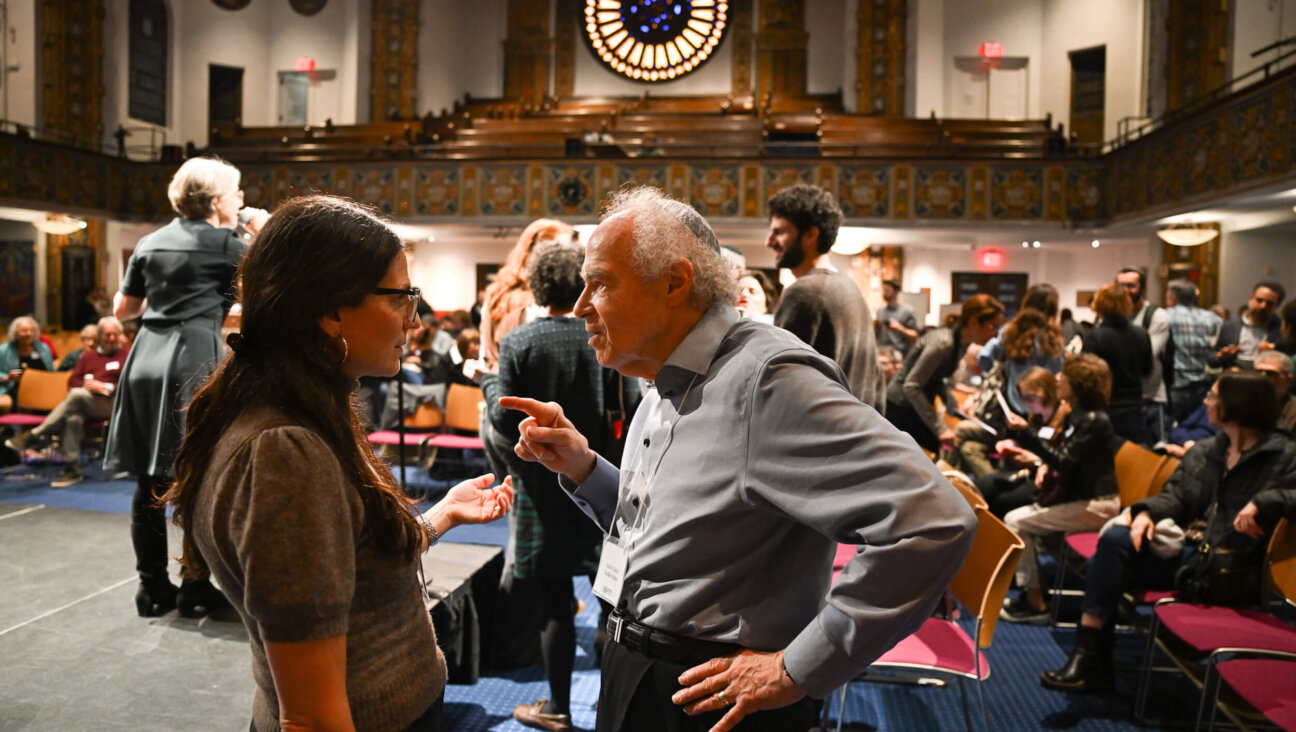
The Power of Talk: Members of the dialogue group. Image by Courtesy of Letty Cottin Pogrebin
At the beginning, I thought, “We will go and show those Jewish women who is the aggrieved and who is the criminal here.”
I anticipated a head-to-head confrontation when we talked about Israel’s injustices and human rights violations. I thought the Jews in the Dialogue would try to convince us that Israel has the right to do what it does. Frankly, I expected our first meeting to be the last. But here we are, two-and-a-half years later, still talking.
The reason I keep attending our meetings is that I know we all share the goal of a peaceful solution to the conflict, and I believe the Jewish women in our group understand the pain we have endured in our struggle for national liberation. Though they weren’t the first Jews I heard express support for a Palestinian state, they are the first I’ve met who genuinely sympathize with our plight.
Two of them call themselves Zionists and two do not identify with the label — which, in and of itself, was interesting to me — but all four want to learn more about how we feel, who we are and what we want. Moreover, all eight of us are committed to moving beyond each group’s stereotypical perceptions of “the other.”
As a result of our intense, often volatile, discussions, I came to see that each side perceives itself as the victim and sees the other as the aggressor. I also realized that Israelis feel as vulnerable and scared as Palestinians, even though Israel is so strong and Palestine so weak. And I see that Palestinians are imagined powerful enough to influence the entire outcome of the conflict by ending our resistance to occupation, which, whether violent or non-violent, Israel calls “terrorism.”
The trouble is, recent events give the lie to that scenario. The hundreds of Palestinians who’ve lately embraced the strategy of passive resistance do not seem to have won the heart of the oppressor. On the contrary, during several peaceful demonstrations in West Bank villages where Jews have been appropriating property for their own use, video footage shows the Israel Defense Forces provoking violence.
I believe change happens exponentially — two, four, eight people at a time. By carrying our process outside of our closed-door meetings and onto this page, we are modeling mutual respect and peaceful co-existence. I hope our group inspires other Jewish Americans and Palestinian-Americans to come together to find light at the end of this very long tunnel.
Born in Gaza in 1951, Sabah Allen, a writer and editor, became a United States citizen in 1988. Currently she serves as an Adviser at the United Arab Emirates Mission to the United Nations.
This is a moment of great uncertainty. Here’s what you can do about it.
We hope you appreciated this article. Before you go, we’d like to ask you to please support the Forward’s independent Jewish news this Passover.
This is a moment of great uncertainty for the news media, for the Jewish people, and for our sacred democracy. It is a time of confusion and declining trust in public institutions. An era in which we need humans to report facts, conduct investigations that hold power to account, tell stories that matter and share honest discourse on all that divides us.
With no paywall or subscriptions, the Forward is entirely supported by readers like you. Every dollar you give this Passover is invested in the future of the Forward — and telling the American Jewish story fully and fairly.
The Forward doesn’t rely on funding from institutions like governments or your local Jewish federation. There are thousands of readers like you who give us $18 or $36 or $100 each month or year.
Support our mission to tell the Jewish story fully and fairly.