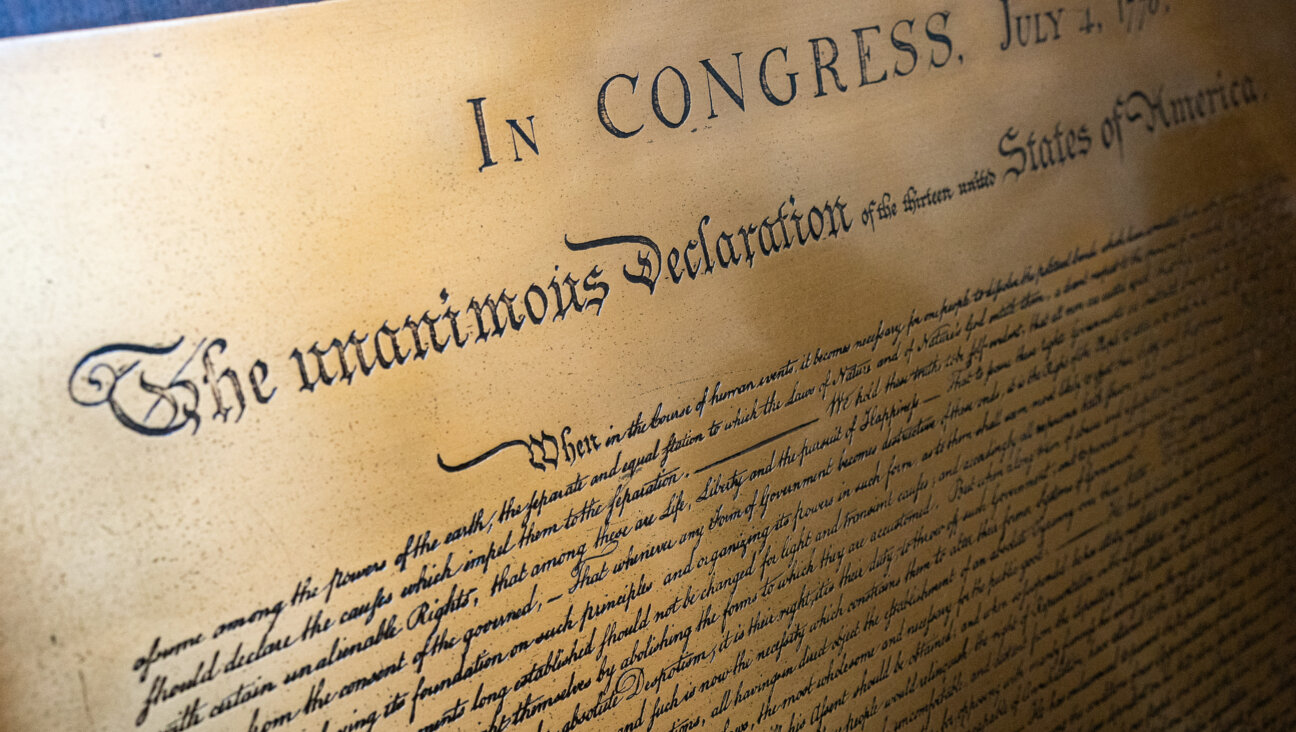
If America Had Laws Like Israel

Graphic by Angelie Zaslavsky
Thinkstock
A new proposed bill, supported by senators on both sides of the aisle, will finally define and determine the United States of America as the land of the Protestant People, the largest religious constituency in the U.S. and the group out of which America’s founding fathers and ruling leadership emerged.
The new law aims to anchor Protestant values in the laws of the land, inspired by the spirit of the American Constitution. Furthermore, the bill proceeds to state that the U.S. will continue to uphold a fundamentally democratic character. According to the new law, the United States will be fully committed to the foundations of Freedom, Justice, and Peace, in light of our Lord Jesus Christ.
At the same time, the bill suggests, the right to implement a national self-definition will be exclusively reserved for the Protestant People. According to the new bill, Protestant values will serve as inspiration to lawmakers and judges at the different levels of the United States’ legislative and judicial branches. In cases where a court of justice encounters difficulties in ruling over issues that have no readily available answers in the Law, in the Christian Canon, or in logical reasoning, it will then rule according to the principles of freedom, justice, integrity and peace stemming from the Protestant heritage.
In addition, the national emblems of the United States, such as its flag and national anthem, will be drawn directly from the tradition of the Protestant Church, and the official calendar of the U.S. will follow the Protestant liturgical year. Finally, the United States will further act to preserve and entrench the Protestant historical and cultural tradition and to cultivate it in the U.S. and abroad.
Any reader who has gotten this far would probably note that such a law could not be passed or even seriously proposed by the United States legislature. In Israel, however, it could become a fundamental law, on a level equivalent to a constitutional amendment in the United States.
The different clauses listed above are not a free interpretation of the bill or wild projections of what this bill could imply; they are the clauses of the original Hebrew bill, translated into the U.S. political context. I have simply replaced the phrase “the Jewish People” and its associated traits with the “Protestant People” and its associated traits, such as “Protestant values” and “the Christian Canon.”
There are currently close to 8 million people living in Israel, more than 20% of which are Palestinian citizens. After years of de facto discrimination against Palestinian citizens of Israel in various aspects of daily life, this new law, if passed, will make such discrimination official: Palestinians will become formally, legally, second-class citizens. And this is without even mentioning the Palestinians who still live under the Israeli occupation in the West Bank.
If you would oppose such a law had it been proposed in your own country, how can you support it when proposed in another country? If you would have objected to such a law because it would discriminate against you as a member of a religious or ethnic minority, how can you possibly support such a law when it is being put forward in your name, with you as the would-be member of Israel’s Jewish majority?
Avital Burg is a New York based artist and writer from Tel Aviv.
This is a moment of great uncertainty. Here’s what you can do about it.
We hope you appreciated this article. Before you go, we’d like to ask you to please support the Forward’s independent Jewish news this Passover. All donations are being matched by the Forward Board - up to $100,000.
This is a moment of great uncertainty for the news media, for the Jewish people, and for our sacred democracy. It is a time of confusion and declining trust in public institutions. An era in which we need humans to report facts, conduct investigations that hold power to account, tell stories that matter and share honest discourse on all that divides us.
With no paywall or subscriptions, the Forward is entirely supported by readers like you. Every dollar you give this Passover is invested in the future of the Forward — and telling the American Jewish story fully and fairly.
The Forward doesn’t rely on funding from institutions like governments or your local Jewish federation. There are thousands of readers like you who give us $18 or $36 or $100 each month or year.
Support our mission to tell the Jewish story fully and fairly.