Israel has a crucial lesson to learn from apartheid South Africa. It isn’t what you think
Peace doesn’t come on any one group’s timeline — but there are still meaningful ways to prepare
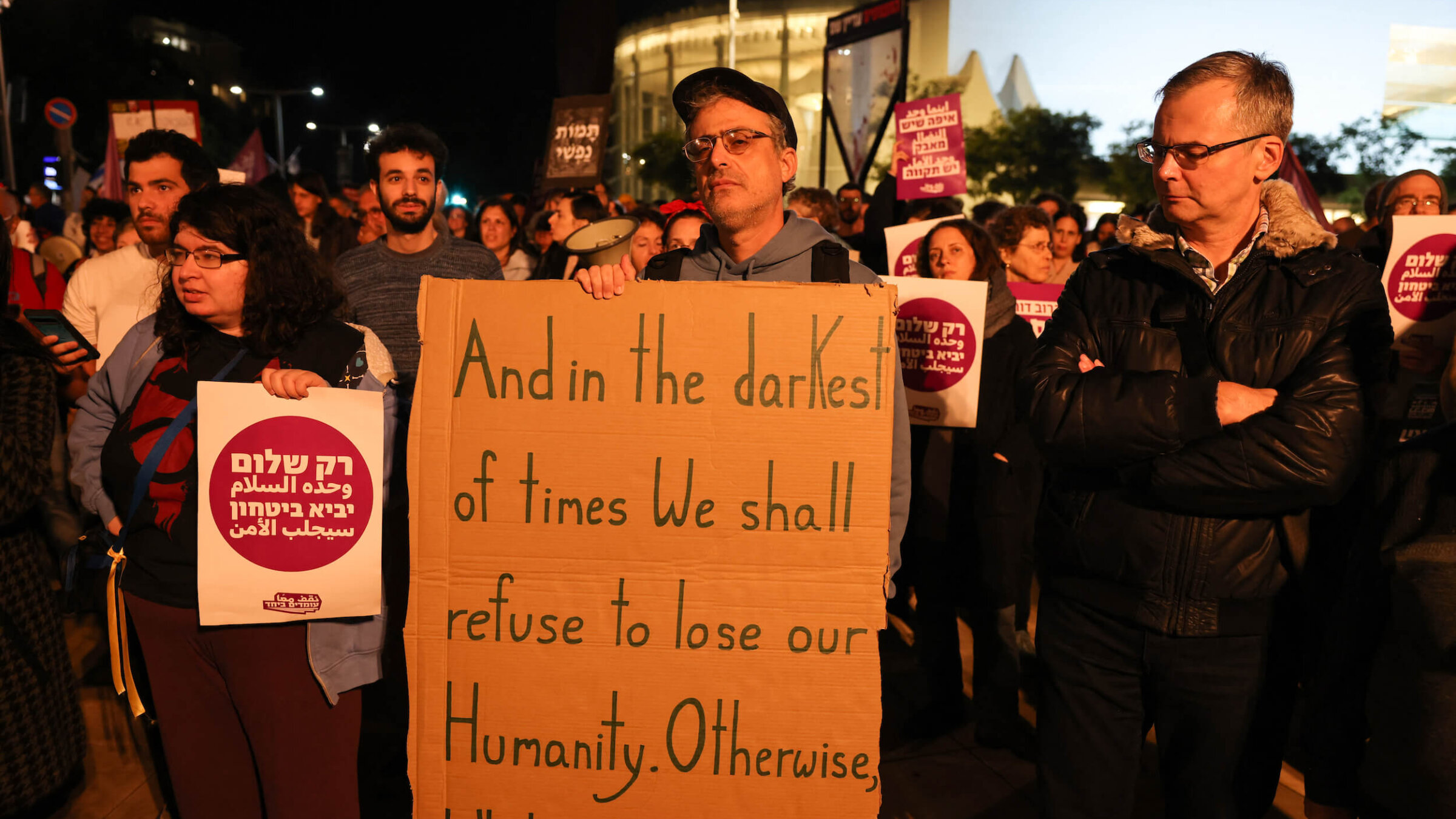
An anti-war demonstration organized by the group Standing Together in Tel Aviv on Dec. 28, 2023. Photo by Ahmad Gharabli/AFP
Some years ago, I traveled to South Africa with a group of Israelis to study the anti-apartheid movement. On our first morning, our guide posed a question: Why did apartheid end?
We offered the standard answers: because internal resistance grew stronger, because international pressure mounted, because the regime lost legitimacy. The guide listened and then said: Apartheid didn’t end for any of those reasons. It ended when the Berlin Wall came down.
His point was not that South Africans were passive. It was that political change does not happen on timetables set by internal movements alone. Power shifts systemically and globally, and when it does, the outcome depends on whether societies are prepared to move when the moment comes. Movements cannot control when history accelerates, but they can determine whether they have built the moral clarity, political vision and organizational capacity to act when it does.
A few years later, I traveled with the same group to Serbia and met former student leaders of Otpor, the movement that helped unseat the dictator Slobodan Milošević. They described how they began as a marginal, improvisational group, driven more by urgency than structure.
What eventually changed their trajectory, they told us, was recognizing that mobilization only works if people can see not just what they are resisting, but what they are building toward. They developed a concrete vision of a democratic Serbia that people could recognize as an alternative — not just to the regime, but to permanent instability. When the political opening arrived, there was something ready to replace what had collapsed.
Political change begins with imagination — but that imagination must be taken seriously.
This past weekend in Israel, something shifted quietly, and if you blinked, you may have missed it.
At a meeting for its 10th anniversary, Standing Together — the largest Jewish-Arab grassroots movement in Israel — formally adopted a framework for ending the Israeli-Palestinian conflict that proposes two states not as sealed national projects but as overlapping political realities.
That vision, put forward by the group A Land for All, would see Israelis and Palestinians both have freedom of movement and equal rights in the land between the Jordan River and Mediterranean Sea, and shared sovereignty in Jerusalem. It establishes mutual recognition of autonomy between the two peoples as a premise for peace, rather than as a final-status issue to address, as it was in previous peace efforts like the Oslo Accords.
This was not an organizational merger or a policy announcement. It was the articulation of a political horizon.
For most of its history, Standing Together has focused on equality within Israel itself: advocating for labor rights and a reasonable cost of living, combatting racism, and promoting shared civic life. Since the Hamas attack of Oct. 7, 2023, it has been one of the only Israeli movements willing to organize sustained opposition to the war in Gaza, engage in civil disobedience, and try to deliver humanitarian aid in the face of increasing hostility.
Through this vote, the movement sought to expand its domain of responsibility — from Israel’s internal democracy, to the scope of the Israeli-Palestinian conflict as a whole.
It’s just one group; just one vote. But it’s also a reframing of what the future is allowed to look like, and a landmark moment of Israelis and Palestinians engaging in a joint political process. Its importance lies less in its technical details than in its structural ambition: replacing separation as the organizing principle, and establishing equality as the baseline.
In a context where imagination itself has been steadily eroded, this matters.
Israeli life has been governed for years by a doctrine of management — managing conflict, managing unrest, managing despair. The public has been trained to treat war as permanent; inequality as unavoidable; and a punishing power hierarchy as necessary for survival. This is not an accident. It is a governing logic that eliminates alternatives by framing them as incoherent, naïve or dangerous.
The most lasting damage done by Prime Minister Benjamin Netanyahu to Israel may turn out not be the ways in which he’s degraded the country’s electoral system and democratic institutions. It may be psychological.
On his watch, Israel’s political culture has been systematically emptied of credible futures. What remains is a society fluent in fear and increasingly unable to articulate what it is trying to become.
Comprehensive political visions change the conditions of organizing. When people can describe a wished-for future in concrete, realizable terms, political engagement stops being purely reactive and starts becoming constructive. It reshapes alliances, alters the language of debate, and changes the kinds of risks individuals and movements are willing to take.
South Africa understood this. Serbia understood it. Even New York City saw a version of this dynamic recently, when Mayor-elect Zohran Mamdani went from polling at around 1% in the early days of the primary to winning the general election on a platform of affordability and thriving that did not dilute its goals in exchange for political safety.
Israel’s ruling order will not last forever. Regimes built on a premise of permanent emergency aren’t sustainable. What matters is whether there will be anything ready to replace it when it cracks.
Standing Together did not change reality with its vote in favor of a different kind of future — but it clarified what that future could practically look like, and in a country trained to believe that no future exists. And that, on its own, is a political marvel.
This is a moment of great uncertainty. Here’s what you can do about it.
We hope you appreciated this article. Before you go, we’d like to ask you to please support the Forward’s independent Jewish news. All donations are still being matched by the Forward Board - up to $100,000 until April 24.
This is a moment of great uncertainty for the news media, for the Jewish people, and for our sacred democracy. It is a time of confusion and declining trust in public institutions. An era in which we need humans to report facts, conduct investigations that hold power to account, tell stories that matter and share honest discourse on all that divides us.
With no paywall or subscriptions, the Forward is entirely supported by readers like you. Every dollar you give is invested in the future of the Forward — and telling the American Jewish story fully and fairly.
The Forward doesn’t rely on funding from institutions like governments or your local Jewish federation. There are thousands of readers like you who give us $18 or $36 or $100 each month or year.

Support our mission to tell the Jewish story fully and fairly.