The part of the Hanukkah story we ignore — and why it matters to converts like me
The holiday’s call to make Judaism visible raises an old question: What do people find when they choose us?
Graphic by Discan/iStock; Collage by Benyamin Cohen
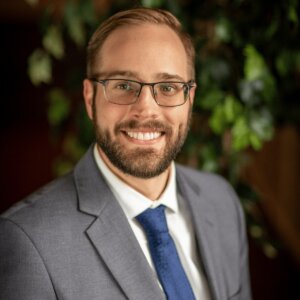
Austin Albanese December 10, 2025
Converts to Judaism are often treated as rare exceptions — surprised looks, intrusive questions, comments like “who’s the lucky girl.” Yet conversion is no anomaly. It is now more common than at any point in the last 2,000 years. You see it in synagogue pews. You see it in rabbinical leadership.
As Hanukkah approaches, with its call to make Jewish identity visible, I keep returning to what happens when people choose Judaism — and to the parts of our tradition that do not fit the story we usually tell.
We often repeat that Judaism doesn’t seek converts. But clearly, people are seeking Judaism. Hanukkah forces us to ask what kind of Judaism they are finding by looking at the holiday’s own complicated history with power and conversion.
We usually tell Hanukkah as a straightforward story of good and evil: a small band of Jews defends their faith against an empire, and a miracle in the Temple affirms that steadfastness can overcome adversity. The holiday’s defining commandment, pirsum ha-nes — publicly proclaiming the miracle — seems equally simple. We put the menorah in the window for all to see. Judaism doesn’t hide.
But if you look more closely at the history behind that beloved story, Hanukkah is also about force, conversion and the question of what kind of Judaism we choose to embody when we’re no longer powerless.
John Hyrcanus, a later Hasmonean ruler and direct descendant of the Maccabees, is rarely mentioned in Hanukkah celebrations. Yet his legacy haunts the holiday. A generation after the revolt, Hyrcanus used the political power of the Hasmonean kingdom to forcibly convert the neighboring Idumeans to Judaism. A movement that began as resistance to assimilation ended in the coerced assimilation of others. The people whose story we tell as a fight for religious freedom became, in time, the ones taking that freedom away.
It’s an uncomfortable truth, especially for those of us who, like me, chose Judaism. I didn’t convert to marry in or reclaim distant ancestry. I converted because I saw in Judaism a faith worth choosing: a tradition grounded in human dignity and a God who seeks relationship. For years I was told Judaism was always a non-proselytizing, purely voluntary faith, the opposite of traditions that sought converts — including Jews — through coercion.
But our own texts complicate that narrative. Near the end of the Book of Esther, in a verse most Purim spiels rush past, we read: “And many of the people of the land professed to be Jews, for the fear of the Jews had fallen upon them.” That is not a story of seekers drawn by theology, but of people compelled to join the Jews out of fear.
When Judaism welcomed seekers
Those coercive moments sit alongside a very different strand of Jewish history — one in which Judaism didn’t force, but attracted. In the late Hellenistic and early Roman era, Christian and Jewish sources describe synagogues filled not only with those born Jewish but with converts and “God-fearers,” people drawn to Jewish ethics, study and monotheism. As a convert drawn to Judaism by faith alone, I came to see myself not as an anomaly, but as part of that long line.
Centuries later, a similar universalist voice resurfaced in 19th-century America, especially in the early Reform movement. Rabbis such as Isaac Mayer Wise preached Judaism’s mission not as an inward inheritance but as a message about human dignity meant for the world.
In 1870, laying the cornerstone of Columbus, Ohio’s first synagogue, Wise told a largely non-Jewish crowd that Judaism’s purpose was to remind humanity that “God hath made man upright,” A direct rejection of the Christian doctrine of Original Sin. Synagogues etched Isaiah’s verse — “For My house shall be a house of prayer for all peoples” — onto their facades and welcomed neighbors of every faith inside. Converts were welcomed as a natural extension of that conviction.
That confidence, too, was battered by history. Mass immigration of Eastern European Jews, the Holocaust, and the urgent work of supporting refugees and the new State of Israel all pushed the universalist voice to the background. Yet, more people are converting to Judaism than at any point since Roman times.
Meanwhile, religious identity in North America has become unusually fluid. Many people describe themselves as spiritually seeking but institutionally unaffiliated, brushing against Jewish life through family, friendships or personal study.
And yet, the gatekeeping persists. Converts are asked to defend their legitimacy. Jews-by-choice face skepticism in Israeli bureaucracy and suspicion in American Jewish spaces. I’ve been told I “don’t look Jewish,” and once, at a community film screening, another attendee — a fellow Jew — grabbed my name tag and publicly questioned whether I was really Jewish.
Those moments aren’t just rude; they reveal a deeper anxiety about boundaries: the fear that if Judaism is too open, it will lose itself. It’s a fortress mentality, one that sees every door as a potential breach.
What Judaism we reveal now
Hanukkah offers another possibility. The holiday asks us to present Judaism so that others can see it. It remembers a moment when Jews refused to disappear, and it also reminds us that Jews have sometimes used political power in ways that betrayed our deepest values. To take Hanukkah seriously in our time is to recognize that Jewish history, like the histories of all faiths, holds moments of both coercion and holiness — and that we have a choice about which lineage to lean into now, when seekers are again at the door.
The question is not whether Judaism should send out missionaries. Rather, it is whether we will live as if Isaiah’s verse still says what we claim it does: that our house is meant to be a house of prayer for all peoples, including those who, in every generation, find their way to our door.
This Hanukkah, as we place our menorahs in doorways, balconies and windows, the question beneath pirsum ha-nes is sharp: What kind of Jewish confidence are we proclaiming — a brittle confidence that closes in on itself, or a steadier confidence that welcomes those moved by the stories and ethics we are illuminating?
The miracle is not only that the Jewish people have survived. It is that Judaism continues to draw people in. The doors we open — or keep shut — will determine who gets to stand in that glow with us.
This is a moment of great uncertainty. Here’s what you can do about it.
We hope you appreciated this article. Before you go, we’d like to ask you to please support the Forward’s independent Jewish news this Passover.
This is a moment of great uncertainty for the news media, for the Jewish people, and for our sacred democracy. It is a time of confusion and declining trust in public institutions. An era in which we need humans to report facts, conduct investigations that hold power to account, tell stories that matter and share honest discourse on all that divides us.
With no paywall or subscriptions, the Forward is entirely supported by readers like you. Every dollar you give this Passover is invested in the future of the Forward — and telling the American Jewish story fully and fairly.
The Forward doesn’t rely on funding from institutions like governments or your local Jewish federation. There are thousands of readers like you who give us $18 or $36 or $100 each month or year.
Support our mission to tell the Jewish story fully and fairly.