The Bondi Beach attack is inspiring Jewish pride. For our children’s sake, we need to allow our fear, too.
Sometimes the most Jewish thing we can do is to sit quietly with children in their fear, writes the head of the Jewish Education Project
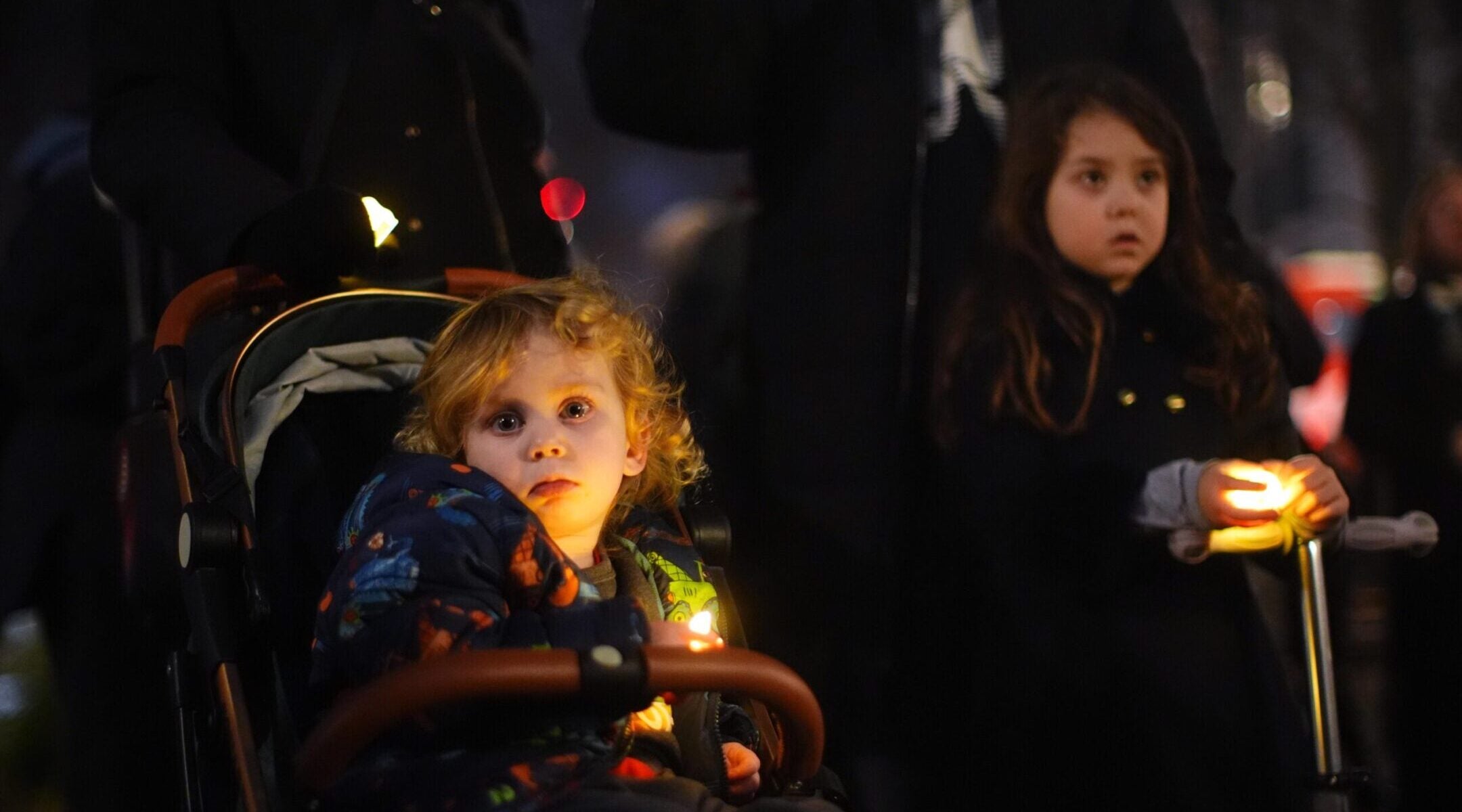
Children attend a vigil outside the Australian High Commission in central London, following the terrorist attack targeting a Jewish celebration at Bondi Beach in Sydney, Australia, on Dec. 14, 2025. Photo by James Manning/PA Images via Getty Images
(JTA) — Just last Monday night, I experienced one of the pinnacles of my professional life: interviewing Rachel Goldberg-Polin and Jon Polin. That evening, Rachel, who herself has endured unimaginable suffering, reminded us that hope is a commandment. Not a passive wish, but an active pursuit. The conversation took place at the Jewish Futures Conference, dedicated to what I called the pedagogy of hope: the idea that hope can be taught, modeled and lived.
One week later, our world was shattered.
On the first night of Hanukkah, an unthinkable tragedy unfolded at Bondi Beach in Sydney. Fifteen people were murdered. Scores more were wounded. And what will forever mark this event is not only its brutality, but the fact that it was an antisemitic attack—an attempt to murder Jews in public Jewish spaces.
I am Australian. I was born in Melbourne and lived and worked in Sydney for two years. Like so many people I love, I know Bondi Beach intimately: the fish and chips, the place you take friends and tourists, the breathtaking walk from Bondi to Coogee — one of my favorite walks in the world. Bondi is joy, openness, life. And now, it is also a site of terror. That can never be erased.
Today, we are mourning and burying our dead. And still — we are commanded to hope. To be proud.
But sometimes, hope cannot be rushed.
As educators, teachers, and especially as parents, our first obligation is to listen to our children. To all of their emotions: fear, anger, confusion, sadness. Sometimes telling children to “be proud,” to “go outside and shine your menorah brightly,” is not the right response in the immediate aftermath of violence. Sometimes the most Jewish thing we can do is to sit quietly with them in their fear. To be scared together for a moment. Emotions are real, and they cannot always be controlled or overridden by ideology or slogans.
Adults can be adults. But we must also let kids be kids.
Inevitably, adults will begin the blame game. Politics will follow. There will be time to dissect the Australian government’s response — or lack thereof — to the pleas of Australian Jewry over the past two years. There will be time to ask hard questions about whether Australia remains a safe haven for Jews. I have always known Australia as one of the luckiest places in the world, and I hope — with everything in me — that it emerges from this tragedy stronger and more resilient.
But not yet.
For educators especially, it is essential to remember that our primary role is not to make young people think what we think or believe what we believe. Our first task is to nurture them — to care for their emotional well-being. Good education does not create replicas of adults. It creates critical thinkers who can reach their own enduring understandings of the world and form their own systems of values.
Yesterday, I spent my day waiting for names to appear on lists of the wounded and the dead. I have done this before — most recently on Oct. 7. I reached out to friends in Sydney, waiting anxiously for replies. When one didn’t respond for 24 hours, my heart sank. The full list has not even been released yet. This is the reality of the world we live in.
Friends in Israel sent me a photo of a sign on the Tel Aviv boardwalk: “From Tel Aviv Beach to Bondi Beach.” A painful reminder of how small the world is — and how close the Jewish people are.
So, what is the message of Hanukkah this year?
Among the heroes of Bondi is Ahmed al-Ahmed, a 43-year-old father of two and fruit shop owner, who was shot multiple times while disarming one of the attackers. His courage echoes a story Rachel Goldberg-Polin tells of a Bedouin man who pleaded to save Jews sheltering from Hamas terrorists, only to be murdered himself. Even in the deepest darkness, there is good in the world.
None of this means we should stop striving to raise proud, thriving Jews. We should light our menorahs. Place them in our windows. Gather publicly. Be visible and unafraid.
And we must also listen to our children.
They are not only our future. They are our present.
The views and opinions expressed in this article are those of the author and do not necessarily reflect the views of JTA or its parent company, 70 Faces Media.