When my children decorate for Hanukkah, I don’t just see pride. I see pluralism in action.
The shooting in Sydney highlights the deadly consequences of a world intolerant visible religious difference, writes a rabbi
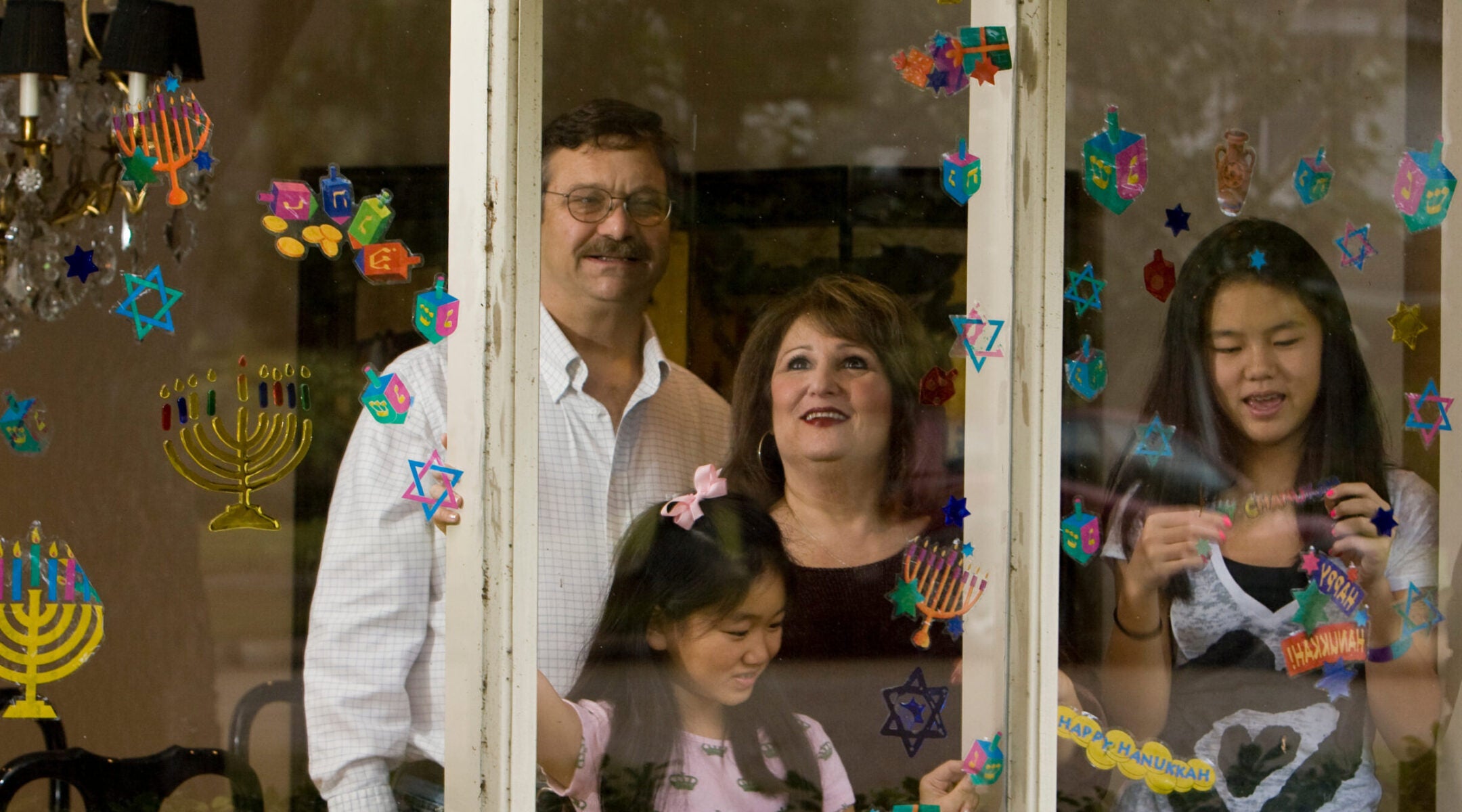
A Jewish family decorates their windows for Hanukkah in Houston in December 2008. Photo by Nick de la Torre/Houston Chronicle via Getty Images
(JTA) — Shortly after Thanksgiving, my children develop a refrain: “We have to start decorating for Hanukkah!” They pull out a plastic bin stuffed with decorations — some purchased at Target, others created at their Jewish day school — and transform our front window. They hang metallic dreidel cut outs along the frame. They press gel letters spelling “Happy Hanukkah” against the glass and move a credenza in front of it, arranging the menorahs on top, eagerly awaiting the first night’s candle-lighting.
It’s the kind of scene my grandparents would hardly recognize. Decorations were for Christmas, not Hanukkah. And in the late 1980s, when I was a child, there weren’t many Hanukkah decorations to buy, even if you had wanted them. Global manufacturing had not yet turned every holiday into an aisle of seasonal merchandise.
Some traditionalists might see these store-bought decorations and new customs as inauthentic or overly Americanized. But this doesn’t make my children’s version of Hanukkah “less authentic.” It is simply shaped by a different material and cultural world. Religion, after all, evolves with the people who practice it. My awareness of global, distinct Jewish traditions — whether from Israel, India, Morocco, Argentina or elsewhere — as well as my access to goods from around the world have allowed my family to expand our practices. As my children have grown, my family has experimented, borrowed and adapted. A holiday that once unfolded quietly around the kitchen table now spills out onto our windows and our social media feeds.
For some in the Jewish community, this kind of cultural adaptation reflects a worrying sign of assimilation while for others, a marker of renewed Jewish visibility. But this is not a sign of either decline or triumph. It is what religious life has always looked like — religious expression is continuously shaped by the shifting cultural contexts in which its practitioners live. And once we understand religion as something shaped by people, not simply imposed from above, it becomes clear why attempts to rigidly define it are so misguided.
This is especially true when it is political leaders who try to define what religion should be. Whether the claim comes from the far left, insisting that certain places are too sacred for politics, or from the far right, insisting that real Americanness requires a specific Christian expression, the instinct is the same: to fix religion – and religious expression – as rigidly defined.
The danger of trying to fix religion into a single, approved form is not abstract. When religious expression is narrowed — politically, culturally or physically — it becomes easier to mark some expressions as illegitimate, threatening or disposable. In moments like the shooting in Sydney, which targeted Jews publicly practicing Hanukkah, we see the deadly consequences of a world that struggles to tolerate visible religious difference.
In recent months we’ve seen statehouses mandate the display of the Ten Commandments, often framed through explicitly Christian interpretations, in public schools, while, on the left, some now contend that synagogues should bar certain political themes, reasoning that “sacred spaces” must not be used for events they view as morally or legally objectionable. These impulses differ politically, but they share a desire to police the sacred.
But that’s not how religion actually works. Religious communities are rarely politically neutral and they’re rarely politically uniform. They argue about values, practice, leadership, ethics and identity. They evolve. They absorb the cultures around them. Sometimes contributing and sometimes resisting. The result is not a single expression of religiosity, but a layered tapestry, vibrant and often contradictory. And this debate isn’t uniquely Jewish: Catholic parishes, Black churches, and Muslim communities, among others, are all wrestling with what belongs in their sacred spaces and who gets to decide.
And Hanukkah, of all holidays, should make us suspicious of neat categories. The Maccabees were zealots who not only fought imperial rule but also battled other Jews whom they viewed as insufficiently observant. Yet when Jews came to America, they retold the story of Hanukkah as one about religious freedom — of a small band of Jews, resisting an oppressive empire. The Jewish community in America elevated a once-minor holiday to a new cultural context.
Hanukkah’s evolution shows how religious traditions are shaped by the people who practice them, in the places where they take root, and through the cultural exchanges that surround them. This is precisely why attempts to rigidly define religion now threaten a core tenet of liberal democracy: religious pluralism.
This elasticity is not a weakness of religion. When politicians announce that houses of worship must be apolitical, they are projecting a sanitized ideal on communities that are always grappling with moral questions of their time. When others call on religious institutions to endorse candidates or crusade for partisan causes, they are treating religion as a tool rather than a living tradition.
In both cases, the beautiful variety of actual religious life is at risk of being lost, threatened by a single official version that bears little resemblance to the lived reality of communities like mine. If we want a healthy democracy, we must resist efforts — from the left or right — to freeze religion into a single, approved form.
That’s why Hanukkah decorations in my window feel especially meaningful this year. They’re not a celebration of purity, or a symbol of moral certainty. They are a reminder of the centrality, and fragility, of religious pluralism to American public life.
Pluralism isn’t about keeping religion out of the public square, and it’s not about demanding that religion speak with one voice. It’s a recognition that healthy democracy depends on many traditions, stories, and forms of expression, none complete on their own. It’s a recognition that America is richer when different communities bring their customs into view, even if those customs evolve or look unfamiliar to previous generations.
When my children decorate our window, they are doing what children in every generation have done, creating and contributing to their tradition through the world they inhabit. And when the candles are lit for each night, they illuminate not a message of religious purity, but the possibility of a society where diverse practices and identities can coexist — messy, imperfect, real and not without risk. That, to me, is a miracle worth publicizing.
The views and opinions expressed in this article are those of the author and do not necessarily reflect the views of JTA or its parent company, 70 Faces Media.
This is a moment of great uncertainty. Here’s what you can do about it.
We hope you appreciated this article. Before you go, we’d like to ask you to please support the Forward’s independent Jewish news this Passover. All donations are being matched by the Forward Board - up to $100,000.
This is a moment of great uncertainty for the news media, for the Jewish people, and for our sacred democracy. It is a time of confusion and declining trust in public institutions. An era in which we need humans to report facts, conduct investigations that hold power to account, tell stories that matter and share honest discourse on all that divides us.
With no paywall or subscriptions, the Forward is entirely supported by readers like you. Every dollar you give this Passover is invested in the future of the Forward — and telling the American Jewish story fully and fairly.
The Forward doesn’t rely on funding from institutions like governments or your local Jewish federation. There are thousands of readers like you who give us $18 or $36 or $100 each month or year.
Support our mission to tell the Jewish story fully and fairly.