Jewish identity surges after Bondi, highlighting internal divisions — and the potential for renewed Black-Jewish cooperation
After the deadly Hanukkah attack in Australia, Black Jewish leaders say rising antisemitism — alongside enduring racism — has created an opening to rebuild cross-community alliances in the fight against hate
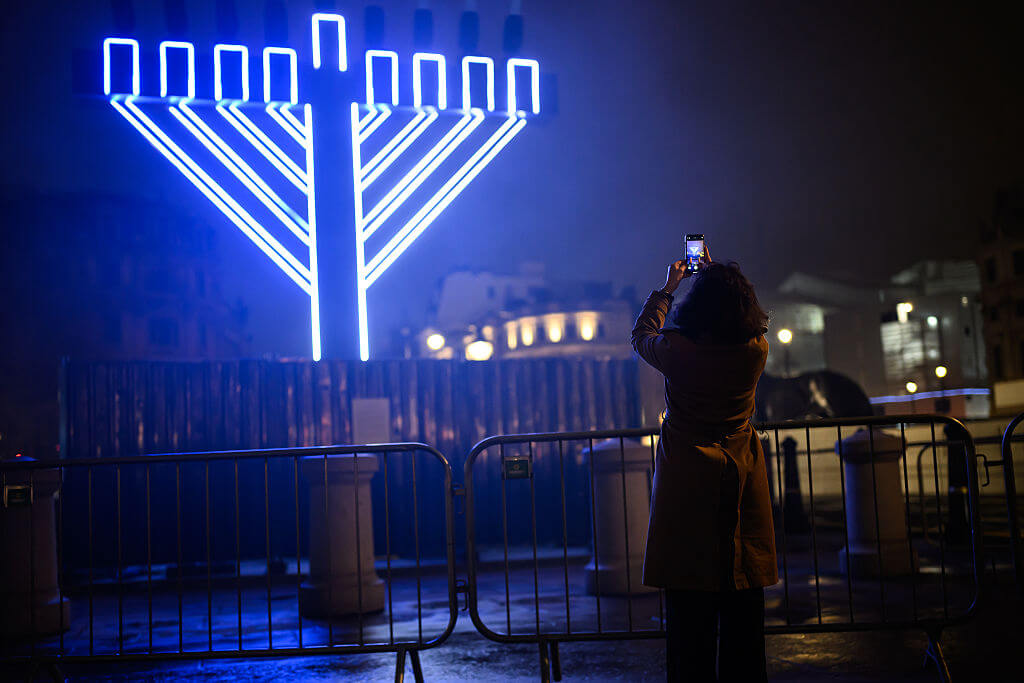
People stop to look at an illuminated Menorah during Hanukkah concert at Trafalgar Square in London on December 16. Photo by Leon Neal/Getty Images
Editor-at-Large Robin Washington December 17, 2025
In the backlash against Israel following the Oct. 7, 2023 Hamas terrorist attack, many American Jews put away Stars of David or avoided wearing yarmulkes in public, fearing they would be targeted in antisemitic violence. The burgeoning anti-Zionist protests on the left, coupled with emboldened right-wing antisemitism during the Trump years, shattered a sense of security that many Jews believed they had finally achieved in America.
But with antisemitism showing no sign of abating — most horrifically in the deadly Hanukkah attack at Bondi Beach in Australia on Sunday — the reticence among Jews to express their identity may be dissipating.
That renewed sense of empowerment and pride — even at some risk to personal safety — may open an opportunity to renew alliances with others committed to combating hate. Shoshana Brown, the co-founder of the Black Jewish Liberation Collective, says she would welcome the return of a Civil Rights Movement–style partnership between her Black and Jewish communities.
“The only people who reached out directly to me after Bondi Beach were two African American Muslim women who I have been doing anti-Islamophobia and anti-antisemitism work alongside of for over two years now,” Brown said.
In that time, mainstream Jewish organizations and white Jews generally (or “white-presenting,” since in recent years the idea of Jews as white is itself being re-examined) have focused on antisemitism to the exclusion of other anti-hate work, she said.
“They were all in for anti-Black racism and George Floyd and all that. But as soon as Oct. 7 happened, all the money, all the resources, everything turned to fighting antisemitism,” she said. “It’s like white Jews can’t walk and chew gum.”
Brown and other Black Jews point out that unlike their white sistren and brethren, they do not have the option of hiding their identity from those intent on spreading hate — with people who would attack Jews likely to be the same as those who would target Black people.
“I’m a woman, I’m Black, I’m an immigrant. I have an accent. Being a Jew is the least of my problems,” said longtime Boston publicist Colette Phillips.
Phillips, who converted to Judaism not long before the 2023 attack. “I wear my Magen David because I did not become Jewish to hide my Judaism,” she said using the Hebrew term for Star of David, adding, “If people have a problem with that, so be it.”
She too has noticed a re-embracing of Jewish identity, if only in a sampling of one.
“As a matter of fact, today, my fiancé — he happens to be white, Ashkenazi Jewish — wore his kippah, because, he said, ‘Look, you’re wearing your Magen David out.’”
Although there is no shortage of evidence that antisemitism has been rising in recent years, starkly in the 2018 Tree of Life Synagogue murders in Pittsburgh and Charlottesville’s 2017 Unite the Right rally, it remains difficult to measure precisely. Even the definition of what constitutes an antisemitic attack has been fiercely debated, with some arguing that protests against Zionism or Israel’s war in Gaza are not attacks on Jews for being Jewish.
And Jews find themselves on each side of that divide, with organizations like Jewish Voice for Peace among the strongest critics of Israel.
Brown said the split is also reflected in how Jews respond to adversity, with some anti-Zionist Jews nonetheless embracing their religiosity as others sought to hide it.
“I actually have seen that part of the Jewish community dig deeper into their Jewish roots,” she said. “More people wanting to be rabbis, more people wanting to do Torah study, more people wearing a kippah, more people looking to Jewish practice in hopes of finding interpretations” supporting their activism.
If antisemitism is difficult to measure, there is one constant regardless of how much it has increased: There was never a time it did not exist in America.
The same is true of racism.
Nicky McCatty, who has experienced both racism and antisemitism as a Black Jew, was a longtime Boston area resident before moving back to his childhood home of Brooklyn at the start of the pandemic.
There, he said, he noticed white people were no longer crossing the street as he walked toward them on the sidewalk. Maybe New Yorkers weren’t as racist.
Then he realized he was now using a walker, making his six-foot frame look more like five-six — meaning he was no longer the stereotypical scary Black man.
“I might not be catching some of the stuff that I otherwise would if I still looked like a strong 50-year-old,” said McCatty, who is 73 and wears a hamsa necklace and can hardly conceal his Blackness.
Like antisemitism, racism hadn’t gone away. And he wasn’t hiding anything.
A version of this first appeared in the Bay State Banner.