Why Poland’s president canceled his menorah lighting — and how the West helped make that happen
Ending the menorah lighting at Poland’s presidential palace isn’t a minor break with tradition — it’s the predictable result of years of accommodation with Holocaust distortion and antisemitism
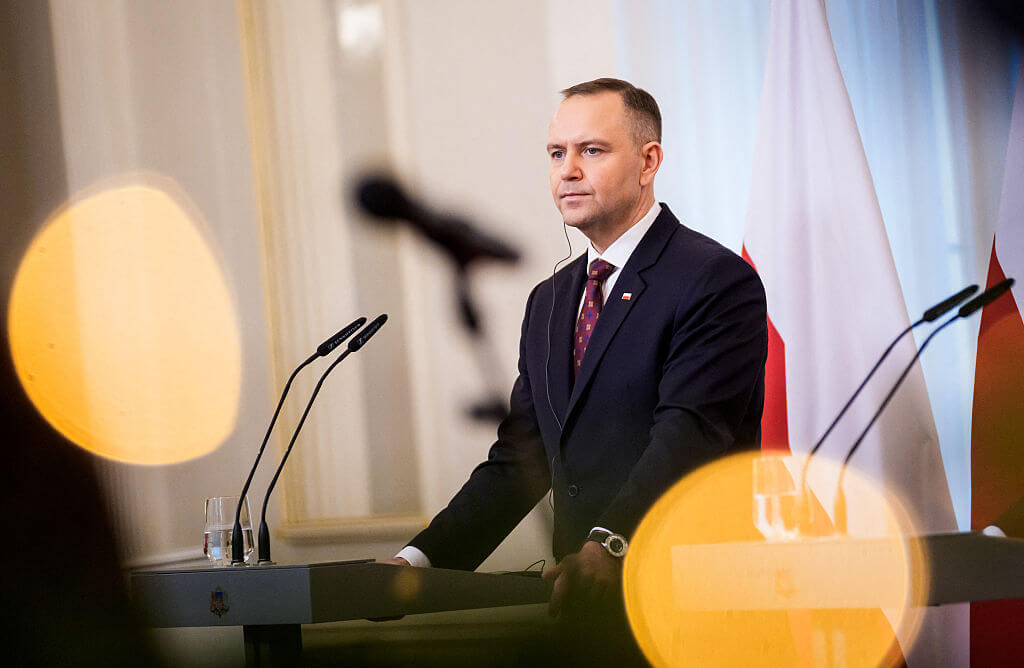
Poland’s President Karol Nawrocki at a news conference in Latvia on Dec. 11. Photo by Gints Ivuskans/AFP via Getty Images

Lev Golinkin December 18, 2025
As we grapple with the horrific massacre of Jews celebrating Hanukkah in Bondi Beach, Australia, another assault on a Jewish holiday tradition is occurring halfway across the world. It’s not violent, thankfully, but it sure is ominous.
This Hanukkah, the night is darker over Warsaw.
For the past decade, each December, a menorah burned in Poland’s presidential palace. It was a gesture of tolerance and interfaith friendship as well as a token of recognition for the 5 million Jews killed in Poland during the Holocaust.
But this Hanukkah, the candles remained unlit as Karol Nawrocki, the country’s new president, fulfilled a key campaign promise: end the menorah lighting.
“I take my attachment to Christian values seriously, so I celebrate holidays that are close to me as a person,” Nawrocki said, when explaining why he wouldn’t continue the tradition, a move seen as pandering to the country’s far right.
It’s never a good sign when a European leader rides to power by turning his back on Judaism. Unfortunately, Nawrocki’s decision is only the latest in a series of disturbing events. Last month, his political ally delivered a speech at the gates of Auschwitz, proclaiming “Poland is for Poles, not Jews.” Meanwhile, this July, plaques blaming murdered Jews for their fate were erected at the site of an infamous 1941 massacre.
It’s an astonishing turnaround for a country that only a few years ago was extolled as a paragon of Holocaust remembrance, but it didn’t come from nowhere. Indeed, it’s what happens when the West ignores warning signs of antisemitism in an ally.
Nawrocki became president this summer after beating a pro-EU opponent in a tight election. His candidacy alone raised alarm bells. A historian by trade, Nawrocki had supported legislation whitewashing the fact that some Poles killed Jews in the Holocaust; he also denounced respected scholars who brought up Poland’s dark past as purveyors of “disgusting attacks” on the country’s reputation.
Then came Nawrocki’s decision to ally himself with Grzergorz Braun, an openly antisemitic member of the European Parliament who’d accused Jews of controlling Poland and conducting ritual sacrifices of Christians. In 2023, Braun physically extinguished a menorah in the Polish parliament, proclaiming the sacred Jewish ceremony a “Satanic cult.”
In order to triumph in the extraordinarily close presidential election (the final vote was decided by less than 2 percentage points), Nawrocki courted Braun, turning the antisemitic firebrand into a kingmaker. In order to prove his bona fides to Braun’s supporters, Nawrocki said he would end the annual presidential menorah lightings.
Last month, several prominent figures, including Poland’s justice minister, decried Braun’s diatribe at Auschwitz. Nawrocki, however, has remained notably silent.
Western silence enabled this
How could such disquieting developments occur, especially in an EU and NATO member? Part of the reason has to do with a crucial mistake made by Israel and international Jewish groups.
In January 2018, Poland’s parliament passed a law making it a crime to accuse Poles of complicity in the Holocaust. This salvo against Holocaust remembrance triggered condemnations from the U.S. State Department, Israeli Prime Minister Benjamin Netanyahu, and Jewish organizations.
A few months later, Warsaw softened the law by making it a civil offense, reducing the penalty from imprisonment to a fine.
Netanyahu, eager to restore relations with Poland, touted the downgraded law as a victory; several Jewish groups joined him.
But the legislation itself, not the penalty, was the problem. Whether criminal or civil, Warsaw was still institutionalizing Holocaust revisionism, arming itself with a mechanism to persecute those who challenged its narrative.
The West essentially acquiesced to government-sponsored Holocaust distortion, as long as it didn’t carry prison time. Yehuda Bauer of Israel’s central Holocaust museum succinctly described this capitulation as a “betrayal.”
Is it any wonder Nawrocki felt emboldened to get in bed with an overt Holocaust denier, pledged to end menorah lightings, and had chosen to say nothing in response to Braun’s chilling anti-Jewish tirade two weeks ago? If we in the West stay silent, why shouldn’t he?
A menorah is merely a symbol, of course, but given the explosion of antisemitism across Europe, even a symbolic light would be welcome.
“To discontinue the tradition of lighting the Hanukkah candles by the President would mean to give in to the demands of antisemites and, more broadly, to further undermine the respect for minorities in Polish society,” Rafal Pankowski, a Warsaw-based political scientist and head of the Never Again anti-hate organization, told me.
There are still a few nights left in Hanukkah – perhaps there’s still time for Western leaders to ask Nawrocki to dispel the darkness. We could sure use it.
This is a moment of great uncertainty. Here’s what you can do about it.
We hope you appreciated this article. Before you go, we’d like to ask you to please support the Forward’s independent Jewish news this Passover. All donations are being matched by the Forward Board - up to $100,000.
This is a moment of great uncertainty for the news media, for the Jewish people, and for our sacred democracy. It is a time of confusion and declining trust in public institutions. An era in which we need humans to report facts, conduct investigations that hold power to account, tell stories that matter and share honest discourse on all that divides us.
With no paywall or subscriptions, the Forward is entirely supported by readers like you. Every dollar you give this Passover is invested in the future of the Forward — and telling the American Jewish story fully and fairly.
The Forward doesn’t rely on funding from institutions like governments or your local Jewish federation. There are thousands of readers like you who give us $18 or $36 or $100 each month or year.
Support our mission to tell the Jewish story fully and fairly.