An Israeli media mainstay is crumbling. Will liberal democracy go with it?
With a vote to close Army Radio, the cabinet takes yet another alarming antidemocratic step
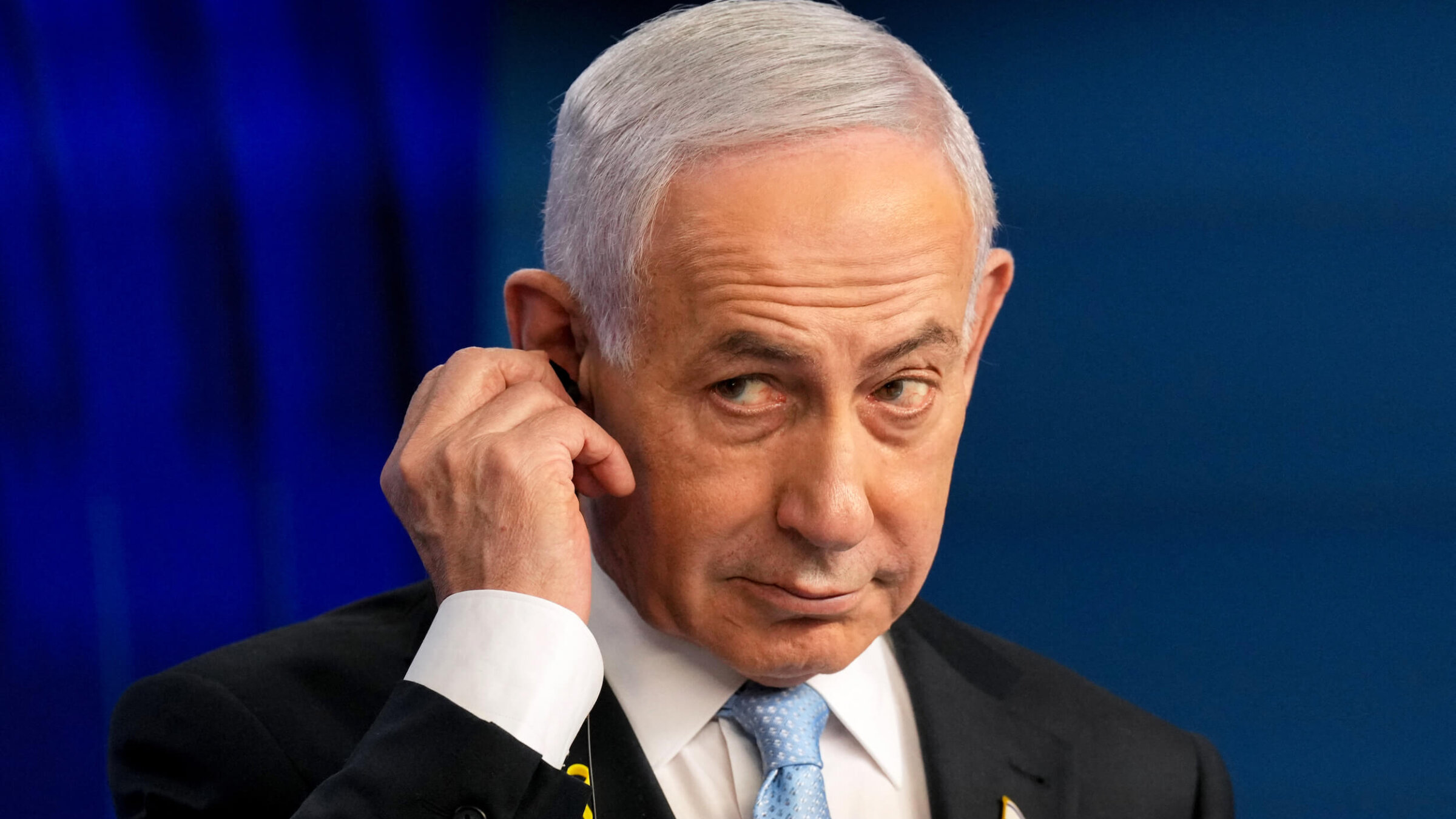
Israeli Prime Minister Benjamin Netanyahu in Jerusalem on Dec. 7. Photo by Ariel Schalit/Pool/AFP

Columnist Dan Perry December 24, 2025
The Israeli government has taken another alarming step in its efforts to crack down on the press by moving toward shutting down Army Radio, which reaches some 900,000 listeners a day.
A unanimous Monday cabinet vote to close the station is being sold as a matter of logic, efficiency and principle. Why, after all, should a military institution operate what has long functioned as a national news outlet? Why should soldiers be involved in journalism? Why should the army run a radio station that frequently criticizes the government and the defense establishment itself?
On the surface, those questions sound persuasive. In most democracies, such a setup would indeed raise eyebrows. Militaries are meant to fight wars; broadcasting current affairs, as Army Radio has since 1950, does not clearly serve that purpose. The independence of the press is a foundational democratic norm; there are good reasons to question whether a military-run outlet can uphold it. Strip away the Israeli context, and the case for closing Army Radio could sound like common sense.
But Israel is not an abstract political theory exercise. It is a specific country with a specific history, and Army Radio is a specific institution that plays a role no other outlet can fully replace. Its shuttering would be devastating. And the move to shut it down cannot be understood in isolation. It fits neatly into the broader campaign led by Prime Minister Benjamin Netanyahu to weaken, intimidate or take over every independent institution capable of producing criticism, accountability or resistance.
Army Radio is not just another broadcaster. It is one of only two national radio stations in Israel that produces comprehensive news coverage.
The other is Reshet Bet of Kan, the public broadcaster that itself has been under constant attack by this government, facing unceasing efforts to strip its funding. Eliminate Army Radio, and Israel’s radio news landscape will be reduced to a single vulnerable station — precisely the outcome critics of the government’s media policy have warned about for years.
Historically, Army Radio has been a cornerstone of Israel’s free press ecosystem. It has trained generations of journalists who later shaped the country’s media culture — some while serving as soldiers, others as civilian staff who stayed on for decades. Its newsroom culture helped normalize the idea that journalism’s role is not to flatter power, but to scrutinize it.
That tradition emerged because the Israel Defense Forces, uniquely among militaries, is a “people’s army,” rooted in near-universal conscription and embedded in society rather than standing apart from it. Israelis have long understood that a station staffed in part by conscripts from across the country — religious and secular, right and left, center and periphery — is not a mouthpiece in the classic sense. On the contrary, Army Radio often earned its reputation by irritating ministers, generals, and prime ministers alike.
That approach earned it broad public trust — the same kind of trust that once established the IDF’s legitimacy. Incredibly, the government is also trying to undermine that trust through constant feuding with the military brass, and a concerted effort to deflect all blame for the Oct. 7 meltdown on the military. (Both government and military certainly failed on that day.)
The effort to close Army Radio mirrors the government’s campaigns against the judiciary and the police, among many other targets. Each time, the strategy is the same: identify a real or arguable flaw in an institution that exercises independence from total government control, exaggerate it, and then use it to justify dismantling or weakening that institution.
Netanyahu’s goal — similar to the successful project led by President Vladimir Putin in Russia, and to ongoing efforts in Hungary and Turkey — is to transform Israel into a country with something close to an elected dictatorship. His arguments are never openly authoritarian, but rather procedural, managerial, technocratic — and therefore harder to resist.
Communications Minister Shlomo Karhi’s broader project to restructure, weaken, and politicize Israel’s media landscape, framed as deregulation and modernization, consistently moves in one direction: reducing independent oversight, centralizing power and increasing political leverage over broadcasters. Where takeover is possible, pressure is applied. Where it is not, closure becomes the solution. Army Radio, inconveniently independent and symbolically beloved, cannot be easily captured, pressured through advertisers, or quietly restructured. So it must be eliminated.
Public opposition to the move has been broad and intense, cutting across ideological lines. For many Israelis, Army Radio is not merely a broadcaster; it is part of the country’s civic fabric. Closing it feels less like reform and more like provocation — another deliberate escalation in an ongoing culture war designed to pit Israelis against one another.
That, too, is a feature, not a bug.
This government thrives on confrontation with institutions that command public trust. By attacking them, it forces citizens to choose sides, reframes resistance as elitism or sabotage, and mobilizes its base through grievance and the seductive argument that a government elected by a majority is always legitimate in its actions.
Army Radio, anomalous as it is, stands in the way of Netanyahu’s Putinization dreams. Its existence contradicts the idea that media must either align with power or be marginalized. It reminds Israelis that criticism from within the system is not treason but patriotism. And that is precisely what makes it intolerable to an increasingly illiberal government.
None of this requires romanticizing Army Radio or denying that its structure is unusual. Yes, a military-run news station is an oddity. Yes, in another country, reform might be justified. But democracies are not built by eliminating every anomaly. They are sustained by preserving institutions that work, even when they defy neat theoretical categories.
Israel does not need fewer trusted voices right now. It does not need another symbolic demolition of a shared civic institution. And it certainly does not need to hand its already embattled media landscape another blow on behalf of a government that does Israel devastating harm.
This is a moment of great uncertainty. Here’s what you can do about it.
We hope you appreciated this article. Before you go, we’d like to ask you to please support the Forward’s independent Jewish news this Passover. All donations are being matched by the Forward Board - up to $100,000.
This is a moment of great uncertainty for the news media, for the Jewish people, and for our sacred democracy. It is a time of confusion and declining trust in public institutions. An era in which we need humans to report facts, conduct investigations that hold power to account, tell stories that matter and share honest discourse on all that divides us.
With no paywall or subscriptions, the Forward is entirely supported by readers like you. Every dollar you give this Passover is invested in the future of the Forward — and telling the American Jewish story fully and fairly.
The Forward doesn’t rely on funding from institutions like governments or your local Jewish federation. There are thousands of readers like you who give us $18 or $36 or $100 each month or year.
Support our mission to tell the Jewish story fully and fairly.