‘Jesus is a Palestinian,’ claims a Times Square billboard. Um, not quite.
A new billboard in Times Square is misguided in dangerous ways
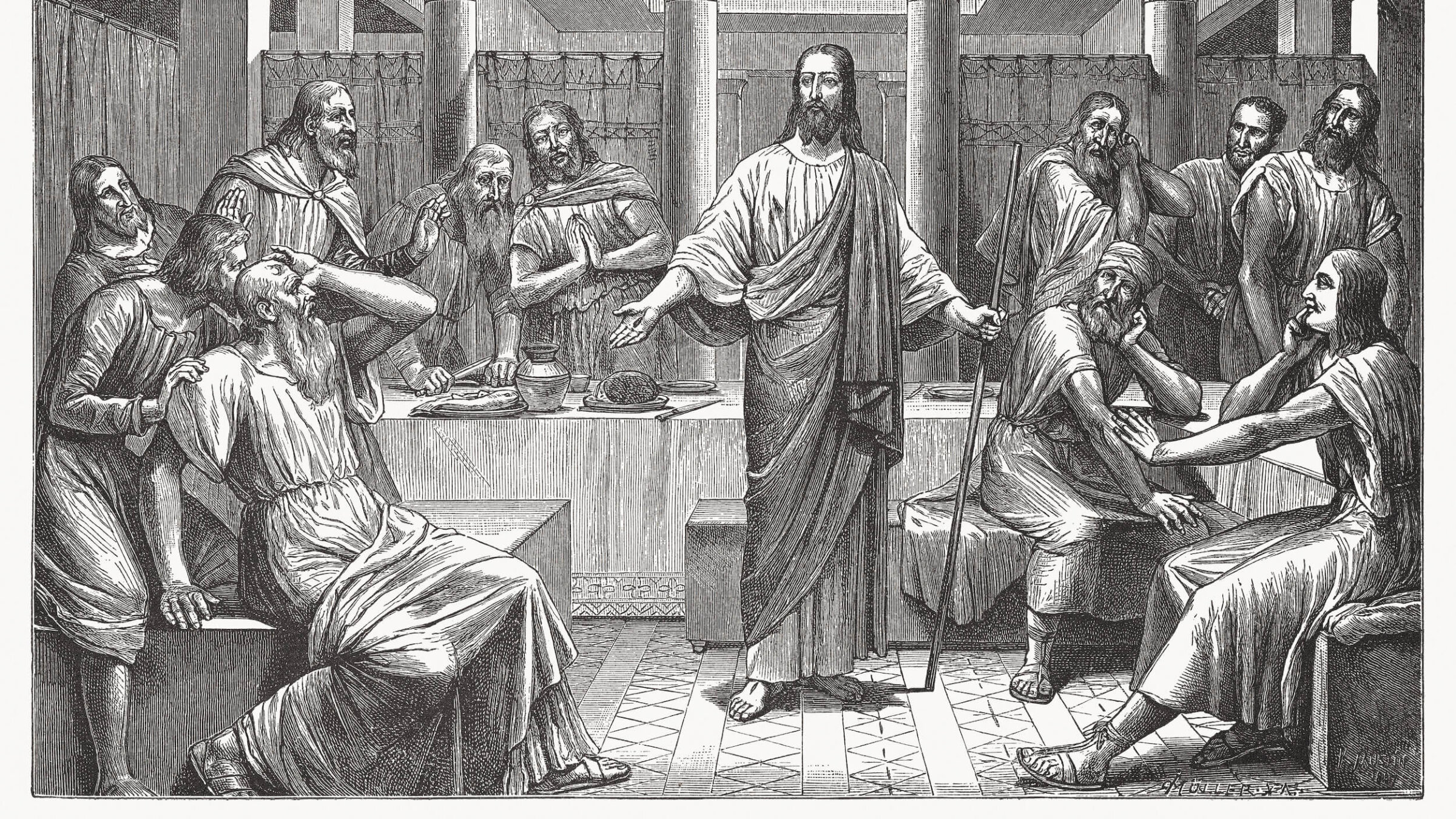
The resurrected Jesus appears to his disciples in a wood engraving after a drawing by Karl Jauslin by Ellen G. White, published by the Internationale Traktatgesellschaft ca. 1890. Courtesy of iStock by Getty Images

Rabbi Jeffrey K. Salkin December 26, 2025
“Merry Christmas,” proclaims a billboard in Times Square: “Jesus is Palestinian.”
Countless people will walk by the display or see it on social media, and many will believe it.
So, let’s go through why that statement is such a mistake, once again.
Jesus was a Jew. He was born to Jewish parents, was circumcised under Jewish law — traditionally, on Jan. 1, which is how that day became known as the Feast of the Circumcision — and lived as a Jew. He taught from the Hebrew Scriptures. He worshiped in the Jerusalem Temple. He observed Jewish festivals. He debated Jewish law with other Jews using Jewish modes of argument.
Go back to the Gospels in the New Testament — specifically Luke 4:16: “He went to Nazareth, where he had been brought up, and on the Sabbath day he went into the synagogue, as was his custom.” Or, John 4:9, in which a Samaritan woman asks Jesus: “How is it that you, a Jew, ask a drink of me, a woman of Samaria?”
Cross-reference other ancient sources. Josephus, a first-century Jewish historian, refers to Jesus as a Jewish figure executed in Judea. No serious historical study of Jesus elides this basic truth: Jesus was a Jew.
Yet many efforts through history have sought to sever Jesus from his Judaism — often, if not always, in an attempt to denigrate Jews.
In the second century, the theologian Marcion sought to completely sever Christianity from Judaism. For him, the God of Israel was inferior and the God of the Christians was morally superior. Jesus, therefore, belonged to a different moral universe. The early Church condemned Marcionism precisely because it erased Jesus’ Jewish roots, and ultimately dismissed the idea as a heresy that needed to be rejected.
In the twentieth century, Nazi theologians attempted to portray Jesus as Aryan and anti-Jewish, which Susannah Heschel documents in her book The Aryan Jesus: Christian Theologians and the Bible in Nazi Germany.
But it’s not just because of his religion that Jesus shouldn’t be considered Palestinian.
“Why not?” you might ask. “Didn’t he live in Palestine?”
The short answer is: Not yet.
When Jesus lived, the land of Israel was called Judea. It was under Roman rule, and it fell under several administrative districts: Judea, Galilee and Samaria.
So, what is the source of the name “Palestine” for that area? It comes from the ancient people known as the Philistines, a perennial enemy of the Israelites. After the Romans crushed Jewish independence, they deliberately renamed the province in an effort to sever Jewish historical ties to the land, as well as to humiliate them by naming the land after their ancient foes.
To call Jesus “Palestinian” is therefore anachronistic.
Yet even so, the idea of Jesus as Palestinian appears in some strands of Palestinian liberation theology. Those strands tend to envision the Palestinian people as Jesus on the cross — crucified by Israel and the Jews, in an image that recalls the longstanding and deeply misguided allegation that “the Jews killed Jesus.”
This language appears repeatedly in the writings and sermons of Naim Ateek, the influential founder of the Jerusalem-based Christian organization Sabeel. In his 2001 Easter message, he wrote, “as we approach Holy Week and Easter, the suffering of Jesus Christ at the hands of evil political and religious powers 2,000 years ago is lived out again in Palestine,” adding that “Jesus is the powerless Palestinian humiliated at a checkpoint, the woman trying to get through to the hospital for treatment, the young man whose dignity is trampled, the young student who cannot get to the university to study, the unemployed father who needs to find bread to feed his family; the list is tragically getting longer, and Jesus is there in their midst suffering with them.”
Yes, of course, Palestinians have suffered and continue to suffer. But illustrations of that suffering should not include the pretense that Jesus was Palestinian. It suggests that Palestinians need to be seen as akin to Jesus to deserve safety and dignity, when in fact they deserve safety and dignity simply because they are human. And casting Israel and the Jews as crucifiers only resurrects medieval theology and hatreds; it adds nothing to the hopes for justice for Palestinians.
Mainstream Christianity has rejected this foul mythology. We have recently celebrated the 60th anniversary of the Christian world’s most vociferous denial of that ancient hatred. In 1965, Vatican II’s Nostra Aetate explicitly rejected the charge that Jews are responsible for Jesus’ death. The World Council of Churches issued similar warnings about reviving Passion-based antisemitism — the revival of the ancient accusation that Jewish leaders were responsible for the crucifixion of Jesus, and that Jews bear that guilt eternally.
History matters. Theology matters. And words matter — especially when they carry 2,000 years of blood-soaked memory.
This is a moment of great uncertainty. Here’s what you can do about it.
We hope you appreciated this article. Before you go, we’d like to ask you to please support the Forward’s independent Jewish news this Passover. All donations are being matched by the Forward Board - up to $100,000.
This is a moment of great uncertainty for the news media, for the Jewish people, and for our sacred democracy. It is a time of confusion and declining trust in public institutions. An era in which we need humans to report facts, conduct investigations that hold power to account, tell stories that matter and share honest discourse on all that divides us.
With no paywall or subscriptions, the Forward is entirely supported by readers like you. Every dollar you give this Passover is invested in the future of the Forward — and telling the American Jewish story fully and fairly.
The Forward doesn’t rely on funding from institutions like governments or your local Jewish federation. There are thousands of readers like you who give us $18 or $36 or $100 each month or year.
Support our mission to tell the Jewish story fully and fairly.