A Jewish philosopher’s warnings expose the injustice of Trump’s attack on Venezuela
Michael Walzer’s ‘Just and Unjust Wars’ is as applicable to Venezuela as it was to Vietnam
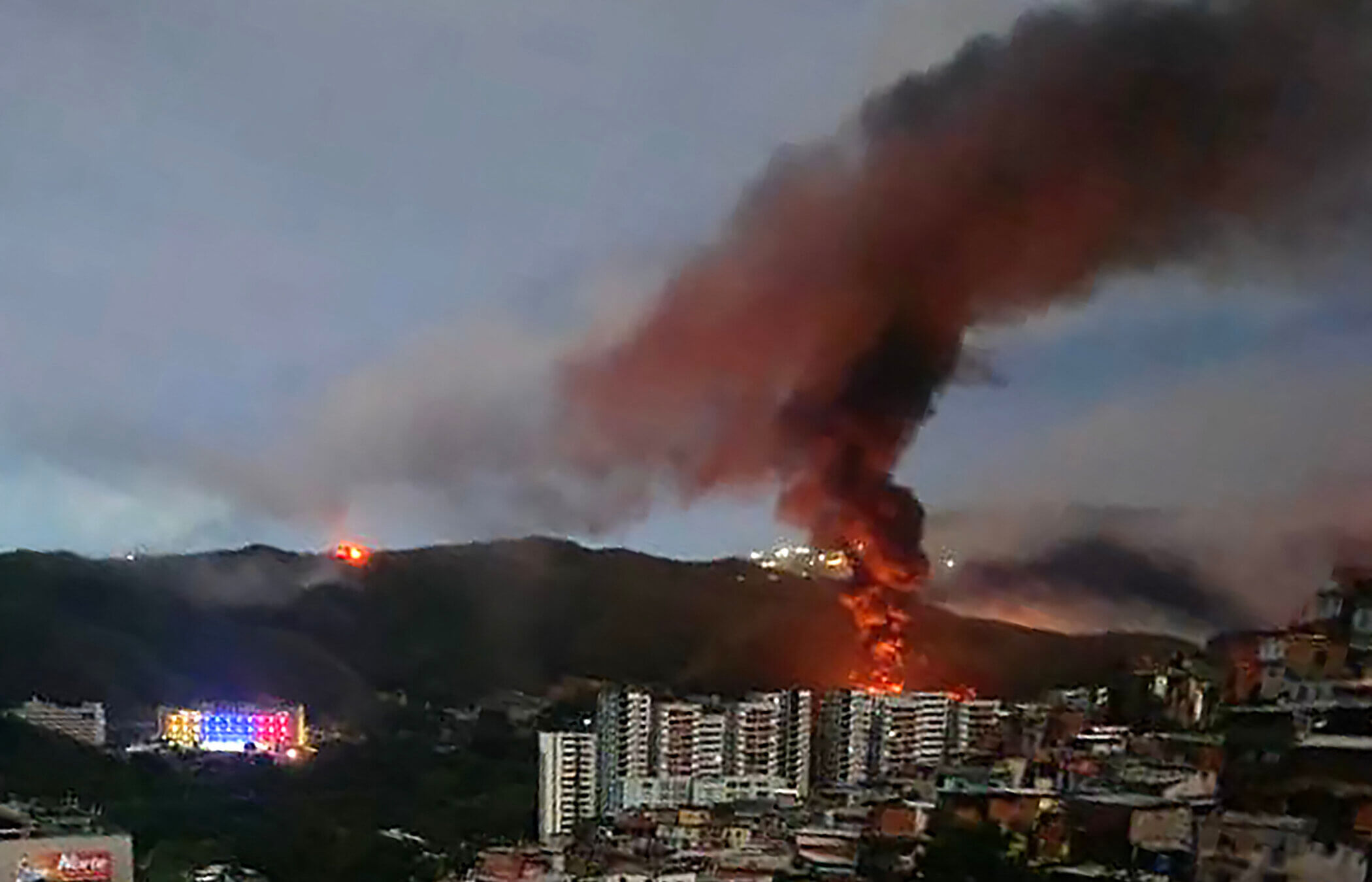
Fire at Fuerte Tiuna, Venezuela’s largest military complex, is seen from a distance after a series of explosions in Caracas Jan. 3. Photo by AFP via Getty Images
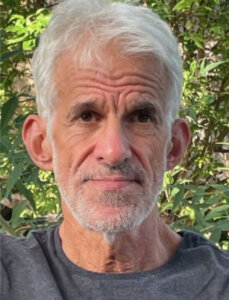
Robert Zaretsky January 5, 2026
“‘Emergency’ and ‘crisis’ are cant words, used to prepare our minds for acts of brutality. And yet there are such things as critical moments in the lives of men and women and in the history of states. Certainly, war is such a time: Every war is an emergency, every battle is a possible turning point. Fear and hysteria are always latent in combat, often real, and they press us forward toward fearful measures and criminal behavior.”
The political theorist and philosopher Michael Walzer wrote these words nearly 50 years ago in his brilliant Just and Unjust Wars. Though the book’s inspiration was the Vietnam War, its subsequent four editions — the fifth edition was published in 2015 — have shaped debates over the Gulf War, followed by the wars in Afghanistan and Iraq. Not surprisingly, both Walzer’s book, and Walzer himself, most recently became embroiled in the very public clashes over Israel’s actions in Gaza. (He has argued that the Israeli army has repeatedly violated the rules of proportionality.)
Should the 90-year-old Walzer ever write a preface to a sixth edition, he will surely reflect on President Donald Trump’s decision to bomb Iran’s nuclear sites last year and his order to attack Venezuela. Though I don’t know if Walzer would have anything to say about the president’s press conference, where he proclaimed the Monroe Doctrine had been supplanted by the “Donroe Doctrine,” I think I know how he would respond to the invasion itself.
Inter arma silent leges: In time of war the law is silent. What makes our time so unusual is that, since Trump returned to office a year ago, the law has been mostly silenced. This explains the nearly surreal quality to the countless discussions of the legal basis for the attack.
It is not that commentators are parsing the application of jus ad bellum (the justice of war) and jus in bello (justice in war) to Operation Absolute Resolve, but something simpler: Did Trump and his administration break American and international law — as with the attacks on the alleged drug boats — in their invasion of Venezuela? These discussions, however, resemble a madly pedaling cyclist who, convinced she is closing in on her destination, is sitting on a stationary bike.
Yet pedaling with Walzer might nevertheless cast some light on this topic. In his discussion of the justice of war and justice in war, he points out that it is “perfectly possible for a just war to be fought unjustly and for an unjust war to be fought in strict accordance with the rules.” With his gift of being uniquely lawless, Trump is fighting an unjust law in an unjust fashion. He asserts he will act as he wishes, justifies these acts by a logic all his own, dismisses constitutional obligations to seek consent from the U.S. Congress, and scorns the U.N. Charter’s obligation to marshal support from the international community.
As a result, our nation, along with the rest of the globe, finds itself saddled with a man who, in command of the world’s most powerful military, needs no reason to go to war. All he requires is the impulse to do so — impulses that were on full display during his press conference. During this spectacle direct from Mar-a-Lago, and whether in response to a question asked by a journalist or simply to an exhalation from his reptilian depths, Trump declared that Colombia’s president had better “watch his ass” and that “something’s going to have to be done with Mexico.”
Just a few days earlier, at 2:58 a.m., Trump posted yet another impulse on his Truth Social platform, warning that if “Iran shots [sic] and violently [as opposed to gently] kills peaceful protesters, which is their custom, the United States of America will come to their rescue. We are locked and loaded and ready to go. Thank you for your attention to this matter!”
No need to thank us: Of course you have our attention. How can you not when these “matters” envision acts of violence? In his chapter “The Crime of War,” Walzer reflects on an observation made by the 18th-century Prussian general and military theorist Carl von Clausewitz: “We can never introduce a modifying into the philosophy of war without committing an absurdity.” The very nature of war, Clausewitz argues, not only entails ever greater violence, but it also ends at every imaginable (and unimaginable) extreme.
This strips away all the euphemisms and weasel words, baring the pitiless unfolding of war. It is also why, as Walzer writes, “it is so awful to set the process going: The aggressor is responsible for all the consequences of the fighting he begins. In particular cases, it may not be possible to know these consequences in advance, but they are always potentially terrible.” But as we see with an administration that gleefully breaks law after law, then heedlessly breaks a government without plans for the day after, terrible consequences be damned.
This is a moment of great uncertainty. Here’s what you can do about it.
We hope you appreciated this article. Before you go, we’d like to ask you to please support the Forward’s independent Jewish news this Passover. All donations are being matched by the Forward Board - up to $100,000.
This is a moment of great uncertainty for the news media, for the Jewish people, and for our sacred democracy. It is a time of confusion and declining trust in public institutions. An era in which we need humans to report facts, conduct investigations that hold power to account, tell stories that matter and share honest discourse on all that divides us.
With no paywall or subscriptions, the Forward is entirely supported by readers like you. Every dollar you give this Passover is invested in the future of the Forward — and telling the American Jewish story fully and fairly.
The Forward doesn’t rely on funding from institutions like governments or your local Jewish federation. There are thousands of readers like you who give us $18 or $36 or $100 each month or year.
Support our mission to tell the Jewish story fully and fairly.