The ICE shooting in Minneapolis shattered my Holocaust survivor father’s American dream
The fatal shooting of Renée Nicole Good by an ICE agent has made terrifying family memories feel too close to reality
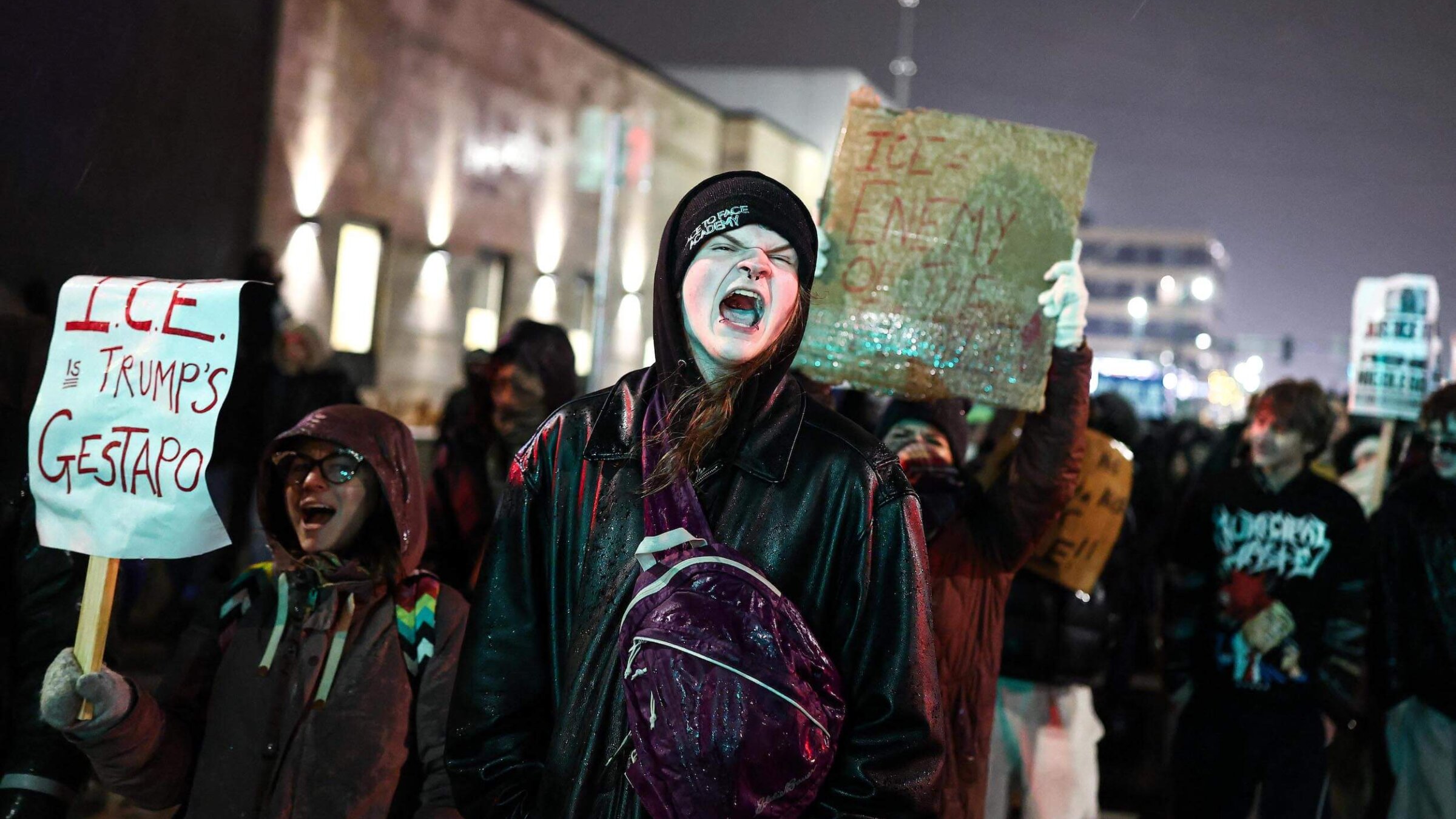
People march during a “Stop ICE Terror” emergency protest in Minneapolis Jan. 8. Photo by Charly Triballeau/AFP/Getty Images
Last fall, I visited a train platform in Zbaszyn, Poland, where my father saw his parents for the last time.
There, he and his brother boarded a Kindertransport to seek refuge in England in 1940. They survived the Holocaust; my grandparents and my aunt were murdered by Nazis. The years before that separation were marked by profound betrayals by the German government, which lied to them, their neighbors and the rest of the world about the violence being enacted against them, and what their future held.
I recalled that visit early Thursday morning, as I stood in front of the Whipple Federal Building in Minneapolis, less than a mile from Bdote — the unceded land, sacred to Minnesota’s Dakota people, where the Minnesota and Mississippi Rivers meet.
That land is where Minnesota’s earliest white settlers displaced, brutalized and killed the Dakota before building Fort Snelling, one of the first United States military outposts in the American West. Later, in 1862, the federal government set up a concentration camp in the same area. Some 1,600 Dakota were sent there, and hundreds died from disease and the harsh conditions.
Now, the thousands of ICE and Border Patrol agents sent by our federal government to terrorize Minneapolis gather and stage at the Whipple Building. And yesterday, an ICE agent named Jonathan Ross left that building, traveled a couple of miles west to South Minneapolis, and murdered Renée Nicole Good.
Good, 37, was a beloved community member. I didn’t know her, but I have friends who did. Their grief is devastating.
Renée was a treasured wife, they tell me. A mom to three children. A poet, an artist, and a community caretaker.
Her unjust death is horrific. And the resonances between our federal government’s bad faith response to it, and the kinds of stories I grew up hearing about the authoritarian government under which my father was raised, are terrifying.
Within hours of Good’s killing, President Donald Trump was spreading false claims about how it happened, claiming that Good ran over the ICE agent who shot her. Multiple video analyses have shown how inaccurate his words are. Homeland Security Secretary Kristi Noem claimed Good, who was driving at the time of shooting, was engaged in “domestic terrorism.” It has been sickening to hear these leaders not only desecrate Good’s memory, but also try to weaponize it to further energize their campaign against our immigrant neighbors and loved ones.
Like many American Jews, I was raised to believe in the American dream, and in a government that was here to represent me, care for me, and be a force for good in the world. And as the daughter of a Holocaust survivor, I always knew how fragile principles of liberty and equality can be.
I have known for a long time that the U.S. government has never equally defended the lives and rights of all people — and that it has too often, as in the case of the Dakota and other Indigenous Americans, actively destroyed those lives. But amid the Trump administration’s campaign against immigrant communities, it’s the tragedy of Good’s death that has most completely shattered the vision of what my Holocaust survivor father had taught me to hope for in the U.S.
Our current federal government lies to us, and lies about us. They blur the line between fact and fiction. They gaslight. They have specifically tried to foment discord within the Jewish community, and between us and our allies. They try to divide us because they’re afraid of the strength and power that we have when we rise up as one.
That is why we gathered at the Whipple Federal Building today to honor Good’s memory, and to protest ICE’s ongoing assault on our fellow Minnesotans. This is the place where some of our neighbors go to be detained, and never come back. Instead, they are deported — sometimes to countries where they have never before set foot — and ripped from those they love, just as my father was ripped from his parents.
As Jews, we remember our family histories not to make us fearful or to isolate ourselves, but rather to prepare us for moments just like this one. Our history is not meant to be forgotten. It is not meant to sit neatly on museum shelves or be tucked away in old family albums. We are meant to carry it. We are meant to learn from it. And we are meant to act because of it.
This is a moment of great uncertainty. Here’s what you can do about it.
We hope you appreciated this article. Before you go, we’d like to ask you to please support the Forward’s independent Jewish news this Passover. All donations are being matched by the Forward Board - up to $100,000.
This is a moment of great uncertainty for the news media, for the Jewish people, and for our sacred democracy. It is a time of confusion and declining trust in public institutions. An era in which we need humans to report facts, conduct investigations that hold power to account, tell stories that matter and share honest discourse on all that divides us.
With no paywall or subscriptions, the Forward is entirely supported by readers like you. Every dollar you give this Passover is invested in the future of the Forward — and telling the American Jewish story fully and fairly.
The Forward doesn’t rely on funding from institutions like governments or your local Jewish federation. There are thousands of readers like you who give us $18 or $36 or $100 each month or year.
Support our mission to tell the Jewish story fully and fairly.