In Trump’s ‘Donroe Doctrine,’ echoes of Nazi justifications for aggression
‘Lebensraum’ and ‘Gleichschaltung’ are words that seem right at home in the worldview that the Trump administration is espousing
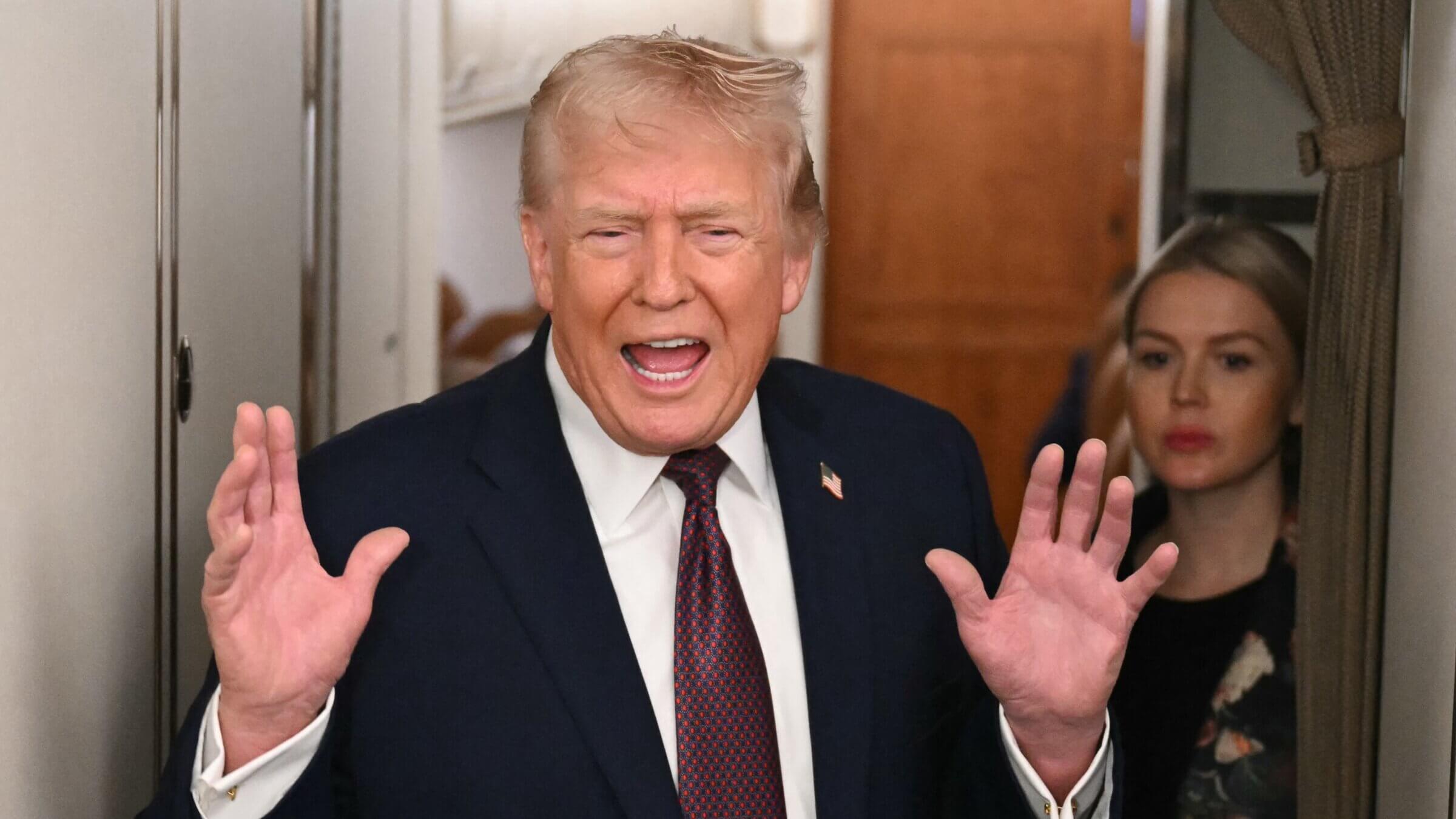
Donald Trump speaks to the press aboard Air Force One Jan. 11. Photo by Andrew Caballero-Reynolds/AFP via Getty Images
Terrence Petty January 14, 2026
When Adolf Hitler was justifying German aggression, he invoked Lebensraum — the claim that a superior nation had the right to expand into neighboring territories to secure the resources it needed. For Donald Trump, whose “Donroe Doctrine” seems to have much in common with the idea of Lebensraum, the prizes are Venezuelan crude, Greenland’s mineral wealth, and uncontested hegemony in the Western Hemisphere.
During the first year of Trump’s second term, the 47th president of the United States attempted his own version of what Germans call Gleichschaltung — the Nazis’ forced alignment of institutions and society with Hitler’s will. Trump moved to bend the federal bureaucracy, the intelligence services, the military chain of command, and the civil service into a single, obedient apparatus.
But unlike Hitler in 1933, Trump has run into real limits at home: courts that won’t bend, Democratic-led states that won’t yield, a resistance that keeps gathering strength, weak polling, and a MAGA movement that’s beginning to splinter. And so, he has shifted his gaze to the outside world — a pivot laid bare in Stephen Miller’s volcanic interview with Jake Tapper on CNN and in Trump’s own Oval Office conversation with New York Times reporters.
Sounding a bit like Joseph Goebbels, Hitler’s right-hand man, Trump’s deputy chief of staff told Tapper, “We live in a world in which you can talk all you want about international niceties and everything else, but we live in a world, in the real world … that is governed by strength, that is governed by force, that is governed by power.”
Two days after Miller’s bellicose comments, Trump echoed the same worldview in his interview with The Times: international law is whatever the United States — meaning he — decides it is.
“I don’t need international law,” he said. “I’m not looking to hurt people.”
Regarding his push for Greenland to become part of the U.S., Trump stated, “Ownership is very important. Because that’s what I feel is psychologically needed for success.’’
There are echoes here of Hitler, who wrote in Mein Kampf that “the stronger must dominate and not blend with the weaker.” In multiple speeches, Hitler made clear that the state’s own interests were supreme and that international law could be brushed aside.
Trump’s foreign policy for the Western Hemisphere comes right out of the authoritarian’s playbook for domination — threats of invasion, extortion, and exploitation of a country’s weaknesses to force that country to bend to the bullying country’s will.
When it comes to Venezuela, Trump, Miller, and Secretary of State Marco Rubio are counting on Delcy Rodríguez, interim leader after Trump’s kidnapping of President Nicolás Maduro, to cooperate with the Trump administration in reviving Venezuela’s oil industry — with oil-sales money going not just to America, but supposedly also to the Venezuelan people.
Trump said that Venezuela “will be turning over” between 30 and 50 million barrels of sanctioned oil to the U.S. “This Oil will be sold at its Market Price, and that money will be controlled by me, as President of the United States of America, to ensure it is used to benefit the people of Venezuela and the United States!” he declared in a Jan. 6 social media post.
“That money,” Rubio told reporters, “will then be handled in such a way that we will control how it is disbursed in a way that benefits the Venezuelan people, not corruption, not the regime, so we have a lot of leverage to move on the stabilization front.”
The American president has not hidden the fact that his motive all along has been to get control of Venezuela’s oil reserves. Only recently, and mostly as an afterthought, has Trump talked about eventually allowing new elections in Venezuela.
In Trump’s mind, at least, he is now dictator of Venezuela.
The Trump–Rubio game plan for Venezuela, as developed so far, hinges on U.S. control of Venezuelan oil as the lever for everything else: a Washington-run “stabilization” period in which the United States sells Venezuela’s crude, controls the revenue, and dictates the terms of economic reopening; a caretaker role for Delcy Rodríguez and the remaining bureaucracy to keep order and carry out U.S. directives; and, somewhere down the line, a vague promise of elections once the country has been reshaped to Washington’s liking.
But how realistic is this plan?
History offers plenty of warnings about how often great-power fantasies collide with the realities of occupation.
When Nazi Germany invaded Norway in 1940, one of its aims was to control Scandinavian resources — including Swedish iron ore and Norwegian shipping routes. Norwegian fascist Vidkun Quisling proclaimed himself head of the government, becoming a puppet of Berlin.
But Quisling never delivered the stability Berlin expected. His government was despised, resistance spread, and the occupation became far more volatile and costly than the Germans had planned. After the war, those who had collaborated with the Nazis paid dearly. Thousands of Norwegians were convicted and 25 — including Vidkun Quisling — were executed.
Venezuela is not Norway. But the assumption that a hand-picked local leader will quietly manage a country whose sovereignty has just been shattered is a dangerous one. Venezuela is thick with armed actors who may see cooperation with Washington as betrayal — heavily armed pro-government paramilitary groups called the colectivos, splintering factions of the military, and a constellation of irregular forces operating along the borders.
For the moment, Trump insists no American boots will be needed on the ground. But that could change quickly, especially if U.S. companies establish a significant presence at Venezuelan oil facilities and an insurgency threatens to topple what many Venezuelans may view as a collaborationist regime in Caracas.
In his interview with The New York Times, Trump said it could take years before Venezuela becomes the stable, petroleum powerhouse he envisions. Which means that U.S. control of Venezuela — however the White House chooses to describe it — will pass to whoever succeeds him as president.
Whatever the outcome of Trump’s Venezuela power grab, the troubles it will unleash may well persist far into the future. And if Trump continues to rattle sabers over Greenland, the consequences could be even direr, raising the specter of Denmark’s NATO allies mobilizing to defend the island against the ambitions of an American president.
This is a moment of great uncertainty. Here’s what you can do about it.
We hope you appreciated this article. Before you go, we’d like to ask you to please support the Forward’s independent Jewish news this Passover. All donations are being matched by the Forward Board - up to $100,000.
This is a moment of great uncertainty for the news media, for the Jewish people, and for our sacred democracy. It is a time of confusion and declining trust in public institutions. An era in which we need humans to report facts, conduct investigations that hold power to account, tell stories that matter and share honest discourse on all that divides us.
With no paywall or subscriptions, the Forward is entirely supported by readers like you. Every dollar you give this Passover is invested in the future of the Forward — and telling the American Jewish story fully and fairly.
The Forward doesn’t rely on funding from institutions like governments or your local Jewish federation. There are thousands of readers like you who give us $18 or $36 or $100 each month or year.
Support our mission to tell the Jewish story fully and fairly.