There’s a vicious antisemitic precedent for Trump’s demonization of Renée Nicole Good
What does George Soros have to do with the violence in Minneapolis? Good question.
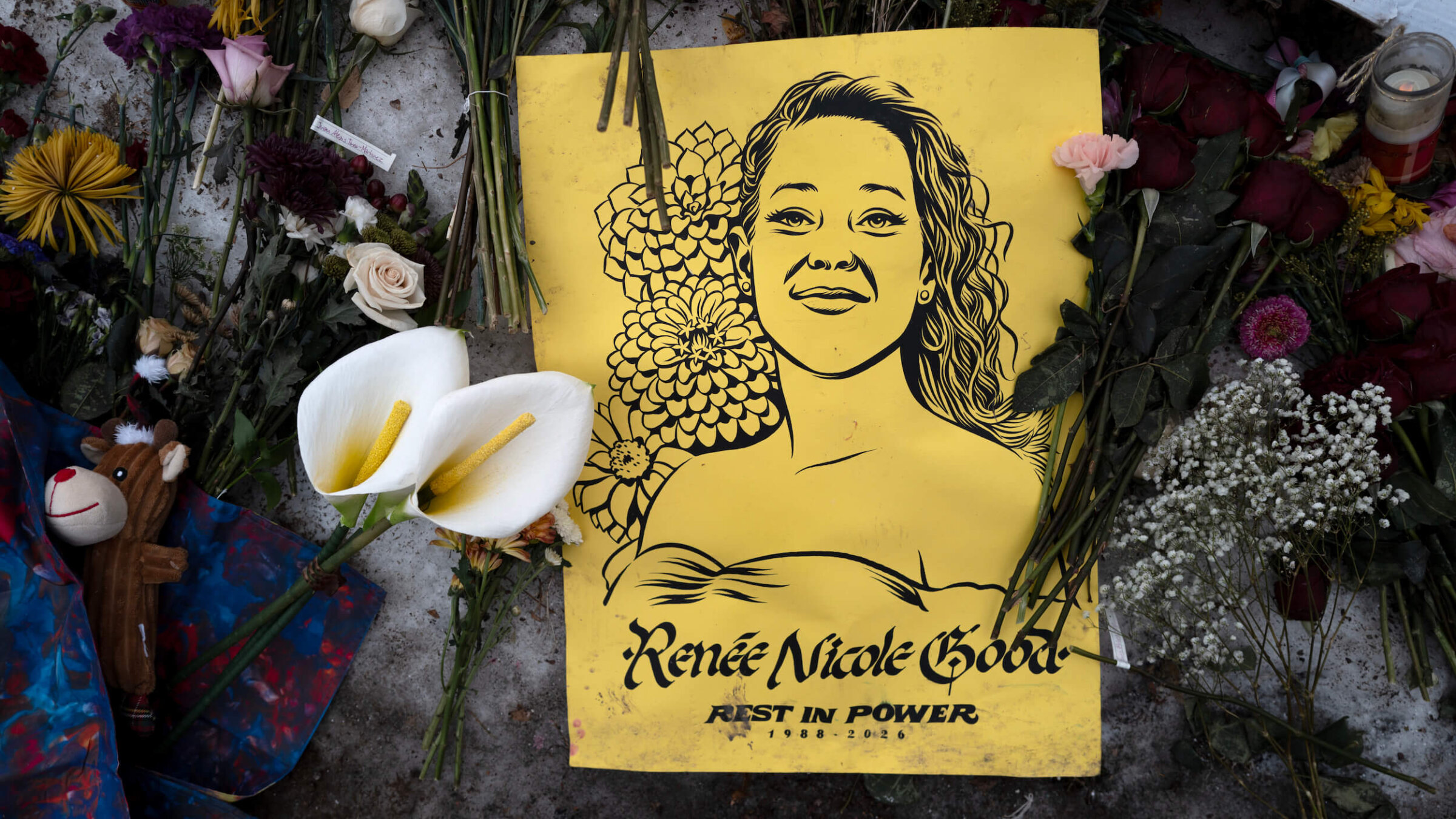
A portrait of Renée Nicole Good sits among other items at a memorial on Jan. 15. Photo by Scott Olson/Getty Images

Contributing Columnist Emily Tamkin January 19, 2026
There’s no reason to think that Renée Nicole Good — the woman shot and killed by an Immigration and Customs Enforcement agent in Minneapolis earlier this month — may have had ties to Jewish billionaire philanthropist George Soros.
Yet President Donald Trump’s administration is reportedly looking into establishing such a connection. And we know why. To understand, all we need to do is look at what happened in Hungary, Soros’ homeland, starting in 2015.
Before that year, conspiracy theories about Soros, the billionaire founder of the Open Society Foundations, had percolated around Central and Eastern Europe for decades. Soros was, after all, rich, famous, and Jewish, invested in both global finance and liberal philanthropy. It was almost too easy to allege that he had manipulated this or that election; that he was using nonprofits to establish a system of unelected international control; or even that he was the recipient of drug money.
But it was after a so-called “migration crisis” that hit Europe in 2015 that the conspiracy theories became something else entirely.
That year, Soros published an essay suggesting a radical rebuilding of the European Union’s asylum system. His ideas, which involved the EU accepting “at least a million asylum-seekers annually for the foreseeable future,” were presented by Prime Minister Viktor Orbán’s far-right Hungarian government as the “Soros plan” in a 2017 questionnaire, a “national consultation” to allow people to “have their say” about Soros’s proposal.
I do not believe that Orbán and company actually wanted to know what Hungarians thought of Soros’ opinion piece. Instead, I think they wanted to inflame a wave of anti-immigrant sentiment, with the side benefit of turning Soros into not just a scapegoat, but a figure seen as trying to transform everything that everyday Hungarians loved about their country.
In 2018, the Hungarian government came out with “Stop Soros” legislation, a series of laws that criminalized helping those trying to claim asylum. At the time, then-Interior Minister Sandor Pinter said the government wanted to use the “Stop Soros” campaign “to stop Hungary from becoming a country of immigrants.”
Similar attacks, alleging that Soros and his “empire” were trying to “organize” migration and get rid of Christians and conservatives, have continued for years.
Antisemitic conspiracy theories about immigration suggest that people with no real loyalty to any country — a version of the old antisemitic trope of “disloyal Jews” — are trying to use an influx of outsiders to take over a nation. And if politicians can get supporters to believe that, then they can use it to justify anything and everything.
Which is why it was so useful for Hungary’s government to make Soros, who has never held elected office and was not in a position to write Hungarian policy, the face of their campaign for an immigration crackdown. Once authorities convinced the populace that disloyal Jewish elites were trying to undermine their country by flooding it with migrants, what kinds of illiberal crackdowns wouldn’t that populace allow in their theoretical defense?
Generally speaking, conspiracy theories about Soros work because they allow politicians to fight the idea of an enemy — cosmopolitan, anti-national, elite and elitist — instead of dealing with the complexities of reality. And they work because antisemitism has come to be so inherent to a certain kind of cultural consciousness that politicians can take advantage of antisemitic word associations without ever saying “Jew.”
Centering antisemitic conspiracies around immigration specifically changes the stakes. It heightens the differences between “us” and “them.” It’s “us,” the true nationals, versus “them,” those who are not even from our nation and wish to corrode it. It becomes existential.
In other words: The potent mixture of antisemitism and anti-immigrant sentiment can persuade people to accept authoritarianism.
Trump appears to have studied this playbook well.
To much of Trump’s base, as to much of Orbán’s, it’s become natural to believe, or at least to assert, that individuals with no real loyalty to any nation are trying to degrade western countries from within.
We have seen that truth unfold in Minneapolis, in the protest-filled days since Good was killed. Some Republicans have alleged that those taking to the streets in protest are paid agitators; the implication, always, is that they are there to serve the agenda of some shadowy force intent on destabilizing society. The New York Post has pointed out that one NGO involved in protests in Minneapolis has previously received money from Soros’s Open Society Foundations, as if to suggest that Soros is that shadowy force. (To be clear, again, there is no evidence to support the assertion that protesters are out on the streets because Soros is paying them.)
The idea is that people are protesting not because they don’t want masked agents terrorizing their communities, or because they’re outraged that a woman was shot in the face and killed. That explanation doesn’t work for a government that wants to expand its campaign of aggression. Instead, these commentators want us to think that the only conceivable explanation for the protests is that they were paid for by someone with malicious ulterior motives.
We’ve seen Trump frame Soros as such a figure before. In 2018, for instance, Trump mused that perhaps Soros was responsible for a migrant caravan that had become a focus of right-wing fear and ire. And Trump has previously also claimed that Soros, through his philanthropic work, is seeking to undermine and undercut the United States, reportedly going so far as to push prosecutors to investigate Open Society Foundations, including, possibly, for terrorism.
This is the same combination — antisemitism and xenophobia; villainizing immigrants and attacking those who would help them — that proved so potent in Hungary. We don’t need to wonder what’s happening here. We know. We know what those in power are doing and we know why they’re doing it. The question that remains: What can we do in response?
This is a moment of great uncertainty. Here’s what you can do about it.
We hope you appreciated this article. Before you go, we’d like to ask you to please support the Forward’s independent Jewish news this Passover. All donations are being matched by the Forward Board - up to $100,000.
This is a moment of great uncertainty for the news media, for the Jewish people, and for our sacred democracy. It is a time of confusion and declining trust in public institutions. An era in which we need humans to report facts, conduct investigations that hold power to account, tell stories that matter and share honest discourse on all that divides us.
With no paywall or subscriptions, the Forward is entirely supported by readers like you. Every dollar you give this Passover is invested in the future of the Forward — and telling the American Jewish story fully and fairly.
The Forward doesn’t rely on funding from institutions like governments or your local Jewish federation. There are thousands of readers like you who give us $18 or $36 or $100 each month or year.
Support our mission to tell the Jewish story fully and fairly.