How Trump’s first year back in office destabilized our country — and our Jewish community
The president has established a roller coaster of a record on Israel, Iran, antisemitism and civil liberties in his first term
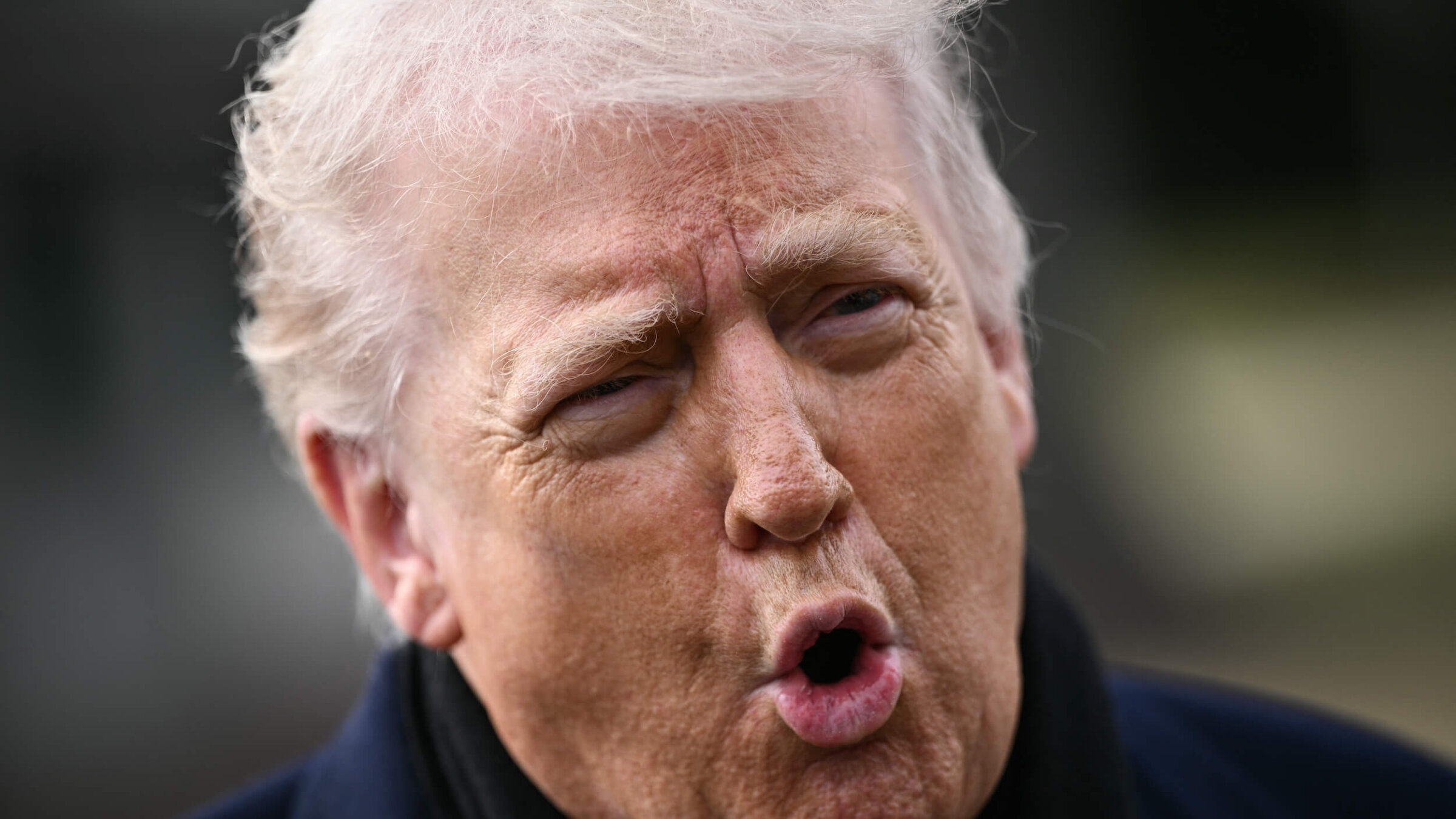
President Donald Trump on Jan. 16. Photo by Brendan Smialowski / AFP / Getty Images

Senior Columnist Rob Eshman January 20, 2026
One year into President Donald Trump’s second term, the American Jewish community is reeling — just like the rest of the country.
For generations now, presidents have at least paid lip service to steadying the ship of state. Trump has taken an axe to the mast.
And as he has destabilized the United States since being sworn into office on Jan. 20, 2025, he has destabilized American Jews.
To mark the end of Trump’s first year back in office, I looked at how a series of his policies and pronouncements have exaggerated already-deep divides in the Jewish community — and bewildered his supporters and detractors alike.
Rooting out antisemitism, or nurturing it?
Trump’s approach to addressing antisemitism has shuttled between a slap and embrace, deeply unbalancing American Jews.
He correctly called out intimidation tactics on college campuses, especially during the anti-Gaza War protests, that violated the civil rights of Jewish students — preventing them from accessing parts of campus or speaking out freely as other students.
But the measures he took against those universities, which included cutting off funding for unrelated research, deporting foreign students for exercising their First Amendment rights, and undermining laudable efforts at diversity, alienated Jews with legitimate concerns about campus antisemitism.
A May 2025 poll from GBAO Strategies reflected the disconnect.
Some 65% of younger Jews expressed concern over antisemitism on college campuses, and 71% said deporting campus protesters made that antisemitism worse.
Any relief Jews felt that Trump was addressing a long-festering problem quickly morphed into the concern that he was using it to carry out an ideological score-settling that had nothing to do with Jews, and that could ultimately backfire on them.
Meanwhile, there’s Tucker Carlson. The ideological Svengali of the GOP, Carlson has used his popular podcast to give a platform to neo-Nazis, push ever more intricate antisemitic conspiracy theories, and suggest that Jews were behind the assassination of Charlie Kirk.
And more recently, he’s provided a serious hint that Trump’s focus on antisemitism isn’t particularly earnest.
“I think we don’t need them,” Trump recently told the New York Times about antisemitic elements in the GOP. “I think we don’t like them.” He thinks, because, well, sometimes he apparently does need them: Carlson lunched twice at the White House this week.
For Trump, antisemitism appears not to be an absolute evil, but yet another issue to use to his political advantage. And as he’s gambled with our community, he’s brought more strife to it. Now, we battle one another over the question of whether Trump has been just what we needed — or the very worst thing that could have happened to us.
Triumph in Gaza, despair in Iran
In October, Trump forged a ceasefire and hostage deal in Gaza that pleased liberal Jews even as it upset many on the Jewish right with its tacit endorsement of an eventual two-state solution. He cashed in the goodwill he had banked with Israel, and, through incessant horsetrading with the Gulf States, leveraged a diplomatic breakthrough.
“He did something so many of us yearned for in the last two years, and he made it happen, and Biden didn’t make it happen,” Abraham Foxman, former CEO of the Anti-Defamation League, told JTA at the time.
Yet Trump started the year making promises to assert U.S. control in Gaza and turn it into a land of luxe resorts, to the horror of many liberal Jews. What can we make of the fact that he then turned around and accomplished a diplomatic feat that so many of us yearned for?
Even this week I find myself rooting for Trump — not something I normally do — to push through his idea of an international Board of Peace to oversee Gaza reconstruction, over the opposition of Israel’s Prime Minister Benjamin Netanyahu.
Yet at the same time Trump has worked for peace between Israelis and Palestinians, his Iran strategy now verges on incoherent, if not cruel. He joined with Israel in attacking and degrading Iranian missile and nuclear ability, and bragged that doing so stripped decades of progress from Tehran’s nuclear program, though evidence suggests the operation brought much more moderate success.
He then threatened to attack again, to stop Iran’s bloody crackdown on protesters who have swarmed the streets this month. That issue is particularly close to the hearts of many American Jews, both because of the Iranian regime’s vehement antagonism toward Israel, and because so many Jews here have roots in Iran and have personal or familial experiences of the regime’s brutality. Then he backed down, convinced, reports say, of Iran’s promise not to execute its political opponents.
“It is unconscionable to say ‘Help is on the way’ and then do nothing,” Elliott Abrams, a senior fellow at the Council on Foreign Relations and a former Iran envoy in the first Trump administration, told Jewish Insider. “I hope the president will change his mind.”
Yes, intervention is a tricky business. But to those American Jews who would see Trump take decisive action to change the status quo in the Middle East, his choice to step aside from this fight seems baffling. And for all of us, it raises questions: Does he actually have a long-term vision for the region, and if so, is he able to commit to a path to deliver it?
The Minneapolis worry
The May GBAO survey found that 74% of American Jews disapproved of the job Trump was doing in office. That was five months into office, before the Gaza deal, but also before — the rest.
Signals differ about where, exactly, Trump stands in American Jewish public opinion. But there are some leading indicators, and they all center around Minneapolis.
The killing this month of Renée Nicole Good by an Immigration and Customs Enforcement agent there; Trump’s knee-jerk defense of the shooting; and his decision to flood the city with more ICE agents prompted a rare attack ad from the American Israel Public Affairs Committee, which does not normally weigh in on issues unconnected to, well, Israel.
The ad criticized former Democratic Rep. Tom Malinowski, who is running in a Feb. 5 primary for the House seat vacated by New Jersey Governor-elect Mikie Sherrill, for voting in favor of more ICE funding in a bipartisan 2019 border bill.
“We can’t trust Tom Malinowski” to stand up to Trump over ICE, said the ad.
Even if it was a cynical use of an issue to undermine a candidate AIPAC may oppose for other reasons — Malinowski is a former director of the nonprofit Human Rights Watch, which accused Israel of apartheid — AIPAC correctly understands how American Jews feel about Trump’s use of ICE: worried sick.
The abuse of state power, the breach in civil liberties, and the atmosphere of intimidation echoes some of the darkest times in Jewish history.
Nothing in Trump’s response to the situation — or his past efforts to engage with civil protest — suggests he will work to calm the situation, back down, or change the approach to international and domestic affairs that has unsettled Americans and American Jews.
And that suggests the most disorienting fact of all, for Jews as for all other Americans: There’s still three years left.
This is a moment of great uncertainty. Here’s what you can do about it.
We hope you appreciated this article. Before you go, we’d like to ask you to please support the Forward’s independent Jewish news this Passover. All donations are being matched by the Forward Board - up to $100,000.
This is a moment of great uncertainty for the news media, for the Jewish people, and for our sacred democracy. It is a time of confusion and declining trust in public institutions. An era in which we need humans to report facts, conduct investigations that hold power to account, tell stories that matter and share honest discourse on all that divides us.
With no paywall or subscriptions, the Forward is entirely supported by readers like you. Every dollar you give this Passover is invested in the future of the Forward — and telling the American Jewish story fully and fairly.
The Forward doesn’t rely on funding from institutions like governments or your local Jewish federation. There are thousands of readers like you who give us $18 or $36 or $100 each month or year.
Support our mission to tell the Jewish story fully and fairly.