Drunk with power, Donald Trump follows the dictates of Athenian commanders — and a certain Jewish philosopher
For both Athenians and Americans, acts of hubris lead inevitably to great tragedy
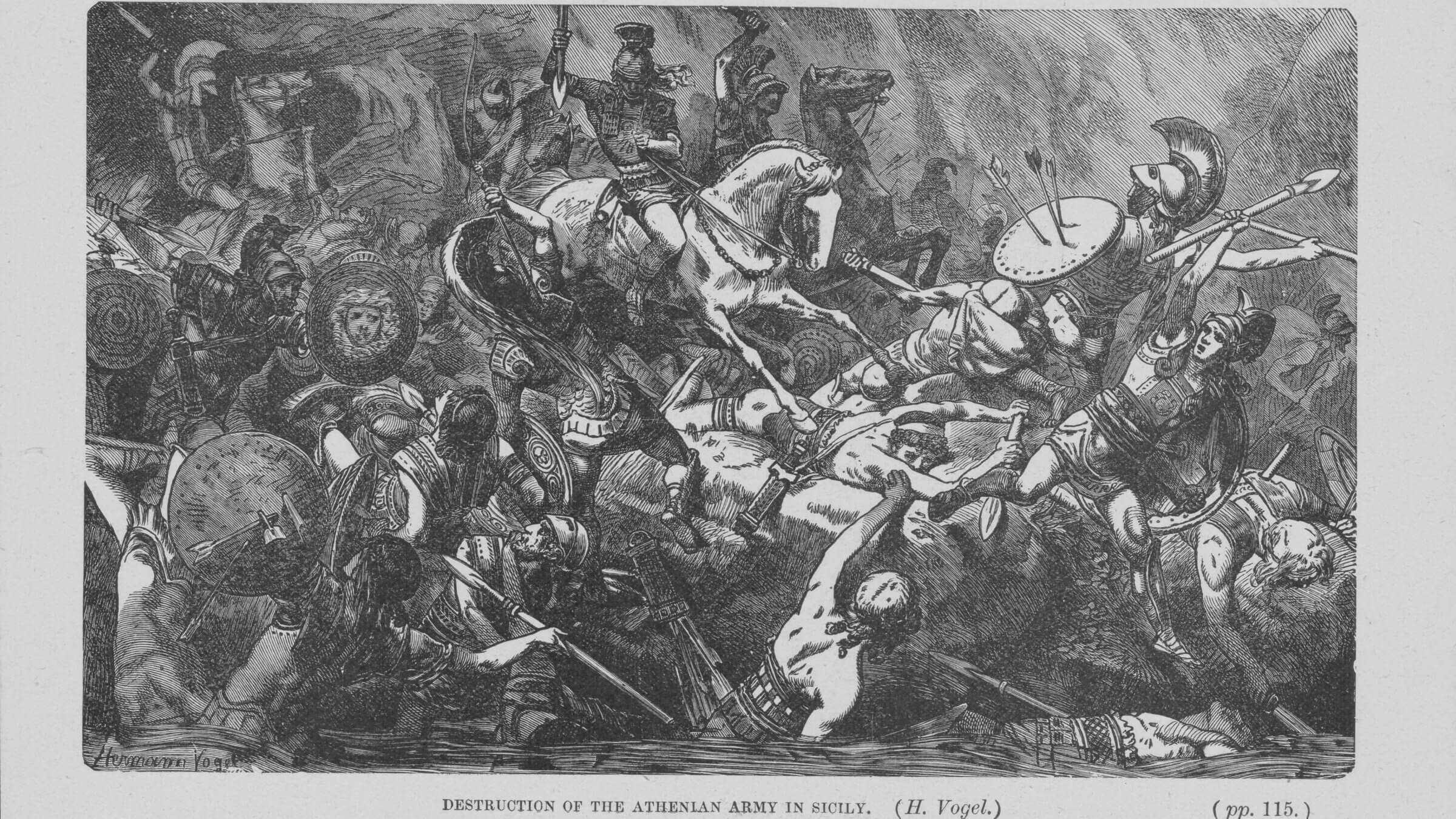
Engraving depicting the destruction of the Athenian army in Sicily, during the Peloponnesian War, circa 431-404 BC. Photo by Archive Photos/Getty Images
Robert Zaretsky January 25, 2026
The strong do what they can, the weak suffer what they must.
This phrase has been invoked by political pundits and leaders, including the Canadian Prime Minister Mark Carney, over the past few days as the world was plunged into Donald Trump’s fever dream of the conquest of Greenland. Yet what they neglected to mention is the quotation’s source and context in which it was uttered.
But both are crucial if we are to fully appreciate the troubling relevance of the phrase and the somber light the German-Jewish thinker Leo Strauss cast on it.
The phrase first crops up in the History of the Peloponnesian War, the ancient Athenian historian Thucydides’ account of one of the most consequential events in the history of the West. In the midst of their war against Sparta, an Athenian fleet lands on the small island of Melos, which they have been ordered to annex or annihilate. The dialogue that follows is entirely the creation of Thucydides, who strips away what he believed were the pleasant fictions we tell to blind ourselves to the reality of human nature.
Despite the Melian delegation’s appeals, the Athenian commanders are unmoved. “Nature always compels men to rule over anyone they can control,” they tell the Melians.“We did not make this law…but we will take it as we found it and leave it to posterity forever, because we know that you would do the same if you had our power as would anyone else.”
Yet the Athenians are tragically blind to the corollary: Human beings will always resist and rebel against those who try to invade them. When the Melians refused to submit, the Athenians were as good as their word; upon breaching the city walls, they slaughtered the men and sold the women and children into slavery. Shortly later, full of their conviction that might makes right, the Athenians decide to invade Sicily — an act of hubris which leads to a catastrophic defeat and a fate like the one they meted out to the Melians.
These world-altering events bring us to Leo Strauss, the man who Harold Bloom once described as a “political philosopher and Hebraic sage.” Born into an Orthodox Jewish family in 1899, by the 1930’s Strauss had won the reputation as a brilliant and not always orthodox political theorist. With the rise of Nazism, Bloom had the means and foresight to quit his native country in 1937. He became something of an itinerant intellectual, finding a series of academic appointments at Columbia University, University of Chicago, and the New School while writing many of his best-known books, including Natural Right and History and Thoughts on Machiavelli.
Over time, Strauss also became known as the éminence grise of neo-conservatism, the hawkish postwar ideology that viewed foreign policy through the harsh lens of political realism and has been credited with influencing the Bush Administration’s cataclysmic decision to invade Iraq. For his critics, it hardly helped that Strauss was influenced by the writings of the Nazi-adjacent and antisemitic legal theorist Carl Schmitt, who favored strong executive authority and believed that the politics of a nation and policies of the state must respond to the distinction between friend and enemy.
An advocate of “reading between the lines,” Strauss basically sets the traditional interpretation of Thucydides and the significance of the Melian dialogue on its head. Most students of Thucydides believe he sides with Pericles, the Athenian leader who, in his famous funeral oration, declares his city as the school for all of Greece. And why not? Thanks to its openness to ideas and debate, Athens excelled in the arts and sciences. No less important, thanks to its sense of civic responsibility, the city’s citizen army excelled in military prowess and power.
That this shining example of democracy should, at the end of a two-decade war, have been defeated and occupied by brutish if not barbaric Sparta marks one of history’s great tragedies. And yet, Strauss suggests we misunderstand the nature of the tragedy. The Periclean vision is inspiring, he allows, but it was also the reason why Athens lost the war. Strauss claims that Thucydides knew this as well. Just like his contemporary Plato, the ancient historian instead thought the best of all models was the closed society of Sparta rather than the open society of Athens.
By “best,” what Strauss meant is that cities like Sparta are best positioned to maintain the endurance and stability of the state and those who look to it for their security. In turn, this requires such states to embrace what he called the “Athenian thesis” which boils down to the claim made by the Athenian commander at Melos: The strong, indifferent to justice or moderation, do what they can while the weak suffer what is meted out to them. After all, Athens was itself an expanding empire that absorbed other cities into its alliance whether they wished to join or not.
Of course, we have no idea what Strauss would have thought about Donald Trump’s efforts to slap tariffs on islands inhabited only by penguins and annex other islands inhabited by people who have made clear they have no desire to become American. But I suspect that Strauss would remind us that the relentless pursuit of power and property is not unique to narcissistic sociopaths. Instead, states are almost always and necessarily driven by the will to expand. And therein lies the true tragedy.
This is a moment of great uncertainty. Here’s what you can do about it.
We hope you appreciated this article. Before you go, we’d like to ask you to please support the Forward’s independent Jewish news this Passover. All donations are being matched by the Forward Board - up to $100,000.
This is a moment of great uncertainty for the news media, for the Jewish people, and for our sacred democracy. It is a time of confusion and declining trust in public institutions. An era in which we need humans to report facts, conduct investigations that hold power to account, tell stories that matter and share honest discourse on all that divides us.
With no paywall or subscriptions, the Forward is entirely supported by readers like you. Every dollar you give this Passover is invested in the future of the Forward — and telling the American Jewish story fully and fairly.
The Forward doesn’t rely on funding from institutions like governments or your local Jewish federation. There are thousands of readers like you who give us $18 or $36 or $100 each month or year.
Support our mission to tell the Jewish story fully and fairly.