What an antisemitic conspiracy theory and the Alex Pretti killing have in common
In Minnesota and Argentina, ideology overpowers evidence
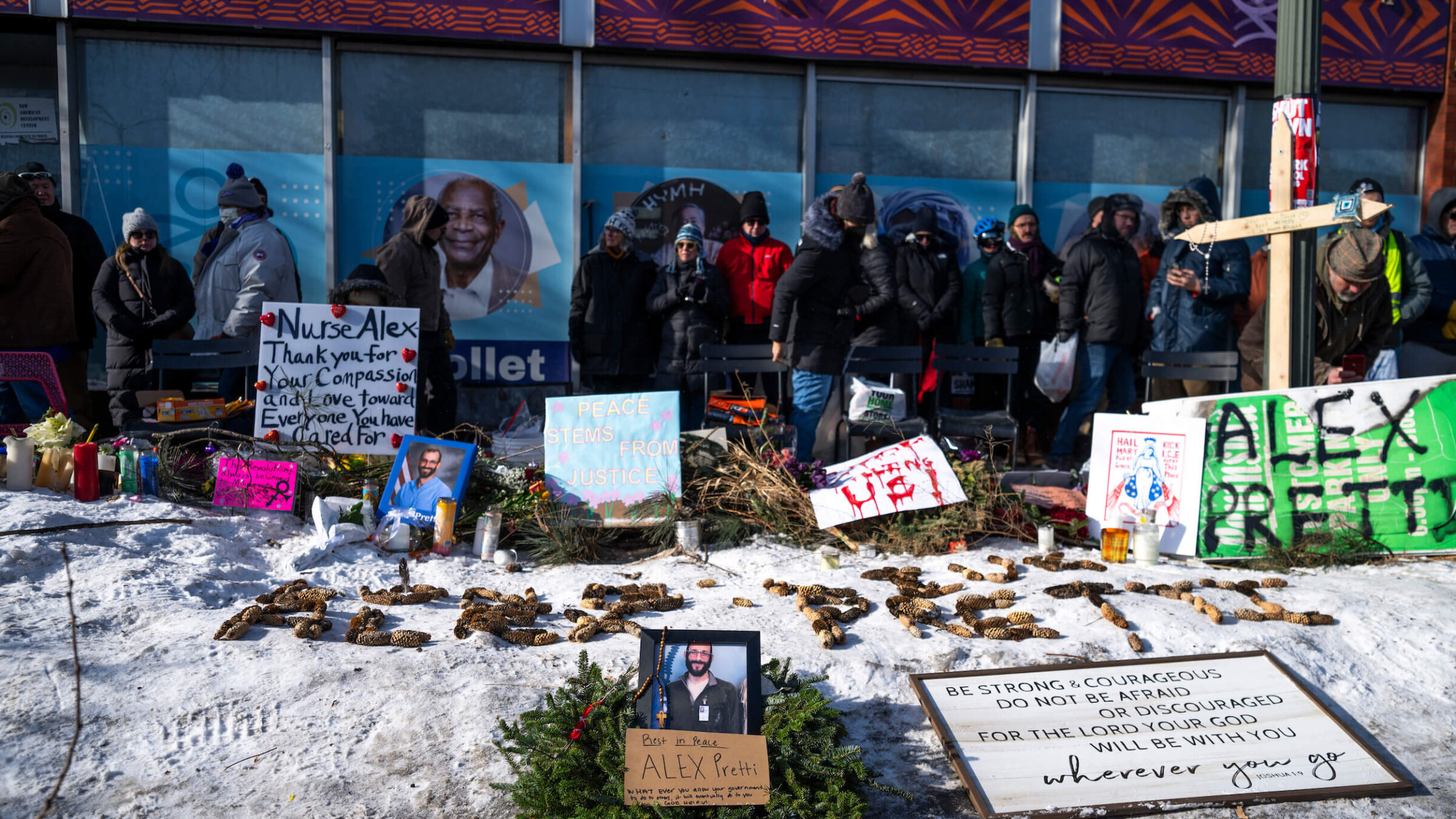
People gather during a vigil held by healthcare workers at a memorial for Alex Pretti on Jan. 25 in Minneapolis, Minnesota. Photo by Stephen Maturen/Getty Images

Senior Columnist Rob Eshman January 26, 2026
The night after Border Patrol agents shot and killed Alex Pretti in Minneapolis, as federal officials continued to spread lies about what happened, a friend asked me for advice on another disturbing instance of misinformation. What she should say, she asked, to a colleague who is posting antisemitic conspiracy theories about last month’s wildfires in Argentina.
That conundrum was related to the horror of our government trying to blame an innocent man for his own murder, I told her. And democracy, our very society, depends on figuring what to do about both.
In both cases, there’s a stubborn refusal to admit reality. Blinded by hate, suspicion or party loyalty, and locked in hermetically sealed media silos, people blame phantoms — in the case of Argentina — or the actual victims — as in Minneapolis — for the ills of our world.
And with each rejection, each accusation, society bends a bit more toward breaking.
In Argentina, after fires ravaged some 3,000 acres earlier this month, retired military general César Milani and others blamed the blazes on Israel.
My friend’s colleague was one of the many thousands of social media posters who spread those accusations, convinced that Israelis in Patagonia deliberately started the fires in order to clear the way for Zionist settlement.
Nothing my friend could say — that authorities had not determined the cause, that the Argentine government itself said the “Zionist fire” accusations were baseless — could convince her colleague otherwise.
“She would just tell me, ‘That’s what they want you to believe,’” my friend said. “What could I say to that?”
I wish I knew. Because all weekend I despaired seeing the same dynamic at work in the United States, in even more tragic circumstances.
Video footage, eyewitnesses and expert analysis show that Border Police shot Pretti multiple times, after they threw him to the ground and removed a holstered firearm he was legally carrying. Videos show that Pretti, who had been using his iPhone to film Border Police and ICE agents, had run to help a woman whom the federal agents had shoved down.
Anyone who takes the time to look and listen to the evidence can agree on what happened. Or so you would think.
Yet many federal officials, including President Donald Trump and Secretary of Homeland Security Kristi Noem, suggested that the real victims were the agents who killed Pretti.
Stephen Miller, Trump’s senior aide, called Pretti “a domestic terrorist.” Gregory Bovino, the official in charge of Border Patrol operations, said Pretti sought to “massacre law enforcement.” (Federal officials used very similar language to describe Renée Good, an unarmed mother whom ICE agents shot and killed earlier this month, after her death.)
Pretti “allegedly tried to pull out a firearm,” reported the resolutely pro-Trump OneAmerica News — ignoring the fact, clear in videos of the incident, that it was agents who removed his firearm from his holster, and agents who shot him after.
As with the Argentine fires, these were the accusations that ricocheted across social media, where posters accused Pretti — with zero evidence — of being an agitator paid for by Jewish Hungarian-born billionaire George Soros.
“Pretti was unalived” — online slang for “killed” — “by federal law enforcement officers who were defending themselves from being murdered by a deranged, Soros-paid terrorist,” was one of the typical, depressing posts to pop up in my feed this weekend.
At least in Argentina the government issued a statement debunking the Zionist arson claim, after an investigation found it was baseless.
In the U.S., a full, fair inquiry into Pretti’s death may shed more light on why the killing occurred. But despite some Republican lawmaker’s calls for a joint federal and state investigation, the federal government is so far doing what it did after the Good’s killing: shutting state authorities out and focusing on the actions of the victims, not the shooter. Three days ago an FBI agent assigned to investigate Good’s death resigned after the Department of Justice pressured her to drop her investigation into the agent behind the shooting.
And so a senseless death that could provide a moment of national reckoning, even reconciliation, will be mourned by many Americans in justifiable outrage. But for others, nothing will penetrate their conviction that Alex Pretti was guilty of provoking his own murder.
The historical record provides little hope that people so locked into a point of view shaped by misinformation can ever change their minds.
I always assumed that the public understanding of the Kent State University shootings, on May 4, 1970, was a matter of settled history: Ohio National Guard troops opened fire on peaceful protesting college students, killing four, and we all knew it was an unjustifiable massacre.
But revisiting that history in the wake of Pretti’s death, I discovered that was far from the truth.
“There was still that sentiment out there that they should have shot more students,” Dean Kahler, a former Kent State protester permanently paralyzed after a National Guardsman’s bullet severed his lower spine, told NPR in 2020, “that they should’ve killed more people.”
And long before Kent State, there was Captain Alfred Dreyfus, the French Jewish officer accused of treason in 1894 and later fully exonerated, in a case that divided France to the brink of civil war.
Ever since, a succession of right-wing elements in France have stuck to their belief in Dreyfus’ guilt. In 2021, the French lawyer Germain Latour said French antisemites suffered from an “epidemic of mental cholera” that prevented them from accepting the truth.
I wish I hadn’t had to tell my friend that it’s hard, if not impossible, to crack open every closed mind. But I did. My friend’s colleague will likely never stop believing Israel burned Argentina. Pretti’s killers will continue to have millions of defenders who will never see what to most of us is obvious.
Both stories follow the same script: reality conflicts with ideology, so reality gets discarded.
What matters more is that the people who care about finding and defending the facts push their institutions — courts, media, academia, clergy — to do the same. It is, to borrow a recent movie title, one battle after another. But for Alex Pretti’s sake, we cannot quit.
This is a moment of great uncertainty. Here’s what you can do about it.
We hope you appreciated this article. Before you go, we’d like to ask you to please support the Forward’s independent Jewish news this Passover. All donations are being matched by the Forward Board - up to $100,000.
This is a moment of great uncertainty for the news media, for the Jewish people, and for our sacred democracy. It is a time of confusion and declining trust in public institutions. An era in which we need humans to report facts, conduct investigations that hold power to account, tell stories that matter and share honest discourse on all that divides us.
With no paywall or subscriptions, the Forward is entirely supported by readers like you. Every dollar you give this Passover is invested in the future of the Forward — and telling the American Jewish story fully and fairly.
The Forward doesn’t rely on funding from institutions like governments or your local Jewish federation. There are thousands of readers like you who give us $18 or $36 or $100 each month or year.
Support our mission to tell the Jewish story fully and fairly.