The Nazis massacred innocents when their regime was crumbling. What does that say about Minneapolis?
Across history, the same pattern unfolds: governments attack civilians when they are at their weakest
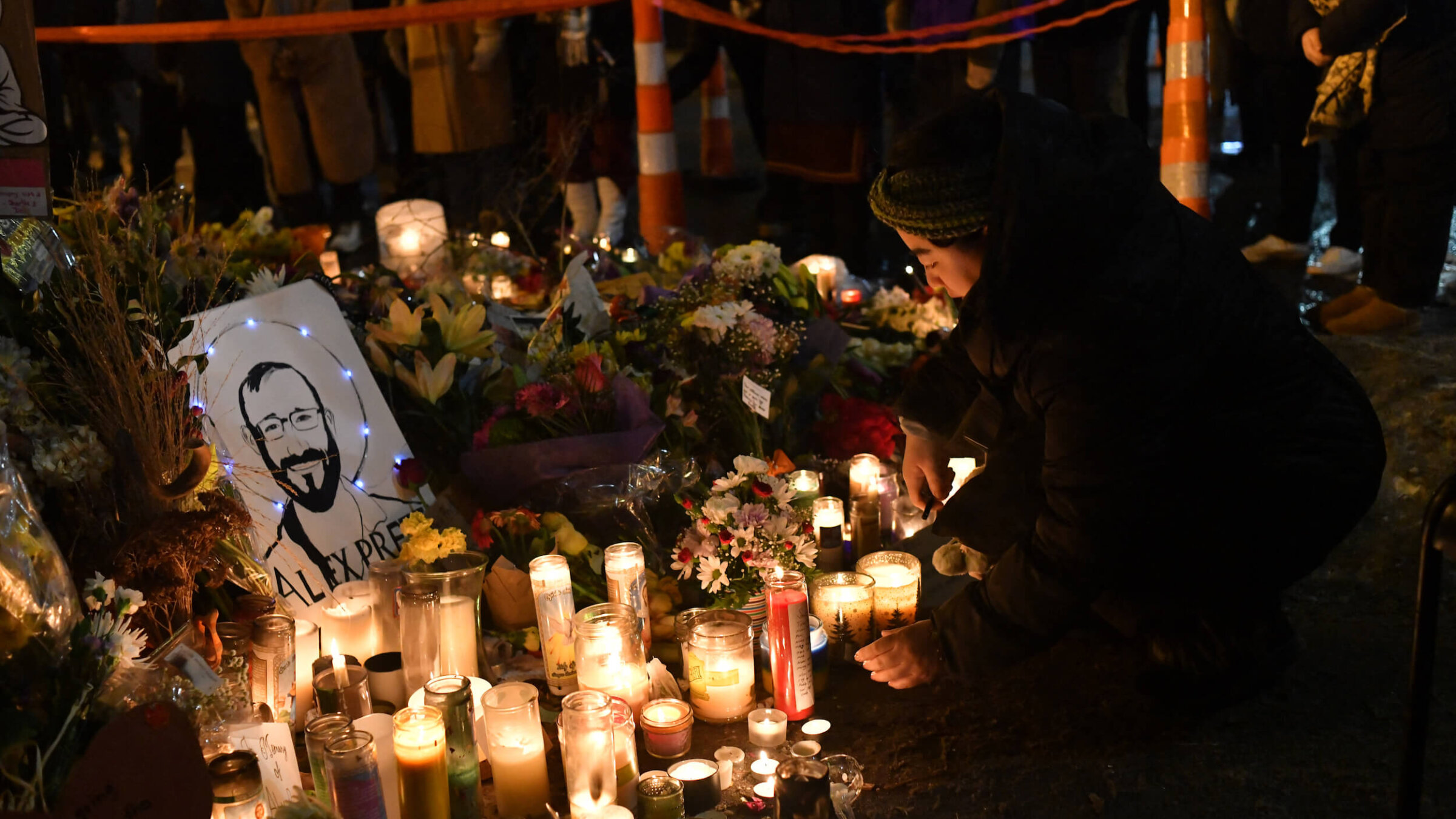
A woman lights a candle on Jan. 26 while mourning at a makeshift memorial in the area where Alex Pretti was shot dead by federal immigration agents in Minneapolis, Minnesota. Photo by Octavio Jones / AFP / Getty Images
“We are the strongest country in the world,” Scott Bessent, the United States’ treasury secretary, said recently on Meet the Press. “Europeans project weakness. We project strength.”
The events of this month in Minneapolis, culminating with the fatal shooting of Alex Pretti by Border Patrol agents last weekend, show he is incorrect. Mass violence by the government against the people is not a sign of strength, but rather a sign of a nation dangerously divided. “Massacres seem, on one level, to be outcomes of power struggles within weak or crisis laden states,” writes Mark Levene, a professor of Jewish history, in The Massacre in History, adding that a massacre is “indicative not of power at the center but rather, of the lack of it.”
Here is one example from history: On June 10, 1944, days after the Allied invasion of Normandy, the German army entered the French village of Ouradour-sur Glane and rounded up 197 men and 445 women and children. They locked the men in a barn and the women and children in a church, and proceeded to kill them — 642 people, including seven Jewish refugees.
German military power made the massacre possible. But the slaughter took place while the Nazi state was disintegrating. The massacre projected weakness on the part of the failing German power, not strength.
More recent examples are also available.
Within the last month, the government of Iran has killed thousands of its own citizens who were protesting the oppressive regime — violence that has brought the country closer to regime change than at any point since the 1979 revolution.
Already weakened by its inability to protect itself from Israeli and American bombardment last summer, the government’s massacre of its own people has been broadly interpreted as a signal of profound instability. The “despotic regime is fragile and desperate,” Benjamin Wallace-Wells recently wrote in The New Yorker. When the government turns to violent repression, it gambles: It can provoke yet more outrage, or it can succeed in forcing calm — temporarily.
Which brings us to the U.S., which Scott Bessent has claimed is projecting strength. What has occurred in Minneapolis does not yet qualify as a massacre, despite the killings of Pretti and Renée Nicole Good. But our own country’s history provides a warning about the dire signal those killings send, and how much worse things could get.
Directly after the end of the Civil War, Memphis, Tennessee received a flood of immigrants, particularly Black citizens newly freed from slavery. The U.S.army occupying Memphis as part of Reconstruction reacted by arresting many of those free black citizens, and forcing them to work in the cotton fields outside the city. Major William Gray ordered that the streets be patrolled by soldiers from Fort Pickering, tasked with making arrests and forcing those they detained to accept exploitative labor contracts with local planters.
Similarly, the Memphis police, all white, took to beating black people in the street for the crime of “insolence.” After a white policeman was shot during an altercation in 1866, a white mob made up in large part by the municipal police and fire fighters ransacked Black homes and killed 46 Black people.
That massacre took place at a time when the United States was bitterly divided. The Civil War had just ended. The President had been assassinated. In Memphis, federal forces rubbed shoulders uneasily with municipal police. Local and national political powers were profoundly at odds.
The massacre in Memphis offers both an explanation and a warning about what is happening today in Minneapolis — and what could still be in store.
Just as our military kidnapped people off the streets of Memphis, forcing them into inhumane conditions, so ICE is kidnapping people in Minneapolis today. Just as children were arrested in Memphis, children as young as 5 have been detained in Minneapolis.
These parallels are evidence of a weak and woefully unpopular government. What is happening in Minneapolis is appalling; the example of Memphis gives us reason to fear that the stage is being set for something worse.
That said, there are no laws of history. Not every weakened or divided society results in a massacre. But there is an alarming resonance between the legacy of the Nazi massacre in Ouradour-sur Glane; the Iranian regime’s massacre of civilian protesters; the 19th-century massacre in Memphis and the outbreak of official violence in Minneapolis. It is that of a radically divided society, with a weakened government, falling prey to horrendous violence.
This is a moment of great uncertainty. Here’s what you can do about it.
We hope you appreciated this article. Before you go, we’d like to ask you to please support the Forward’s independent Jewish news this Passover. All donations are being matched by the Forward Board - up to $100,000.
This is a moment of great uncertainty for the news media, for the Jewish people, and for our sacred democracy. It is a time of confusion and declining trust in public institutions. An era in which we need humans to report facts, conduct investigations that hold power to account, tell stories that matter and share honest discourse on all that divides us.
With no paywall or subscriptions, the Forward is entirely supported by readers like you. Every dollar you give this Passover is invested in the future of the Forward — and telling the American Jewish story fully and fairly.
The Forward doesn’t rely on funding from institutions like governments or your local Jewish federation. There are thousands of readers like you who give us $18 or $36 or $100 each month or year.
Support our mission to tell the Jewish story fully and fairly.