The last hostage returned. Can Israel finally exhale?
The return of Ran Gvili closes one chapter of the war. A more complicated one remains painfully unresolved
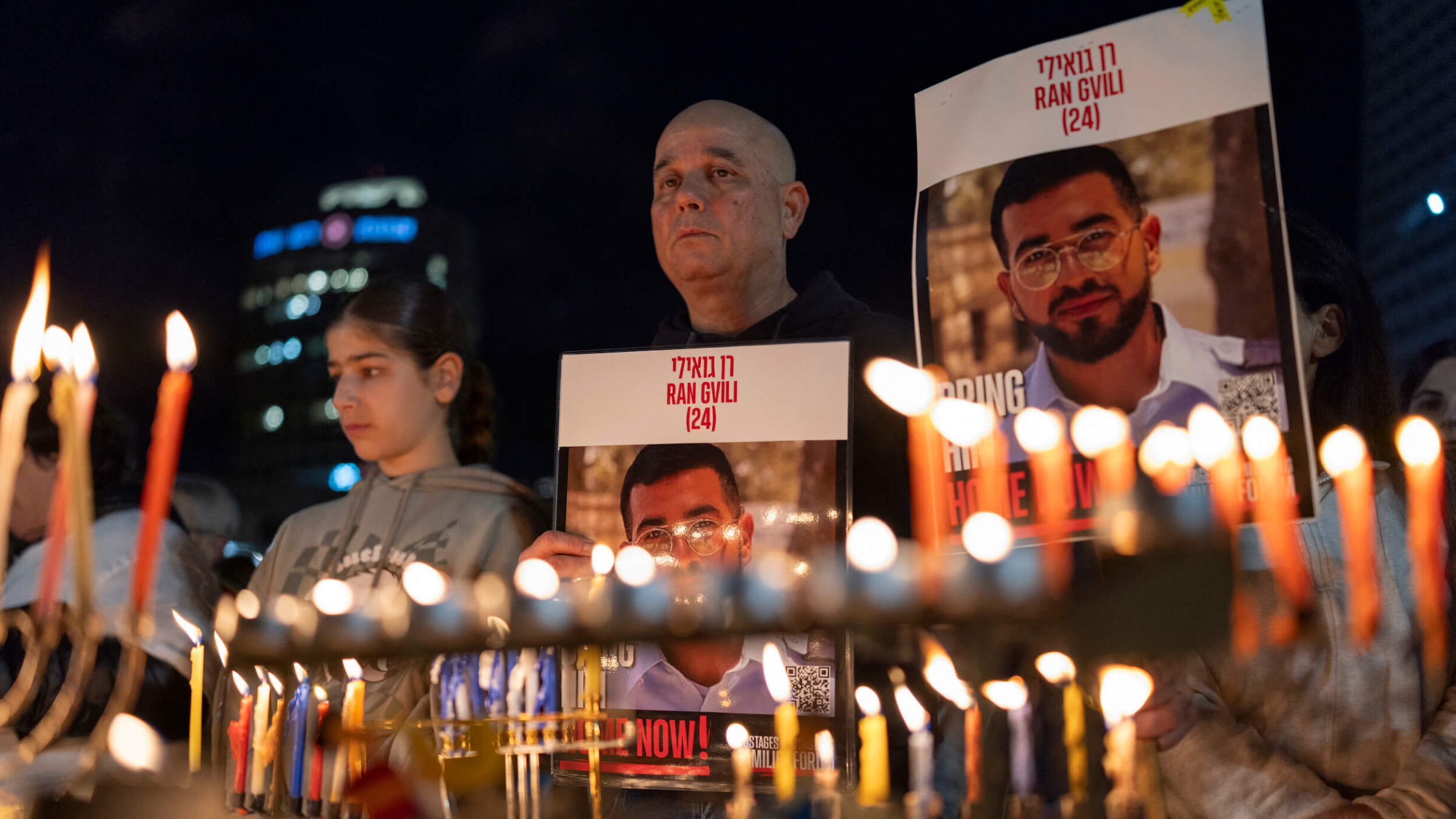
Israelis hold placards bearing the face of Ran Gvili on Dec. 21, 2025, in Tel Aviv. Photo by Ilia Yefimovich / AFP / Getty Images

Columnist Dan Perry January 26, 2026
Israelis went into this week preparing for the possibility of yet more military confrontation. A United States aircraft carrier and other warships were moving toward the Middle East, giving the sense that an attack on Iran might be imminent. Tehran was warning that any strike would be answered with missiles, and that Israel would be implicated whether it participated in U.S. action, or not.
And then came a moment of true peace — perhaps the first since the Hamas attack of Oct. 7, 2023. The last hostage came home.
Israelis have been holding their breath for nearly 28 months. With the return of the remains of Staff Sergeant Ran Gvili, they can finally stop.
Gvili’s tragic story is also almost uniquely heroic — and profoundly Israeli. Despite being in recovery for a fractured shoulder, the 24-year-old put on his uniform on the morning of Oct. 7, when news of the Hamas attack broke, and rushed south. He helped rescue civilians fleeing the Nova music festival. He fought at Kibbutz Alumim.
Then, wounded and surrounded, he was overpowered and murdered. His body was taken to Gaza.
Gvili embodied the most demanding and meaningful quality of Israeli citizenship: obligation. He went in first. He came out last.
The return of his body, which was reportedly discovered in a north Gaza cemetery, resolved one of the two war aims Israel set for itself in the aftermath of Oct.7 catastrophe: to bring every hostage home. It is a milestone worth celebrating. There has been something deeply revealing in how Israelis have spoken about the return of the remains of the last hostages: a refusal to accept that death dissolves social ties. A declaration that dignity does not end when life does.
This is a society obsessed with survival, but not indifferent to honor and human dignity.
Unfortunately, the other aim, the destruction of Hamas, remains disturbingly unfulfilled.
The hostage issue fostered a certain moral unity in Israel. The country was divided over everything else: the conduct of the war, the devastation in Gaza, the government’s competence, the international backlash, the collapse of trust after the judicial overhaul crisis.
But on the hostages there was something closer to consensus. For most, they were family.
Every Saturday night, hostage families gathered in the plaza outside the Tel Aviv Museum, which became known as Hostages Square. Joining them there — to protest in demand of the hostages’ return — became a ritual. My wife went there weekly, along with many thousands of others. For most Israelis, closely following the hostage talks — the rumors and leaks, partial releases and collapses — became part of daily life.
This meant that as the government continued to pursue the Gaza war, the hostages became a massive liability for Prime Minister Benjamin Netanyahu and his cabinet. Long before military stalemate set in, by mid-2024, polls showed overwhelming support for a deal that would end the fighting after Hamas had been badly degraded in exchange for the return of all hostages.
The government did not listen. Hard-liners in the coalition, who controlled its fate, wanted the war to go on indefinitely. They even wanted Gazans forcibly expelled and the territory settled by Jews. Netanyahu basically had to have his arm twisted by President Donald Trump to strike a ceasefire deal in September.
In part because of that delay, today, virtually every poll suggests that forthcoming elections will produce a crushing defeat for Netanyahu’s coalition. Netanyahu rushed to the cameras Monday to declare Gvili’s return a great success, but my sense is that few Israelis are inclined to grant him credit. The state has completed an obligation, but the government has not redeemed itself.
That sense may have implications on the ground in Gaza, in the quest to rid the strip of Hamas once and for all.
The argument that movement toward a second phase of the Gaza framework must wait until the final hostage is returned is gone. The most likely first step is a partial reopening of the Rafah crossing into Egypt, which is as significant to Gazans as the hostage issue was to Israelis. If, as Israeli and American officials have suggested, that reopening moves forward, it will mean an end to the brutal, suffocating total siege of the strip. Coming days will see talks on who and what can get through, who has a role in checking for smuggling, and what limitations might be applied.
They will also see an intensification of discussion on the other main condition for moving forward: the disarmament of Hamas, which still controls large parts of Gaza. The militant group still believes time is on its side; it imagines that by returning the hostages it has purchased survival.
One thing is for sure: In a week when missiles may yet fly, when Israel may yet face costs far beyond its control, something quietly monumental happened. The country exhaled. The last hostage came home. In an cynical era of promises routinely broken, this one in a way has finally been kept.
This is a moment of great uncertainty. Here’s what you can do about it.
We hope you appreciated this article. Before you go, we’d like to ask you to please support the Forward’s independent Jewish news this Passover. All donations are being matched by the Forward Board - up to $100,000.
This is a moment of great uncertainty for the news media, for the Jewish people, and for our sacred democracy. It is a time of confusion and declining trust in public institutions. An era in which we need humans to report facts, conduct investigations that hold power to account, tell stories that matter and share honest discourse on all that divides us.
With no paywall or subscriptions, the Forward is entirely supported by readers like you. Every dollar you give this Passover is invested in the future of the Forward — and telling the American Jewish story fully and fairly.
The Forward doesn’t rely on funding from institutions like governments or your local Jewish federation. There are thousands of readers like you who give us $18 or $36 or $100 each month or year.
Support our mission to tell the Jewish story fully and fairly.