On Holocaust Remembrance Day, warning signs of our contemporary society crumbling
Citizens shot dead in the streets. Eugenics on the rise. We can’t forget where these patterns might lead
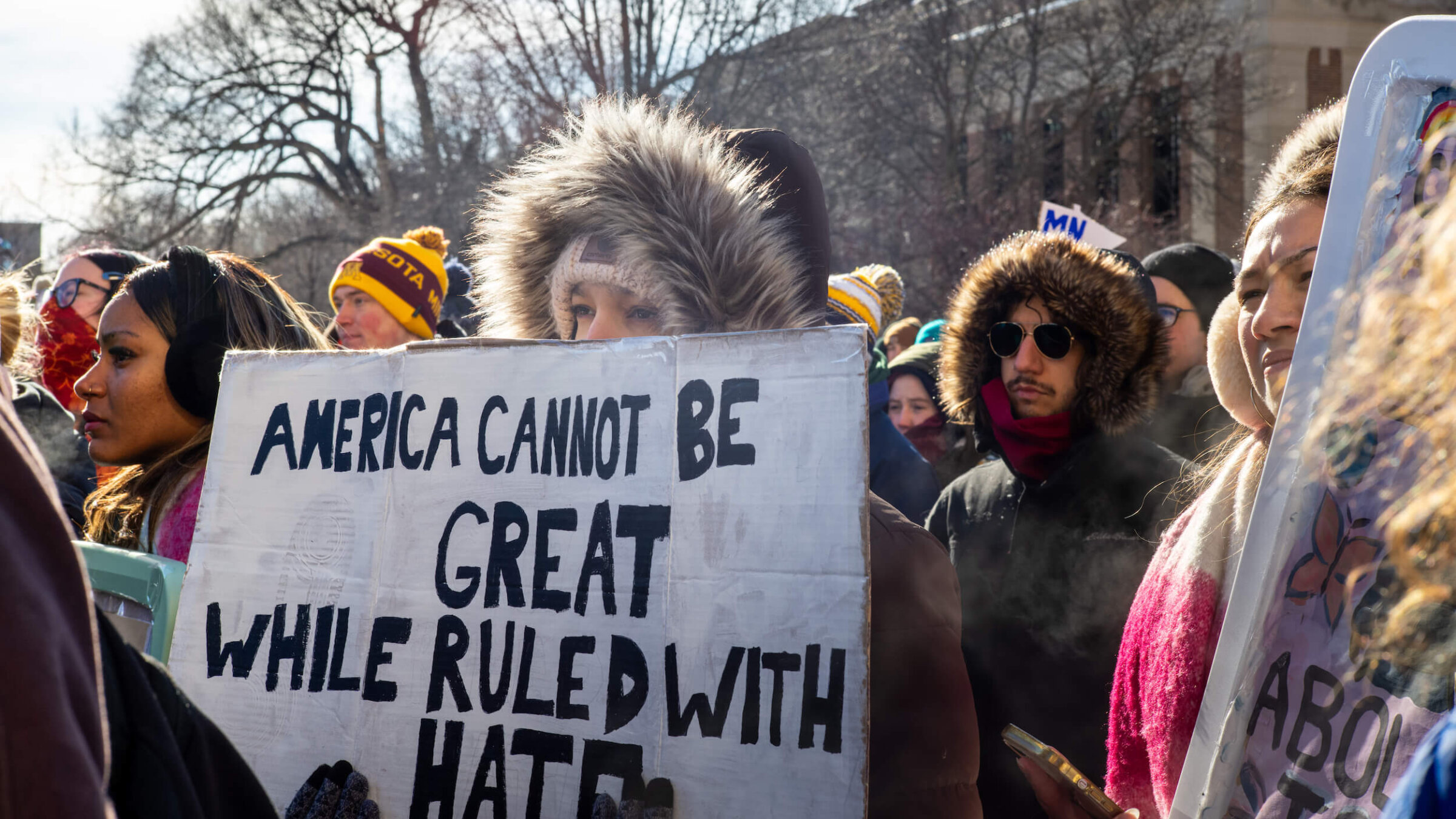
Students protest against ICE during a walkout at the University of Minnesota on Jan. 26. Photo by Brandon Bell/Getty Images
Rabbi Jeffrey K. Salkin January 27, 2026
The fatal shooting of Alex Pretti, a 37-year-old ICU nurse and beloved member of the community in Minneapolis, is not an isolated event.
It is an illustration of how our society risks drifting into patterns of dehumanization — patterns that have paved the way, historically, for some of the worst horrors human beings have ever inflicted on one another.
Over the weekend, I, like millions of others, was shocked by the footage of Pretti’s killing. In a video verified by major news outlets, Pretti is seen holding a phone and standing with protestors before being pinned to the ground and shot multiple times by Border Patrol agents.
He had been legally armed, with his weapon holstered, and had initially gone to help a woman who had been injured by pepper spray. For this, he was accused of “domestic terrorism” by some of our leaders.
And I was shocked, too, by a New York Times report about how researchers with a history of racist thinking obtained the protected genetic data of more than 20,000 American children, and used it to produce studies asserting correlations between race and intelligence. Mainstream scientists have roundly rejected these claims as biased and unsound, but they are spreading anyway: Grok, the Elon Musk-developed AI known for engaging in bouts of antisemitism on X, has cited the pseudoscientific research close to 30 times just this month.
Yes, these two stories — one about an awful killing in Minneapolis, and one about theories of biological racial hierarchies repackaged as science — appear to have little in common. But together, they raise a terrifying and essential question: Are we ignoring the early signs of a far deeper moral unraveling in our society?
Today is International Holocaust Remembrance Day. It’s a day to remember how, to paraphrase a quote often misattributed to Mark Twain — actual provenance unknown — that while history never repeats itself, it rhymes.
In the lead-up to the Holocaust, an influential set of intellectuals and scientists in Germany and elsewhere — including the United States — believed that heredity could explain such so-called “social ills” as criminality, disability and poverty. They believed that society should use biology to control who reproduces and who should not.
They advocated for compulsory sterilization laws, immigration restrictions and other policies that targeted people deemed in some way unfit. In the U.S. alone, tens of thousands of people — disproportionately poor, disabled and people of color — were sterilized under these laws.
From there, it was the express lane to the notion that some lives matter more than others. In Germany, that notion led to the murders of millions.
A society’s moral fabric does not degrade all at once. It does so as a kind of cumulative effect, as the language of hierarchy and worthlessness creeps back into our national conversation; as agencies of state power operate without the restraint of transparent accountability; as deaths are treated as less than tragic, because the people who died were seen as less than fully human.
So, when a study today suggests that mental ability is tied to race, we should tremble. So too when we see an innocent civilian violently killed in the streets, and officials leaping to defend his killers and mock his memory.
We are in a crisis of national conscience. And the risks are great.
Pretti’s killing, like that earlier this month of Renée Nicole Good, has sparked widespread protests because something profound is at stake: the belief that every human life is precious, and that it is our society’s responsibility to care for all lives — not degrade them or treat them as more or less worthwhile.
It is not inevitable that we will repeat the worst chapters of history. But we will — if we fail to hear the alarm when it first sounds. Remembering the past gives us a moral imperative to recognize the early signs and refuse to quietly follow the course.
We must speak clearly: Not this, not again, not on our watch.
This is a moment of great uncertainty. Here’s what you can do about it.
We hope you appreciated this article. Before you go, we’d like to ask you to please support the Forward’s independent Jewish news this Passover. All donations are being matched by the Forward Board - up to $100,000.
This is a moment of great uncertainty for the news media, for the Jewish people, and for our sacred democracy. It is a time of confusion and declining trust in public institutions. An era in which we need humans to report facts, conduct investigations that hold power to account, tell stories that matter and share honest discourse on all that divides us.
With no paywall or subscriptions, the Forward is entirely supported by readers like you. Every dollar you give this Passover is invested in the future of the Forward — and telling the American Jewish story fully and fairly.
The Forward doesn’t rely on funding from institutions like governments or your local Jewish federation. There are thousands of readers like you who give us $18 or $36 or $100 each month or year.
Support our mission to tell the Jewish story fully and fairly.