What we talk about when we talk about Anne Frank hiding from ICE
Is it reasonable to invoke the memory of the horrors Frank suffered outside of a strictly Jewish context?
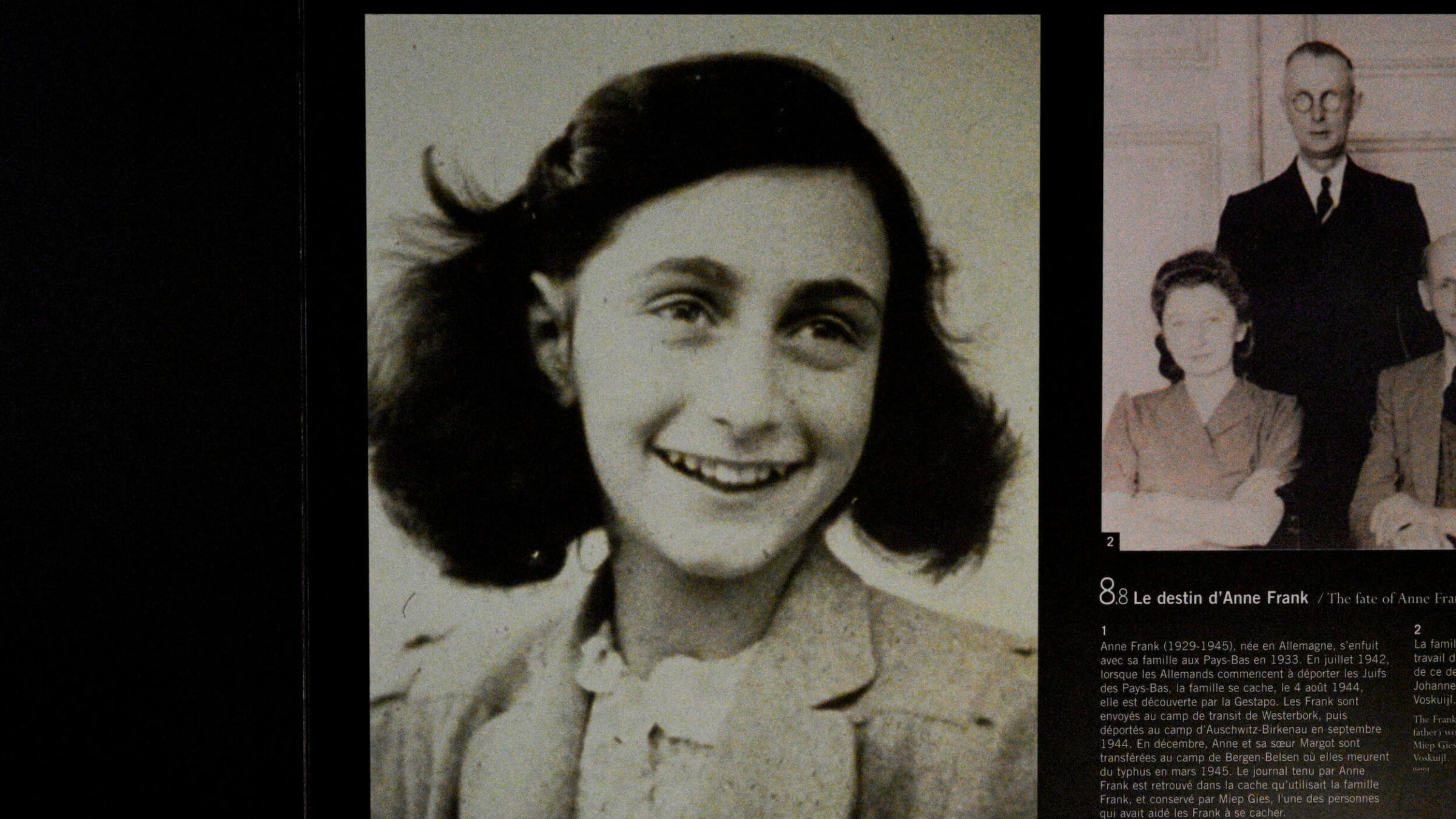
A picture of Anne Frank at the Paris Shoah Memorial on Oct. 6, 2025. Photo by Magali Cohen/Hans Lucas via AFP/Getty Images

Contributing Columnist Emily Tamkin January 27, 2026
Anne Frank’s story — as told in her famed diary — is about many things: persecution of Jews, the horrors of fascism, the perseverance of the human spirit.
But one of the main messages that many have taken from her life and death is this: It is wrong for children to be forced into hiding for any reason, and certainly on the basis of their identity.
That’s the connection that Minnesota Gov. Tim Walz drew while speaking on Monday.
“We have got children in Minnesota hiding in their houses, afraid to go outside,” he said at a press conference. “Many of us grew up reading that story of Anne Frank,” he added. Someday, he thinks, someone will write a similar story about the children of Minnesota.
Thus started one of the most vicious recent battles over what, exactly, Frank’s memory should mean. And in that battle, we can see what we risk by questioning whether it’s reasonable to draw any comparisons, ever, between those who lived in terror of the Nazis, and those who live in terror of other inhumane regimes.
The U.S. Holocaust Memorial Museum responded to Walz by posting on social media: “Anne Frank was targeted and murdered solely because she was Jewish. Leaders making false equivalencies to her experience for political purposes is never acceptable.”
“Despite tensions in Minneapolis,” they added, “exploiting the Holocaust is deeply offensive, especially as antisemitism surges.”
There are good reasons to be protective of Anne Frank’s story as a specifically Jewish one. The instinct to treat her experience as one of universal relevance has sometimes been taken too far, as in the case of a 2017 Dutch play about her that didn’t mention Jews or the Nazis.
But there are also good reasons to lean into the belief that Frank’s story is about humanity at large, as well as Jews, specifically. Frank’s father, Otto Frank, who edited her diary after her death during the Holocaust and pushed for its publication, was among those who said he wanted it to have universal appeal.
“I always said that Anne’s book is not a war-book,” he wrote in a letter in 1952. “War is the background. It is not a Jewish book either, though Jewish sphere, sentiment and surrounding is the background.” He wanted his daughter’s story to reach as many people as possible.
That’s the same instinct, I think, that motivated Walz to make his comparison: the drive to force people to confront the truth that children are suffering inhumanity, and to feel that truth must not be tolerated.
Consider just two of the stories of children in Minnesota over these past few weeks.
Liam Ramos, a 5-year-old, was detained along with his father and sent to a facility in Texas. A photo of Ramos wearing a Spiderman backpack while being forced into an SUV by federal agents went viral, in part, I think because of the profound human urge to protect children from the worst of existence — and the desperation provoked by seeing a child fall prey to it anyway.
Or think about a 2-year-old who was detained and flown to Texas along with her father. She was returned to her mother the next day, but it is impossible not to think that this experience of forced separation from her parents will mark her for life.
These two children were from Ecuador. But I do not see how it erases Frank’s Jewishness to show a parallel. It is wrong that she was forced into hiding because of her identity, and it is similarly wrong to force children in Minnesota into hiding because of theirs.
Far more concerning, I think, is the fact that misinformation about Frank’s story is being spread by some who argue that invoking her in this context is inappropriate.
Ambassador Rabbi Yehuda Kaploun, the U.S. State Department’s special envoy to monitor and combat antisemitism, posted in response to Walz that “ignorance like this cheapens the horror of the Holocaust. Anne Frank was in Amsterdam legally and abided by Dutch law. She was hauled off to a death camp because of her race and religion. Her story has nothing to do with the illegal immigration.”
That’s a terrible rewriting of history. It’s true that Frank was hauled off to a death camp because of her race and religion. But it is not true that she and her family were abiding by the law.
They went into hiding after Frank’s sister, Margot Frank, received and ignored a summons to go to a labor camp. They were hiding precisely because their existence in Amsterdam had become illegal the second that Margo failed to show up; they were all defying orders.
Frank and her family were quite literally breaking the law. It was the Nazis, and the people who turned in the Frank family, who were following it.
Questions of legality do not provide an excuse to force children into hiding because of their race, religion, or where they were born, nor a reason to scar or harm them.
For my own part, I think we are less at risk of forgetting that the Holocaust was carried out against Jews than of being so concerned about losing Jewish specificity that we miss that there are unspeakable harms being carried out against children today. Many of those harms are happening legally.
People can learn from what happened from Anne Frank, or not. People can disagree about exactly what we ought to learn from what happened to her, too.
But if insisting on the specific Jewishness of that story seems more important to you than recounting the history accurately, I think it’s only fair to ask: Are you actually upset about how people tell this story, or just upset that listeners might take away a different moral than you think they should?
This is a moment of great uncertainty. Here’s what you can do about it.
We hope you appreciated this article. Before you go, we’d like to ask you to please support the Forward’s independent Jewish news this Passover. All donations are being matched by the Forward Board - up to $100,000.
This is a moment of great uncertainty for the news media, for the Jewish people, and for our sacred democracy. It is a time of confusion and declining trust in public institutions. An era in which we need humans to report facts, conduct investigations that hold power to account, tell stories that matter and share honest discourse on all that divides us.
With no paywall or subscriptions, the Forward is entirely supported by readers like you. Every dollar you give this Passover is invested in the future of the Forward — and telling the American Jewish story fully and fairly.
The Forward doesn’t rely on funding from institutions like governments or your local Jewish federation. There are thousands of readers like you who give us $18 or $36 or $100 each month or year.
Support our mission to tell the Jewish story fully and fairly.