With the last hostage released, is American Jewish unity over?
The hostage crisis brought together a fractured community. Now that it’s over, the divisions over Israel are back
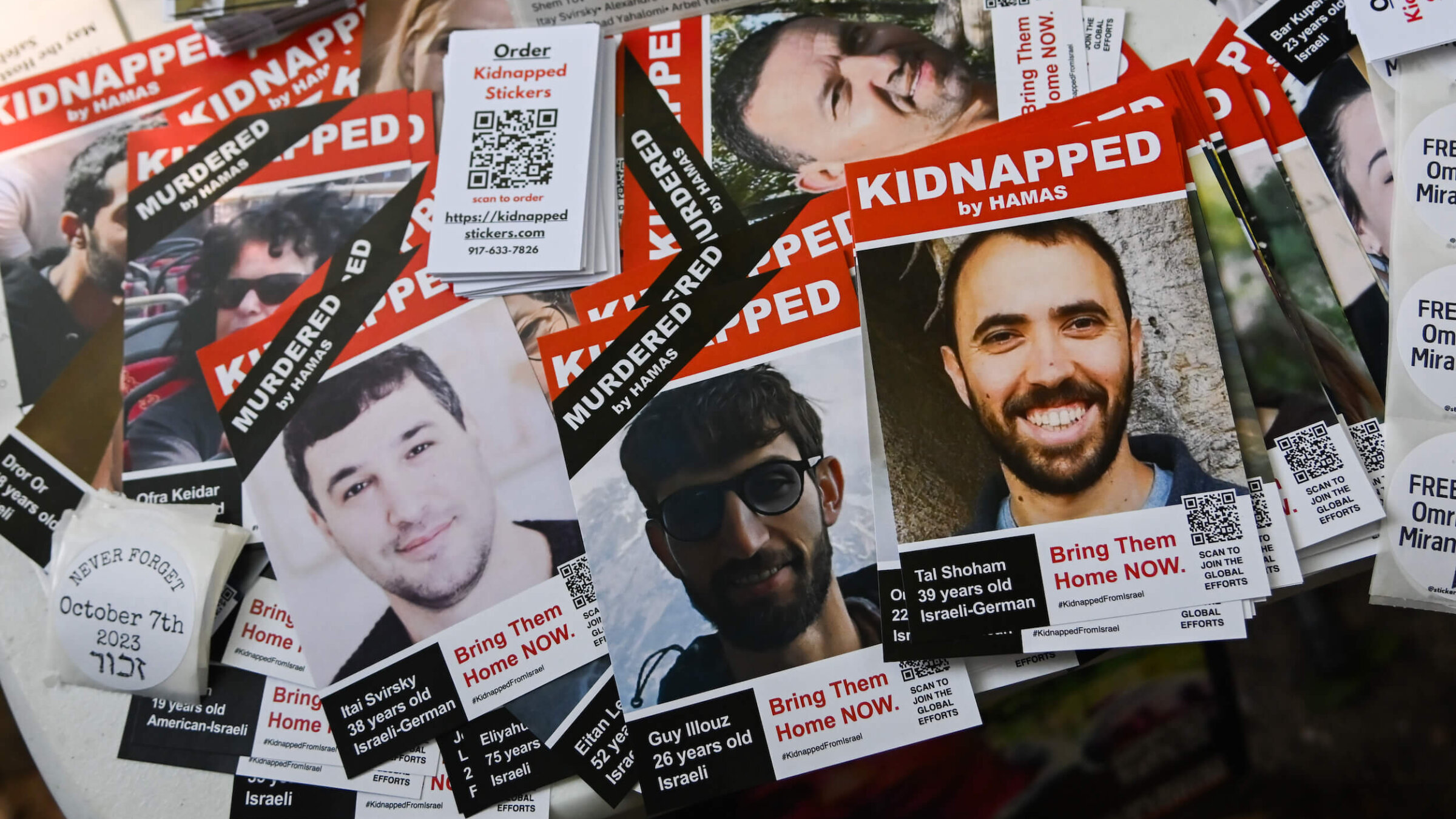
Posters of Israeli hostages are seen during a rally to mark the first anniversary of the Oct. 7 Hamas attack on Israel on Oct. 6, 2024 in New York City. Photo by Noam Galai/Getty Images

Senior Columnist Rob Eshman January 31, 2026
When the remains of the last Israeli hostage in Gaza returned to Israel this week, Scott Spindel, a lawyer in Encino, Calif., finally took off the thick steel dog tag he had put on after the Hamas attack of Oct. 7, 2023.
His friend Lauren Krieger, an orthopedic surgeon, did the same. And he pulled down the last of the names of the hostages remaining in Gaza that his wife, Jenn Roth Krieger, had placed in the window of their Santa Monica home.
During the nearly 28 months that Israeli hostages remained in captivity in Gaza, Krieger, 61, and Spindel, 55, consistently argued over Israel’s war in the strip.
“Lauren would say that we probably were a little too extreme,” Spindel, whose daughter serves in the IDF, told me in a telephone interview. “I don’t think we blew up enough buildings.”
But those differences paled beside their mutual concern over the fate of the hostages.
“Unfortunately,” said Spindel, “it took tragedy to pull us together.”
So it was across the American Jewish landscape. Then, the body of Staff Sergeant Ran Gvili, the 24-year-old Israeli police officer killed on Oct. 7 and taken by Hamas terrorists back into the enclave, was returned to Israel — the last of the hostages to come home.
Jews from across the political spectrum unpinned yellow ribbon buttons from their lapels, removed the hostage posters from their synagogues, and folded up and put away the blue-and-white flags displayed as a symbol of the missing Israelis.
The marches and vigils American Jews held on behalf of the hostages — small but meaningful echoes of the mass rallies that roiled Israel — came to a quiet halt.
Jewish unity is forged in adversity. Without it, we are apt to find enemies among ourselves. And as painful as the hostage saga was, it unified an otherwise fractious American Jewish community in a time of crisis.
Without that common concern, are even deeper rifts our future?
“As committed and connected as we were,” said Spindel, “it doesn’t change the fact that we also were still divided about solutions.”
A family in distress
Across the United States, synagogues of all religious and political bents regularly joined in the same Acheinu prayer for the release and return of the hostages.
“Our family, the whole house of Israel, who are in distress,” the prayer begins — a wholly accurate summation of the totality of Jewish concern.
Surveys showed that the hostages unified American Jews even when Israel’s Gaza campaign divided them. An October 2025 Washington Post poll found that a plurality of American Jews disapproved of Israel’s military actions in Gaza — but a whopping 79% said they were “very concerned” about the hostages.
There have been other moments in recent Jewish history when calamity created unity. The 1995 assassination of Prime Minister Yitzhak Rabin, for instance, brought together the vast majority of American Jews in mourning, even those who opposed his policies.
And, of course the brutal Oct. 7 attack, which claimed almost 1,200 lives, created a near-universal sense of shock and sorrow.
But the hostage crisis may have had an even deeper emotional — and perhaps political — impact.
“Even for people who were not affiliated Jewishly, those hostages struck a deep, deep chord,” Krieger told me. “It felt personal. I don’t think we’ve had that level of collective trauma in our lifetimes in that same way.”
And a family divided
The hostage crisis bonded American Jews to one another, and to their Israeli counterparts, at a time when enormous political rifts were opening within their communities.
In the U.S., as in Israel, there were sharp disagreements over Prime Minister Benjamin Netanyahu’s conduct of the war and whether he was even prioritizing the hostages’ safety.
And the encampments and protests against the war at college campuses — in which many Jewish students participated, and to which many others objected — created even deeper divisions over support for the Jewish state.
But if the hostage issue didn’t erase such differences, it muted them. Krieger and Spindel could frustrate each other in conversations about the conduct of the war, or American support for it. But in the end, they were both in that 79% that the Washington Post poll identified.
What will hold them — and the rest of us — together, now?
The hostage crisis provided something history unfortunately bestows upon Jews with regularity: an external enemy that transcended ideological differences. With it gone, American Jews return to what they’ve always been — a community bound by tradition, and riven by politics.
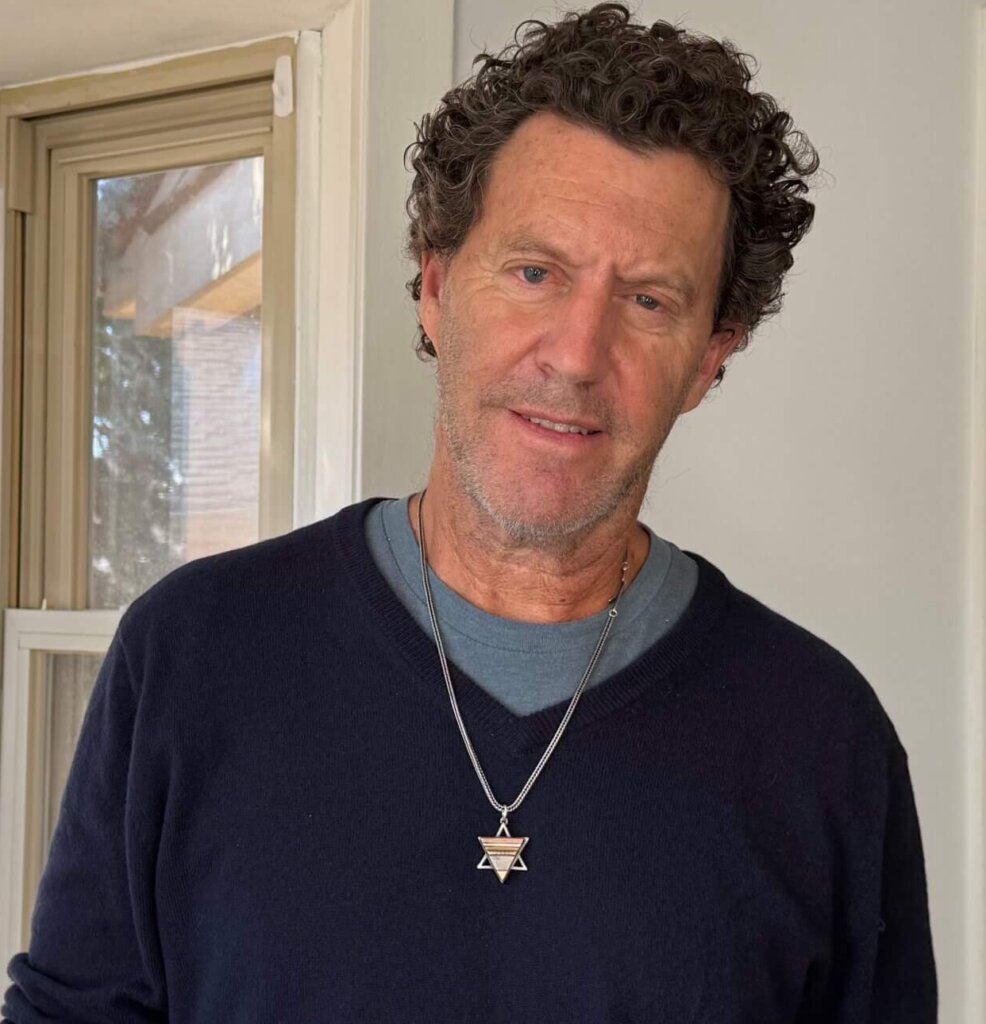
Krieger and Spindel have already resumed their arguments. But even though the dog tags are gone, they’re both still wearing Jewish stars on silver chains around their necks. When someone admires Krieger’s, he takes it off and gives it to them. He buys his metal stars in bulk on Amazon, and has given away dozens since Oct. 7.
“I want people to feel like I do,” he said, “like we’re a peoplehood worth cherishing.”
Worth cherishing — even though we can’t agree on much else.
This is a moment of great uncertainty. Here’s what you can do about it.
We hope you appreciated this article. Before you go, we’d like to ask you to please support the Forward’s independent Jewish news this Passover. All donations are being matched by the Forward Board - up to $100,000.
This is a moment of great uncertainty for the news media, for the Jewish people, and for our sacred democracy. It is a time of confusion and declining trust in public institutions. An era in which we need humans to report facts, conduct investigations that hold power to account, tell stories that matter and share honest discourse on all that divides us.
With no paywall or subscriptions, the Forward is entirely supported by readers like you. Every dollar you give this Passover is invested in the future of the Forward — and telling the American Jewish story fully and fairly.
The Forward doesn’t rely on funding from institutions like governments or your local Jewish federation. There are thousands of readers like you who give us $18 or $36 or $100 each month or year.
Support our mission to tell the Jewish story fully and fairly.