My grandmother Eva Schloss survived Auschwitz. She would not be silent about America today.
Holocaust survivors can clearly see when society is heading in a violent direction
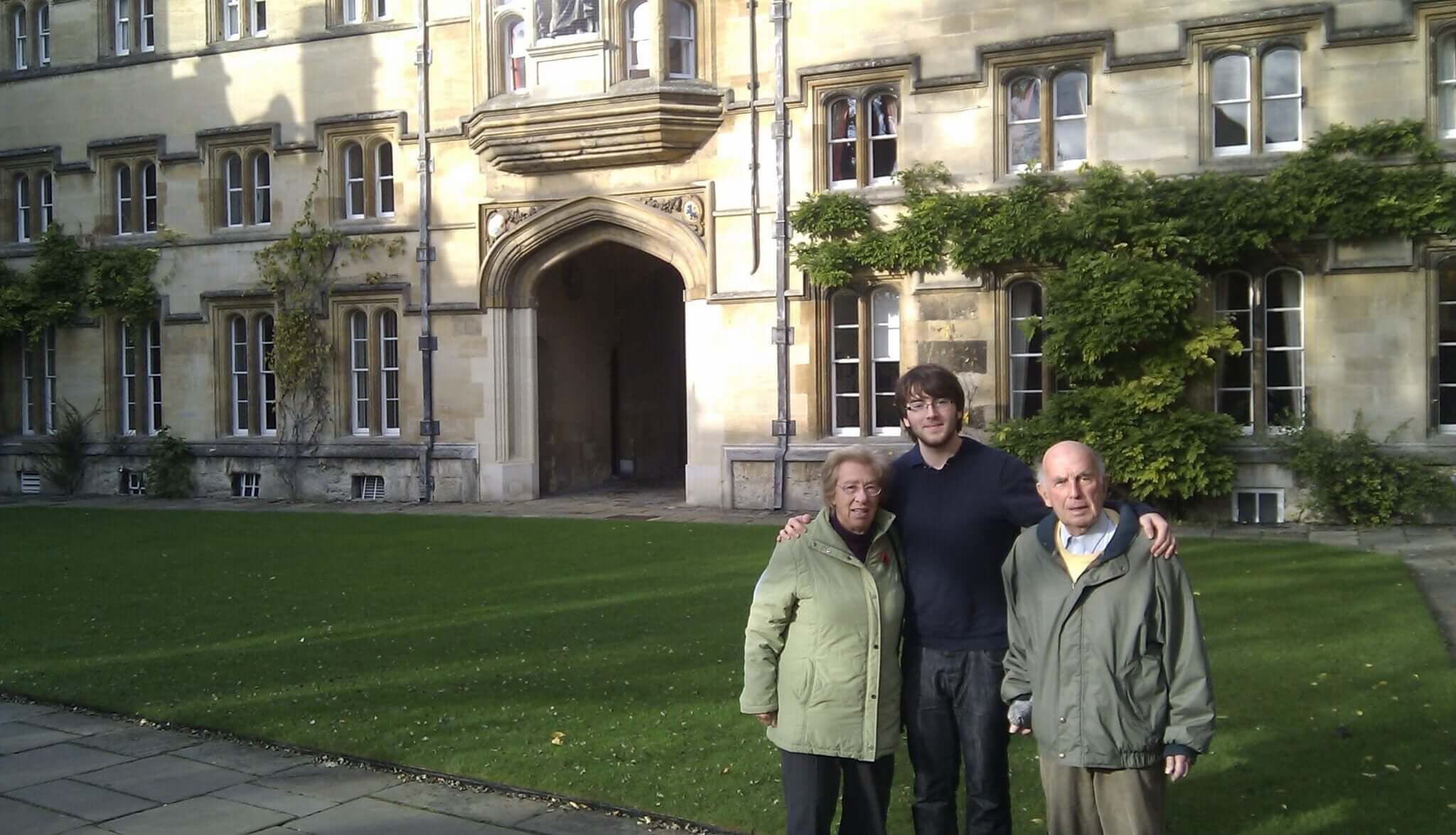
Alex Margolis is flanked by his grandparents, Eva and Zvi Schloss, during a visit to the University of Oxford sometime before Zvi Schloss’ death in 2016. Courtesy of Alex Margolis
(JTA) — Back in 2016, my Oma, Eva Schloss, made international headlines for comparing President Donald Trump and Adolf Hitler. As a child, she lived through the rise of fascism, a pattern she was nervous to see echoed in the United States. She fled from Austria to Amsterdam, only to be deported to Auschwitz with her entire family; she ultimately survived Auschwitz with only her mother — my great-grandmother. She devoted her life to Holocaust education, and she refused to back away from making these comparisons.
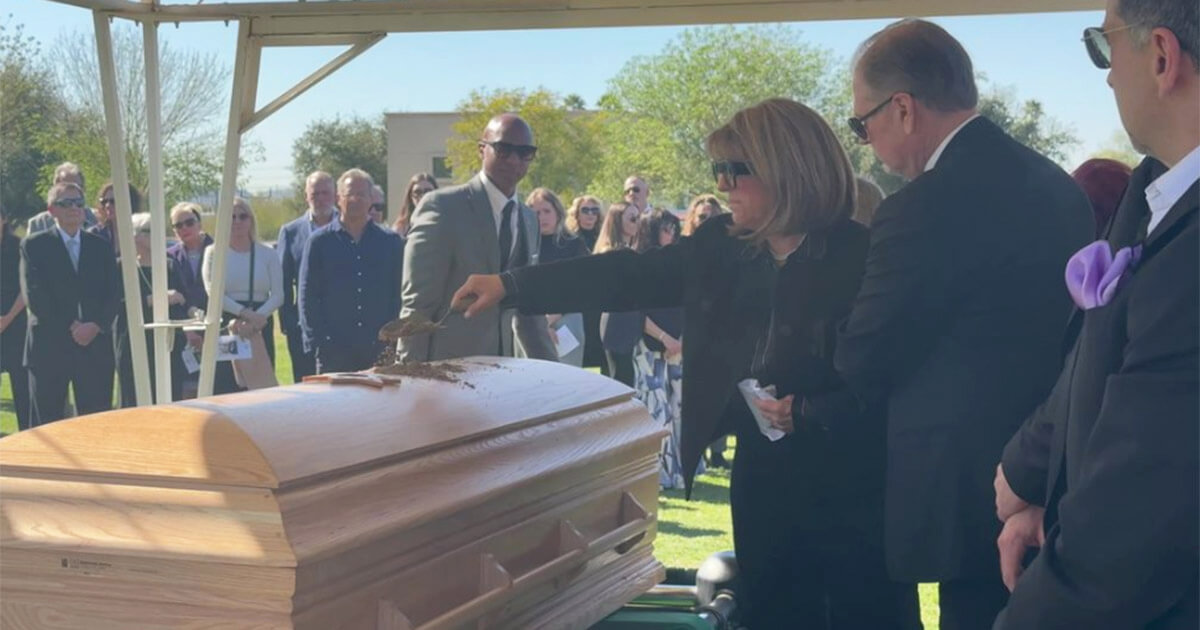
My Oma was famous not only for being a Holocaust educator but also because of who her mother married after the war — Otto Frank, Anne Frank’s father, whose entire family had been murdered. She passed away just a month ago, and I believe it is my responsibility to ensure that her message lives on.
That is why I am saying that it is a shameful disservice to both her memory and Anne Frank’s for the United States Holocaust Memorial Museum to call comparisons between ICE violence and the Holocaust “deeply offensive.”
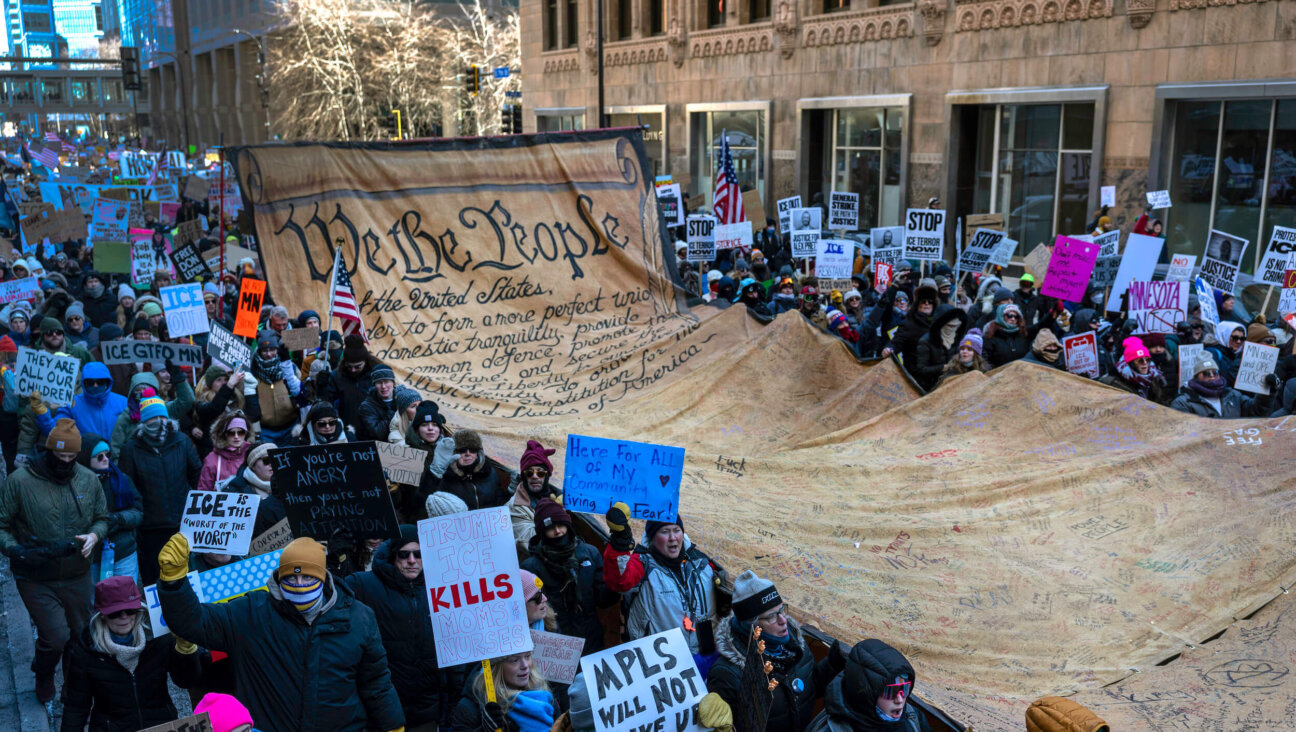
The museum was responding to Minnesota Gov. Tim Walz’s comments urging ICE to leave his state. “We have got children in Minnesota hiding in their houses, afraid to go outside. Many of us grew up reading that story of Anne Frank,” he said. “Somebody is going to write that children’s story about Minnesota.”
I believe he is right. Remembering the Holocaust does not mean waiting for gas chambers before we speak. It means recognizing how ordinary policies — immigration bans, detention regimes, and mass deportations — prepare the ground for mass violence. These are through lines in history. My grandmother spoke because she recognized these patterns as they emerged. Remembering the Holocaust means we need to compare, draw analogies, and recognize how these patterns shift over time — so we can disrupt them before they take hold again.
But the widespread use of Holocaust analogies right now overlooks some key context. Treating ICE’s violence as analogous to the Holocaust risks obscuring the fact that white supremacist violence is deeply embedded in U.S. history itself. Nazi ideology did not emerge in a vacuum; it was partly shaped by American precedents. The notion of Lebensraum (“living space”), a key tenet of Nazi ideology, was inspired by the American notion of Manifest Destiny, as noted by the USHMM itself. The Nuremberg laws targeting Jews were modeled on America’s own racial segregation laws.
When Donald Trump speaks of “bad genes” in relation to immigrants, it’s easy to draw a through line from the American eugenics program of the early 20th century, through Nazi racial ideology, to the actions taken by ICE today. Instead, we should look at contemporary white supremacy in context, as part of an ecosystem of racist and authoritarian movements, influenced by both American and German ideas.
My Oma spoke out for immigrants and refugees because she lived through her family’s death and suffering as a result of countries refusing to open their borders to people fleeing Nazi territory. Trying to escape, running from embassy to embassy, my Oma’s family submitted one last application to move to Australia — but it was denied. She wrote: “It’s almost unbearable to think how much that denied visa application changed our lives,” leading to the death of her father and brother. Over the past nine years, we have seen the near-total collapse of the U.S. asylum and refugee system. My Oma knew that the more borders close, the more children would be stranded in violent and dangerous situations, just like what happened to her younger self and to Anne Frank.
It is unacceptable for the USHMM to distort my family’s history and silence people speaking out about the persecution of others. Many of the same communities who were murdered alongside my Jewish family by the Nazis — including Black, Brown, trans, Indigenous, Romani, queer, and disabled people — are the same groups being targeted directly by this administration.
For those of us who are descendants of Holocaust survivors, remembering our history means refusing to stand idly by as Holocaust memory is misused to downplay the abductions and killings of our neighbors and to falsely justify violent border restrictions. The USHMM is justifying an approach that leans on fear and oppression, which does nothing to protect Jews or anyone else. Instead, we must insist on a world that truly believes, as the Jewish immigration justice organization that I belong to says, “Never again for anyone.”
By condemning these comparisons, the USHMM is not safeguarding Holocaust memory — it is policing historical memory so that it applies only to certain groups, stripping it of its power as a universal warning against dehumanization and state violence. Instead, let’s call out white supremacy and build a society that values our collective safety.
When I was coming home after my grandmother’s funeral in England last month, I was nervous that I might not be let into the country because I know that many immigrants, including green card holders like myself, have been denied entry. Even knowing that my privileges would likely protect me, I felt scared. And that’s exactly what the government is trying to do — make all immigrants (no matter our status) live in fear.
When I think about my Oma, I remember who changed the course of her life: the many members of the Dutch resistance who broke the law to hide her, and the one who followed the law to inform on her.
Now is the time to ask ourselves: which one do we want to be?
This article originally appeared on JTA.org.