My university wants me to sign a loyalty oath — am I in America or Vichy France?
An unsettling memo from a Texas university recalls France’s lurch into authoritarianism during WWII

A Texas flag waves over the Lone Star State, 2025. Photo by Sam Hodde/Getty Images
Robert Zaretsky February 7, 2026
As a historian of modern France, I have rarely seen a connection between my everyday life in my adopted state of Texas and my work on my adopted specialization: the period we call Vichy France. Apart from the Texan boast that the Lone Star Republic is bigger than the French Republic, and the small town of Paris, Texas, which boasts its own Eiffel Tower, I had no reason to compare the two places where I have spent more than half of my life.
Until now.
Last week, professors and instructors at the University of Houston received an unsettling memo from the administration, which asked us to sign a statement that we teach rather than “indoctrinate” our students.
Though the administration did not define “indoctrinate,” it hardly takes a PhD in English to read between the lines. Indoctrination is precisely what our state government has already forbidden us from doing in our classes. There must not be the slightest sign in our courses and curricula of references to diversity, identity and inclusion. The catch-all word used is “ideology,” a term Governor Greg Abbott recently invoked when he warned that “Texas is targeting professors who are more focused on pushing leftist ideologies rather than preparing students to lead our nation. We must end indoctrination.”
This is not the first time in the past several months that I have been reminded of what occurred in France during the four years that it was ruled by its German occupiers and Vichy collaborators.
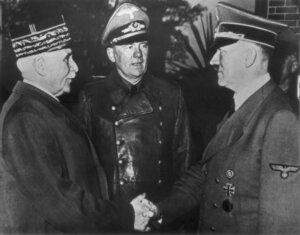
Very briefly, with Germany’s rapid and complete defeat of France in 1940, an authoritarian, antisemitic and collaborationist regime assumed power. Among its first acts was to purge French Jews from all the professions, including high school and university faculties, and to impose an “oath of loyalty” to the person of Marshal Philippe Pétain, the elderly but ramrod straight and clear-headed hero of World War I.
The purpose of the oath was simple and straightforward: By demanding the fealty of all state employees to the person of Pétain, it also demanded their hostility to the secular and democratic values of the French republican tradition. Nevertheless, an overwhelming majority of teachers signed the oath —even the novelist and feminist Simone de Beauvoir, who needed her salary as a lycée teacher, as did the writer Jean Guéhenno, a visceral anti-Pétainist who continued to teach at the prestigious Paris lycée Henri IV until he was fired in 1943.
Vichy’s ministers of education understood the vital importance that schools and universities played in shaping citizens. Determined to replace the revolutionary values of liberty, equality and fraternity with the reactionary goals of family, work and homeland, they sought to eliminate “godless schools” and instill a “moral order” based on submission to state and church authorities. This radical experiment, powered by a reactionary ideology, to return France to the golden age of kings, cardinals and social castes came to an inglorious end with the Allied liberation of the country and collapse of Vichy scarcely four years after it had begun.
The French Jewish historian Marc Bloch — who joined the Resistance and sacrificed his life on behalf of a very different ideology we can call humanism — always insisted on the importance of comparative history. But comparison was important not because it identified similarities but because it illuminated differences. Clearly, the situation of professors at UH is very different from that of their French peers in Vichy France. We are not risking our jobs, much less our lives, by resisting this ham-handed effort to demand our loyalty to an anti-indoctrination memo.
But the two situations are not entirely dissimilar, either. Historians of fascism like Robert Paxton remind us that such movements begin slowly, then suddenly assume terrifying proportions. This was certainly the case in interwar France, where highly polarized politics, frequent political violence and a long history of antisemitism and anti-republicanism prepared the ground for Vichy. In France, Paxton writes, this slow, then sudden transformation “changed the practice of citizenship from the enjoyment of constitutional rights and duties to participation in mass ceremonies of affirmation and conformity.”
As an historian of France, I always thought its lurch into authoritarianism was shocking, but not surprising. After all, many of the elements for this change had existed well before 1940. But as a citizen of America, I am not just shocked, but also surprised by official demands for affirmation and conformity. One day I will find the time to think hard about my naiveté. But the time is now to think about how we should respond to these demands.
This is a moment of great uncertainty. Here’s what you can do about it.
We hope you appreciated this article. Before you go, we’d like to ask you to please support the Forward’s independent Jewish news this Passover. All donations are being matched by the Forward Board - up to $100,000.
This is a moment of great uncertainty for the news media, for the Jewish people, and for our sacred democracy. It is a time of confusion and declining trust in public institutions. An era in which we need humans to report facts, conduct investigations that hold power to account, tell stories that matter and share honest discourse on all that divides us.
With no paywall or subscriptions, the Forward is entirely supported by readers like you. Every dollar you give this Passover is invested in the future of the Forward — and telling the American Jewish story fully and fairly.
The Forward doesn’t rely on funding from institutions like governments or your local Jewish federation. There are thousands of readers like you who give us $18 or $36 or $100 each month or year.
Support our mission to tell the Jewish story fully and fairly.