Why do so many Jews support Israel — but reject ‘Zionism’?
The political idea that once referred to Jewish self-determination has been distorted by occupation and bad faith
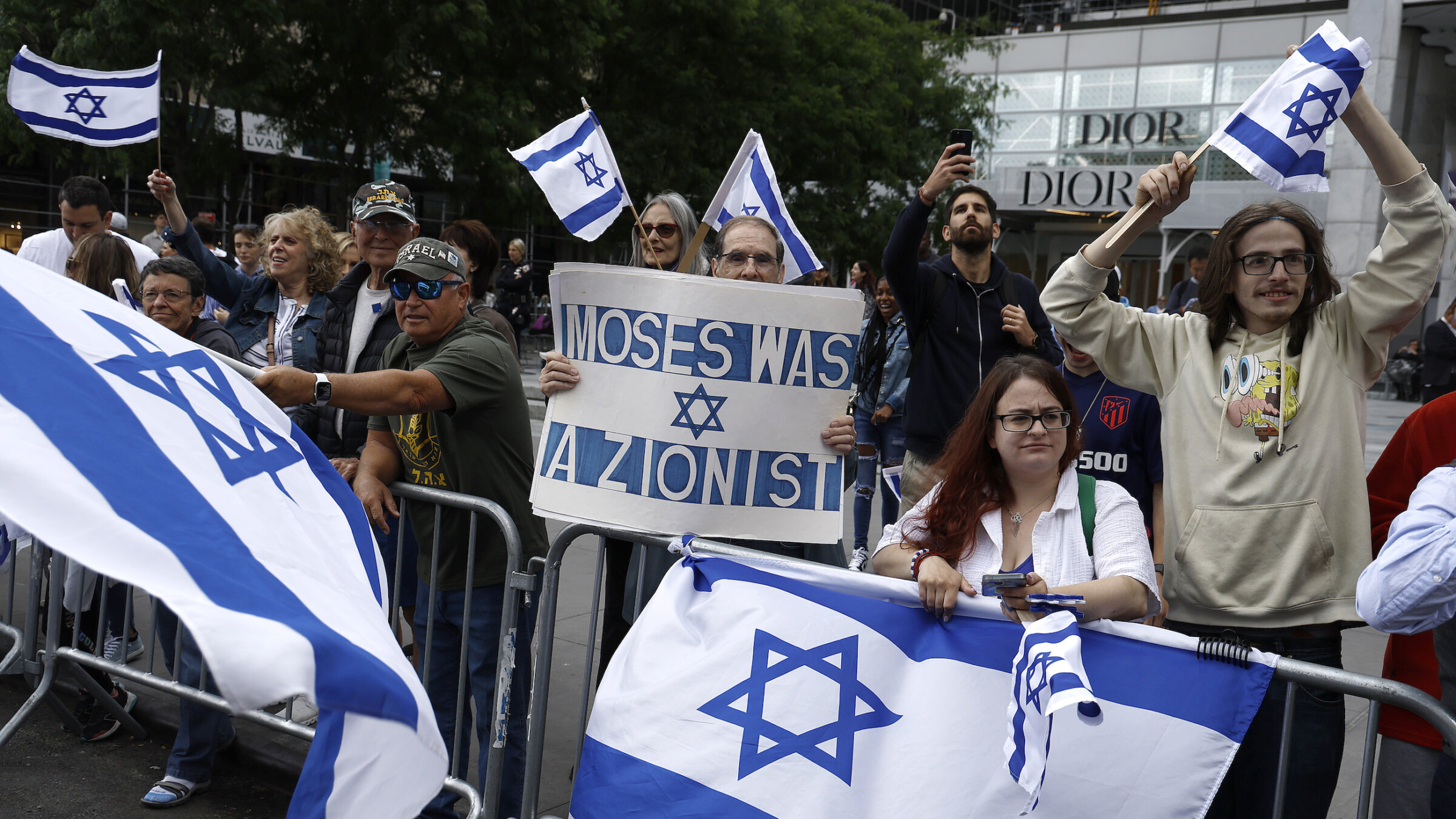
Bystanders cheer the 2023 Celebrate Israel Parade in New York City. Photo by John Lamparski/Getty Images

Columnist Dan Perry February 9, 2026
A new Jewish Federations of North America survey contained a shocking and confusing statistic: While just one-third of American Jews call themselves Zionists, almost 90% say they believe in Israel’s right to exist as a democratic Jewish state.
How could that be?
That finding has been widely read as evidence of a generational collapse in Jewish attachment to Israel. It is nothing of the sort. What it reveals instead is the collapse of confidence in a specific political ideal that, to many, no longer means what it once did.
For much of the 20th century, the term “Zionism” referred to a fairly straightforward and surprisingly normal proposition: that Jews constituted a people, not merely a religion, and therefore had a plausible claim to national self-determination.
The arguments around Zionism were not uniquely Jewish. They echoed similar ideas advanced about Poles, Greeks and Czechs. If Romania could be a Romanian country, the thinking went, Israel could be a Jewish one. Whether Israel should exist was not a particularly hard question. Where its borders should lie, how minorities within those borers should be treated, and how Palestinians displaced by war and state-building should be compensated were.
Even the word itself began modestly. It is widely believed to have been coined in 1890 by Nathan Birnbaum, a Jewish intellectual and activist, to give a name to an emerging political current associated with the Hovevei Zion movement: Jews who believed emancipation would be achieved through collective action.
The idea of a return to Zion was ancient, embedded in Jewish liturgy and longing. The term “Zionism,” by contrast, was new, and political.
That practical spirit carried into the work of Theodor Herzl, who used the term sparingly and without reverence. In his vision, Zionism was not an identity to be worn or a moral credential to be displayed. It was a solution to a political problem: the chronic vulnerability of a stateless people.
“I consider the Jewish question neither a social nor a religious one, even though it sometimes takes these and other forms. It is a national question,” he wrote in Der Judenstaat, his foundational text. “We are a people — one people.” Herzl laid out certain principles for answering that national question: international legitimacy mattered, minority rights within a future Jewish state were essential, and sovereignty imposed obligations rather than erased them. Zionism, he believed, could coexist with liberal norms and civic equality.
Today, that framework has eroded.
The moral mire of occupation
The occupation of the West Bank beginning after the 1967 Six-Day War fundamentally altered the moral landscape in which Zionism is understood.
Settler violence, seemingly permanent military rule over another people without the rights of citizens, a system of legal inequality, and terrible violence resulted. What was once a movement for national self-determination increasingly came to signify, in the public eye, territorial entitlement and moral indifference.
For many Jews, especially younger ones, the word “Zionism” began to feel less like a description of a political belief like any other than a demand for complicity in a reality they never chose.
The rise of Prime Minister Benjamin Netanyahu accelerated this corrosion. Because of his omnipresence in Israeli politics for the last three decades, it is his face many think of now when the term comes up. Over time, the idea of Zionism became rhetorically fused with Netanyahu’s political survival strategy, and, with it, contempt for liberal institutions and a narrowing of Jewish identity into a blunt instrument of power.
In the past, one could be a Zionist and still oppose specific Israeli governments, criticize military actions, or argue for far-reaching compromises with the Palestinians. Zionism was not an oath of loyalty to power; it was a framework for arguing about how Jewish sovereignty should be exercised and constrained.
In an era defined by occupation and Netanyahu’s political scheming, the term “Zionism” became welded to a politician known for corruption, cynicism and conflict. So for liberals — which most American Jews are — it became radioactive.
From specific ideal to vague slur
Then came the Hamas attack of Oct. 7, 2023.
The scale of Israeli suffering on that day might have created sympathy for Israel — but the disastrous war in Gaza that followed put an end to any such compassion. Israeli security officials do not dispute the estimate that the war killed 70,000 people in Gaza, of which half or more are likely to have been civilians. The images coming out of the strip for more than two years have showed scenes of utter devastation.
Layered onto this awful reality was an online ecosystem that rewards distortion. In activist spaces and on social media, the word “Zionist” became a slur, deployed with deliberate vagueness. It could mean “supporter of occupation,” “apologist for civilian deaths,” or simply “Jew with opinions about Israel.”
Bots and bad-faith actors amplified the worst definitions and drowned out the rest. In that climate, identifying as a Zionist began to feel like inviting a moral indictment.
The result is an increasingly familiar absurdity. I find myself appearing on leftist podcasts, listening to earnest but ill-informed commentators say they “suspect” I might be a Zionist, as though they were uncovering a hidden vice.
The irony is that I am a complete and total Zionist — under the original definition. Does it still apply?
I believe Jews are a people; that they have a right to a state; and that Israel’s legitimacy does not depend on being liked, only on existing within moral and legal constraints.
What I do not accept is the mutated version of Zionism that equates Jewish self-determination with permanent and non-democratic domination over another people.
Why does this definitional change matter?
When Jews stop identifying as Zionists, they abandon the clear, shared language that explains why Israel exists at all. That vacuum can be quickly filled with definitions supplied by Israel’s most illiberal defenders and most hostile critics. Without “Zionism” as an acceptable term, it becomes easier to portray Israel as illegitimate by definition. And it becomes easier for people who hate Jews to pretend that they hate “Zionists” instead.
Can the term be reclaimed? That would require an Israel that behaves better. Even then, undoing the damage will be an uphill battle. And of course, many of Zionism’s critics will never be pacified. The strange durability of the phenomenon known as antisemitism makes that crystal clear.
This is a moment of great uncertainty. Here’s what you can do about it.
We hope you appreciated this article. Before you go, we’d like to ask you to please support the Forward’s independent Jewish news this Passover. All donations are being matched by the Forward Board - up to $100,000.
This is a moment of great uncertainty for the news media, for the Jewish people, and for our sacred democracy. It is a time of confusion and declining trust in public institutions. An era in which we need humans to report facts, conduct investigations that hold power to account, tell stories that matter and share honest discourse on all that divides us.
With no paywall or subscriptions, the Forward is entirely supported by readers like you. Every dollar you give this Passover is invested in the future of the Forward — and telling the American Jewish story fully and fairly.
The Forward doesn’t rely on funding from institutions like governments or your local Jewish federation. There are thousands of readers like you who give us $18 or $36 or $100 each month or year.
Support our mission to tell the Jewish story fully and fairly.