For the titans of industry in Nazi Germany and Trump’s America, silence and complicity enable authoritarianism
America’s tech leaders should heed a listen from the tycoons who enabled Hitler’s consolidation of power
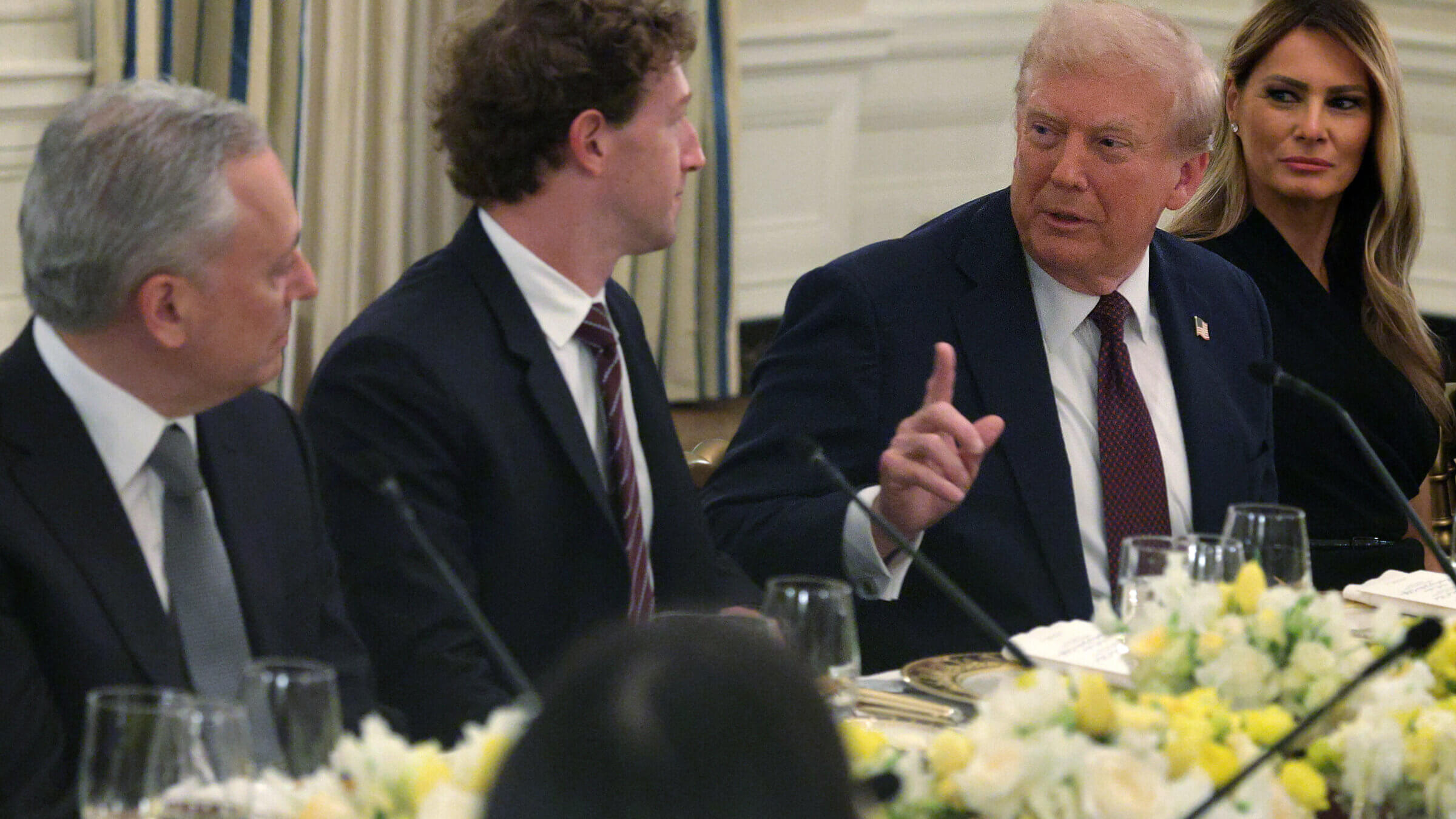
David Scahs, Mark Zuckerberg, Donald and Melania Trump at a dinner Trump hosted for tech and business leaders. Photo by Alex Wong/Getty Images

Terrence Petty February 11, 2026
On a frosty February day in 1933, Adolf Hitler summoned 24 of Germany’s leading industrialists to a government palace in Berlin to enlist them in dismantling the last vestiges of democracy. When it was over, the high priests of commerce and industry had donated a total of 2.1 million Reichsmarks to the Nazi Party.
Last September, at the White House in Washington, D.C., 15 American tech executives sat down for dinner with Donald Trump. For eight months, Trump had been steering the country closer to authoritarianism. Yet instead of challenging him, the executives praised him. Google co-founder Sergey Brin lauded Trump for “supporting our companies instead of fighting with them.” Sam Altman, the OpenAI CEO, thanked him for being a “pro-business, pro-innovation president,” calling him “a very refreshing change.”
German industrialists’ money helped Hitler win enough support in the Reichstag to pass an Enabling Act granting him dictatorial power. American corporate executives’ silence about the path Trump has taken the country down has functioned as a different kind of currency — one that signals to the public that democratic backsliding is tolerable so long as the markets stay calm and the profits keep flowing.
While the political, economic and social circumstances surrounding Hitler’s meeting with industrialists and Trump’s with tech leaders are quite different, moments like these reveal the enduring symbiosis between political power and private capital — and the democratic vulnerabilities that emerge when corporate flattery eclipses civic responsibility.
After arriving at the imposing Reichstag Presidential Palace, the 24 industrialists were ushered into one of its heavily ornamented grand salons. When Hitler entered, he spent 90 minutes promising to smash the left, protect private enterprise, end lawlessness, lead Germany out of its economic crisis, and — most enticing of all — reward German companies with lucrative contracts as he rebuilt the military. The titans of industry were impressed.
Hitler then left the room, leaving Hermann Göring to pass the proverbial hat. The captains of industry had come prepared. Before they walked out of the palace, the Nazi Party had collected 2.1 million Reichsmarks to fuel its Reichstag campaign. The Nazis’ victory in that election gave Hitler the backing he needed to pass the Enabling Act. The Reichstag Fire Decree of February 28 had already gutted democracy by suspending civil liberties and unleashing mass arrests of political opponents. The March 23 Enabling Act supplied the final shovels of dirt, burying parliamentary democracy for the next 12 years.
Hitler came through with all of his promises, and in the process German companies became deeply complicit in his crimes against other countries and against civilians — setting up slave labor camps outside places of mass murder like Auschwitz, and feeding a war machine that killed tens of millions across Europe. These companies were the same ones represented at that fundraising meeting in February 1933. After the Nazis’ defeat, only a handful of German corporate executives were held to account. Most were able to resume powerful positions in postwar Germany.
America’s 21st-century tech titans are not war criminals, nor are they anything like the industrialists who built Hitler’s arsenal. They have thrived in a democracy that has rewarded their ingenuity, protected their freedoms, and made many of them fabulously wealthy. But that is precisely why their reluctance to call Trump to account for the damage he has done to democratic norms is so disconcerting — and so dangerous.
The video of their dinner at the White House makes that reluctance painfully clear. The executives sit around a long table in the State Dining Room, leaning forward, smiling, nodding eagerly as Trump speaks. They offer him compliments. They laugh at his jokes. No one raises a concern about democratic institutions, the rule of law, or the direction of the country.
The killings of Renee Good and Alex Pretti appear to have jolted at least some tech leaders out of that posture of deference. Yann LeCun, Meta’s former chief AI scientist, reposted the video of Alex Pretti’s killing with a single, furious caption: “M U R D E R E R S.” Hemant Taneja, CEO of General Catalyst, warned that “what we are seeing in Minnesota is a threat to those core tenets and to the promise of America.” Venture capitalist Vinod Khosla condemned the federal agents as “macho ICE vigilantes running amuck,” while Google DeepMind’s Jeff Dean called on “every person regardless of political affiliation” to denounce the escalation of violence. James Dyett, a senior executive at OpenAI, noted that “there is far more outrage from tech leaders over a wealth tax than masked ICE agents terrorizing communities.”
Sam Altman and Apple CEO Tim Cook, both of whom had lavishly praised Trump at the tech titans’ dinner, also said ICE had gone too far.
This must be said about Corporate America: its leaders, unlike the industrialists of Nazi Germany, have not been actively complicit in any effort to topple democracy. In the American system, doing so would amount to corporate suicide. But they have weakened democratic culture in quieter ways — such as treating free expression as expendable if it threatens profits. You can see it in the major-network settlements that chilled political reporting at ABC and CBS, and in the efforts to sideline late-night hosts like Jimmy Kimmel and Stephen Colbert.
Jeff Bezos’ $40 million contract with the Trumps for the documentary Melania is another example of this instinct. Bezos kept his distance from the Jan. 29 Melania premiere. But less than a week later the Bezos-owned Washington Post announced it was laying off more than 300 journalists
One of the gravest threats to American democracy today is the fusion of state authority with the private empires of tech tycoons like Elon Musk and Peter Thiel, whose control of critical communications and data-analytics infrastructure gives politically aligned capitalists the capacity to assist an administration intent on expanding executive power.
Civil-liberties activists and several members of Congress have warned that concentrating federal data systems — especially when augmented by advanced AI — creates a structural vulnerability for democracy. Such an architecture, they argue, could be turned toward political ends: monitoring critics, chilling dissent, or enabling forms of surveillance that become far harder to detect or challenge once they are woven into the machinery of government.
The German industrialists who helped Hitler consolidate power largely escaped accountability, their complicity swept under the carpet as Soviet Communism replaced fascism as the perceived greater threat to the West. Will our own era face a reckoning? When future generations look back, they may well ask what America’s most powerful corporate leaders did when democracy was faltering — and whether their silence helped steady the republic, or hastened its decline.
This is a moment of great uncertainty. Here’s what you can do about it.
We hope you appreciated this article. Before you go, we’d like to ask you to please support the Forward’s independent Jewish news this Passover. All donations are being matched by the Forward Board - up to $100,000.
This is a moment of great uncertainty for the news media, for the Jewish people, and for our sacred democracy. It is a time of confusion and declining trust in public institutions. An era in which we need humans to report facts, conduct investigations that hold power to account, tell stories that matter and share honest discourse on all that divides us.
With no paywall or subscriptions, the Forward is entirely supported by readers like you. Every dollar you give this Passover is invested in the future of the Forward — and telling the American Jewish story fully and fairly.
The Forward doesn’t rely on funding from institutions like governments or your local Jewish federation. There are thousands of readers like you who give us $18 or $36 or $100 each month or year.
Support our mission to tell the Jewish story fully and fairly.