Trump is poised to reinforce Iran’s regime — despite Netanyahu’s pressure
There was no sign that a Wednesday meeting between the two leaders advanced Israel’s priorities
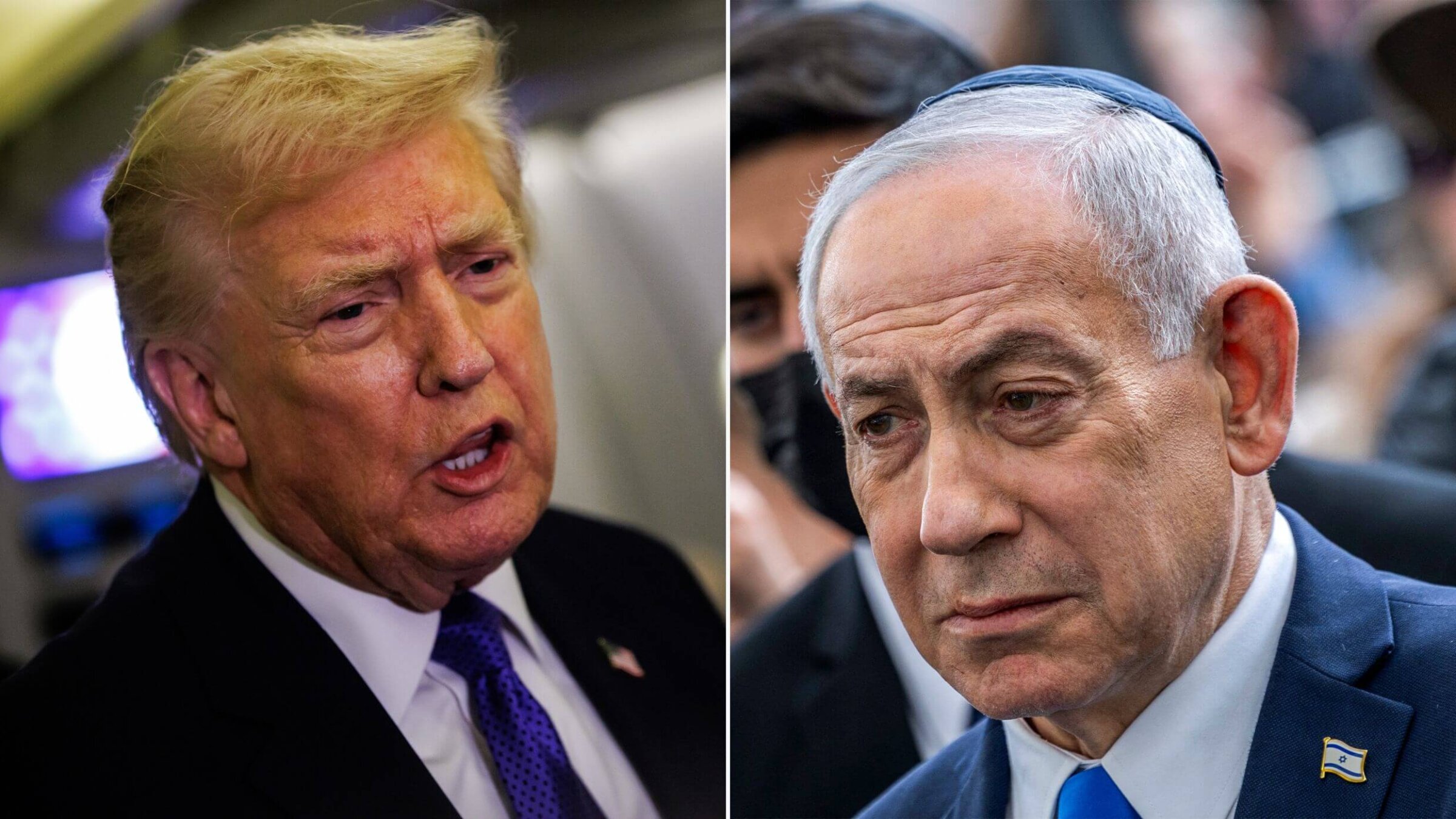
President Donald Trump and Israeli Prime Minister Benjamin Netanyahu appear to still be at odds over Iran. Photo by Samuel Corum/Chaim Goldberg/Pool/AFP via Getty Images

Columnist Dan Perry February 11, 2026
President Donald Trump’s Wednesday meeting with Israeli Prime Minister Benjamin Netanyahu took place with an air of urgency around Iran. Yet the men left their three-hour conclave without resolving a fundamental divergence: Israel is deeply suspicious of any agreement with the Islamic Republic, and Trump has a visible preference for keeping diplomacy alive.
So visible, in fact, that Trump announced on Truth Social after the meeting that negotiations with Iran will continue. Where does that leave Israel, which is deeply concerned that Trump, in search of a quick win, will go for a deal that eases sanctions — strengthening the Iranian regime at precisely the time when it seems brittle enough to fall? And what about Iranian critics of the regime, who have good reason to feel betrayed by an American president who encouraged them to protest, and now seems poised to pursue accommodation with the authorities who had protesters killed en masse?
Of course, nothing in the Trump era can be analyzed with absolute certainty. Strategic misdirection is a recognized feature of even normal statecraft, and Trump has elevated unpredictability into something close to doctrine. Yet even allowing for that ambiguity, the meeting made clear that Israel and the United States are not aligned on an absolutely key issue — a potentially perilous state of affairs.
What does Israel want?
Israel does not trust the Iranian regime, for myriad reasons. The Islamic Republic’s missile programs, its sponsorship of proxy militias, and its long record of hostility toward Israel are viewed as elements of a single strategic problem.
Because of that deep and deeply justified mistrust, Israel is wary of any deal that might stabilize or legitimize the regime — a risk raised by Trump’s interest in a new nuclear deal. Israeli leaders are concerned about long-term risk. A renewed agreement focused narrowly on nuclear restrictions would almost inevitably entail sanctions relief or broader economic normalization. Such measures, from Jerusalem’s perspective, would strengthen the very Iranian system that has spent decades spreading havoc across the region.
That doesn’t mean Israel would prefer immediate military confrontation, or that it will speak out against any deal. An agreement that would dismantle Iran’s expanding missile range, including systems capable of reaching Europe, and cut funding from its network of allied armed groups — Hezbollah in Lebanon, Shiite militias in Iraq, the Houthis in Yemen, and the Palestinian factions Hamas and Islamic Jihad — would possibly be of interest. Trump has so far not publicly stressed those demands.
Israel is politically divided, but when it comes to Iran, a broad consensus cuts across political lines. The regime must fall or radically change, for the sake of human rights within Iran’s borders, and that of a healthy regional future outside them.
What does Trump want?
The American position is less straightforward, largely because it is filtered through Trump’s distinctive political style and his limited regional knowledge. Trump often appears unbothered by expert and public opinion; he seeks drama, through visible wins, deals, and dramatic reversals. He will present any outcome as an amazing achievement that no predecessor could have hoped for — even if he ends up signing an agreement that looks quite a lot like former President Barack Obama’s 2015 nuclear deal, which he walked away from in 2018.
Trump’s broader worldview might provide insight. Unlike earlier American administrations that explicitly championed democracy promotion, with mixed results, Trump’s national security posture has consistently downplayed ideological missions. His rhetoric and policy frameworks have reflected skepticism toward efforts to reshape other societies’ political systems, instead emphasizing transactional relationships and the avoidance of prolonged entanglements.
This orientation is reinforced by his political base. A significant segment of MAGA-aligned voters wants a more isolationist foreign policy. Within that framework, negotiations that promise de-escalation and risk reduction are politically attractive. Military confrontation, by contrast, carries unpredictable costs.
Trump’s posture, oscillating between threats of force and enthusiasm for negotiation, reflects the strange truth that American political alignments on Iran defy traditional expectations, with hawkishness losing favor on the right. He has preserved the military option while simultaneously projecting optimism about a deal. Meanwhile, a huge and growing armada is parked in the waters near Iran.
What does Iran want?
Assessing Iranian intentions is notoriously difficult. The regime’s history of opaque decision-making, tactical deception, and disciplined negotiation complicates any definitive reading.
Yet certain baseline assumptions are reasonable. First, the regime seeks survival. Whatever ideological ambitions authorities may harbor, self-preservation remains paramount. Sanctions relief, economic stabilization, and reduced risk of direct confrontation with the U.S. all serve that objective.
Second, Iran is unlikely to accept a permanent prohibition on uranium enrichment, particularly at civilian levels. Tehran has consistently framed demands for “zero enrichment” as infringements on sovereignty — a defensible position under the Nuclear Non-Proliferation Treaty.
Third, the regime has strong incentives to resist constraints on its missiles and militias, even though the militias are completely indefensible. But the regime exists, essentially, to export jihad, and those groups have been a central pillar of Iran’s project for decades.
Could the Iranian regime be brought down?
This question lurks behind every discussion of Iran, though policymakers rarely address it directly. Regime change, while rhetorically invoked at times, presents immense practical challenges. Many observers doubt that aerial strikes alone could produce political collapse. Modern regimes, particularly those with entrenched security apparatuses, rarely disintegrate solely under external bombardment. Iran’s leadership has demonstrated resilience under severe economic and military pressure, maintaining internal control despite periodic unrest.
That means meaningful regime destabilization would almost certainly require fractures within the state’s military, intelligence, and security forces, or coordinated ground dynamics that external actors can neither easily predict nor control. Such scenarios introduce enormous risks, including civil conflict, regional spillover and severe disruptions to global energy markets.
The regime’s brutality may reinforce its durability. A leadership willing to impose extreme domestic repression is less vulnerable to popular pressure than one constrained by public accountability. Last month Trump suggested the U.S. would support the protesters; that pledge appears to no longer be on his radar. The protesters were not seeking a better nuclear deal — which is now his apparent sole focus — but better lives.
So what happens now?
All of this suggests that Israel will be unhappy with any outcome to this period of tensions. It is much less likely that pressure from Trump will bring real reform to the Iranian regime than that Trump will sign off on a deal that counters Israel’s long-term interests.
In the coming days, it may become clearer whether Netanyahu persuaded Trump to expand the scope of negotiations to include Iran’s missile program and its network of proxy militias. It is also possible that talks will collapse, and that military action will follow.
But this much is clear: If the regime survives intact and is strengthened in the process, that would be a profound tragedy. For 47 years, the Islamic Republic has oppressed its own people while exporting instability across the Middle East. That is roughly the same span of time that communism endured in Eastern Europe before popular unrest finally brought it down.
Only a month ago, there was a palpable sense that the Iranian people were courageously pressing for a similar reckoning. To reward a weakened and discredited regime at such a moment by helping it stabilize itself — in exchange for promises about uranium enrichment alone — would be a historic missed opportunity.
This is a moment of great uncertainty. Here’s what you can do about it.
We hope you appreciated this article. Before you go, we’d like to ask you to please support the Forward’s independent Jewish news this Passover. All donations are being matched by the Forward Board - up to $100,000.
This is a moment of great uncertainty for the news media, for the Jewish people, and for our sacred democracy. It is a time of confusion and declining trust in public institutions. An era in which we need humans to report facts, conduct investigations that hold power to account, tell stories that matter and share honest discourse on all that divides us.
With no paywall or subscriptions, the Forward is entirely supported by readers like you. Every dollar you give this Passover is invested in the future of the Forward — and telling the American Jewish story fully and fairly.
The Forward doesn’t rely on funding from institutions like governments or your local Jewish federation. There are thousands of readers like you who give us $18 or $36 or $100 each month or year.
Support our mission to tell the Jewish story fully and fairly.