The dark message behind Tucker Carlson’s attempt to drum up drama in Israel
A political stunt shows the country has a problem brewing stateside
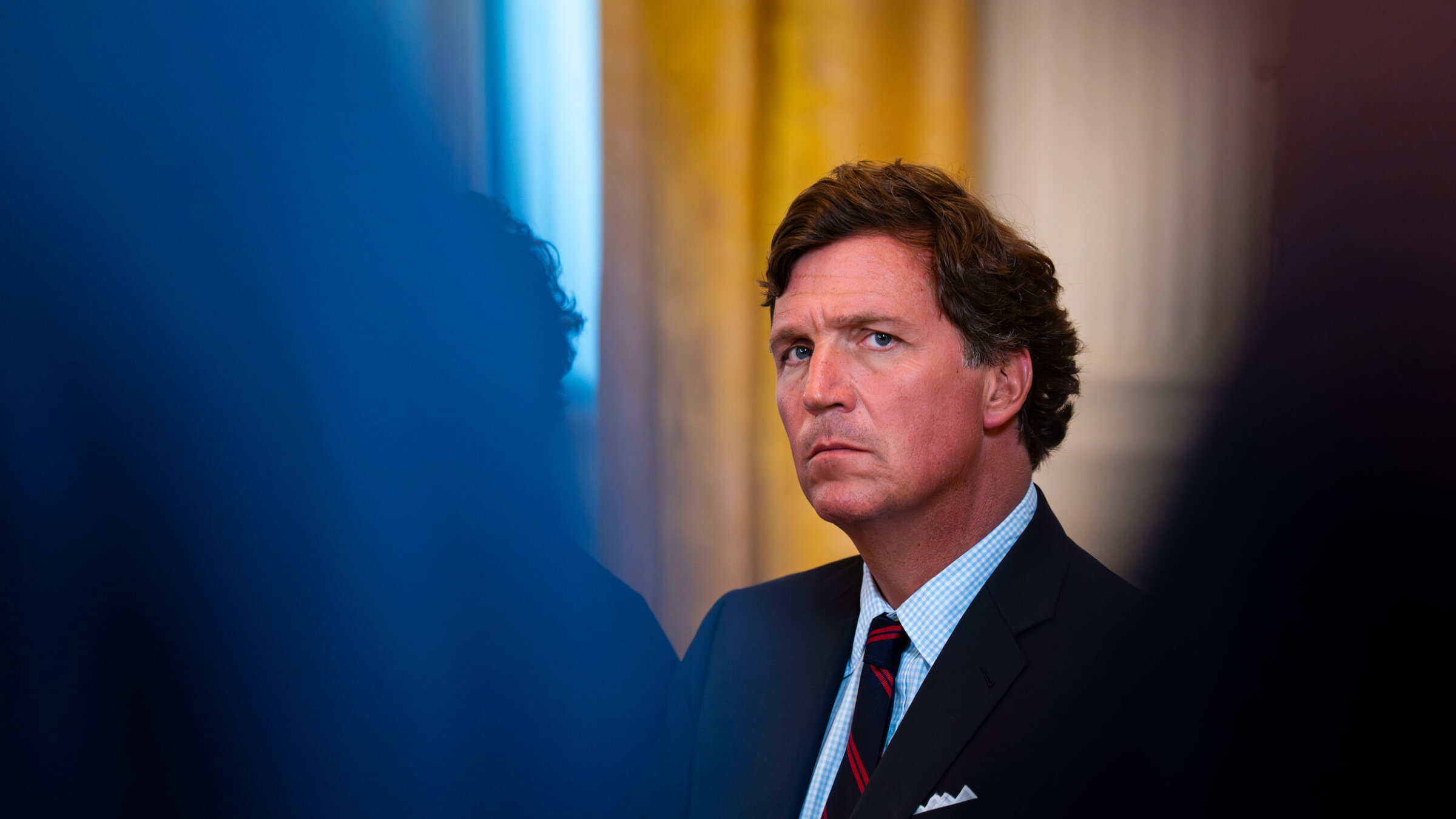
Tucker Carlson attends a meeting in the East Room of the White House on Jan. 9. Photo by Al Drago/Getty Images

Columnist Dan Perry February 18, 2026
Tucker Carlson’s visit to Israel lasted only a few hours — not long enough to experience the country, but sufficient to stage a performance.
Carlson claimed he had experienced “bizarre” treatment at Ben-Gurion Airport, a description that Israeli and U.S. officials dismissed. What actually happened: He underwent routine security questioning on his way to interview United States Ambassador Mike Huckabee.
In Israel, Carlson’s outrage was widely received with a mixture of indifference and eye-rolling. But Israelis with their ears to the ground understood that his attempt to stir the pot means they have a problem brewing in American public opinion — and a more immediate problem with public relations.
Because Carlson’s airport drama was never about Israeli airport procedures. It was about American politics, an arena in which Carlson has built a lucrative post-Fox career selling a particular worldview: one suspicious of alliances, contemptuous toward interventionism, and invested in the conspiratorial belief that shadowy forces distort American sovereignty.
Israel, in this rhetorical universe, functions as a convenient prop in a broader narrative of elite manipulation and national victimhood.
Carlson and Huckabee, the man he traveled across the world to interview, now personify two increasingly incompatible strains of MAGA politics. Huckabee represents something recognizable to mainstream conservatives: He’s traditionalist, evangelical, instinctively pro-Israel and broadly aligned with America’s historical posture as a global power.
Carlson speaks, instead, to a newer faction defined by nationalist retrenchment, hostility to foreign entanglements, and an often-startling indifference to liberal democratic norms. He has been scathingly critical of U.S. support for Israel in its war with Hamas and has backed far-right conspiracy theories about whites being “replaced” by people of color. And when he attacks evangelicals like Huckabee for supporting Israel too much, there is extra value in the antisemitic dog whistle for the white supremacists with whom he is popular.
Call it deep MAGA: a coalition that regards alliances as burdens, admires strongmen — including and especially Vladimir Putin — and deeply disdains anyone who cares about democratic values and their promotion around the world. This large and growing constituency within American conservatism is eager for narratives that recast foreign policy debates as struggles against manipulation rather than disagreements over strategy. And Israel fits neatly into that story.
Carlson’s brief airport encounter was therefore not a journalistic episode, but content generation. The grievance was the product.
Nothing about the incident requires serious factual dispute to achieve its purpose. Its value lies in symbolism, not accuracy. Whether Carlson genuinely subscribes to every element of this worldview is, at this point, almost irrelevant. His extraordinary success after leaving Fox News suggests he understands his audience perfectly. He is not drifting toward obscurity by embracing this kind of stunt; he is responding to market demand.
In doing so, he is illustrating a story about a Republican Party negotiating an identity crisis.
President Donald Trump, widely seen in Israel as a huge friend, is not a reliable ally. If the wing behind Carlson becomes clearly stronger than that behind Huckabee, there’s no telling whether he would hew to their demands. His loyalties are famously contingent, and he has shown little hesitation in entertaining figures once considered radioactive within mainstream Republican politics.
In a movement defined by power, primacy will belong not to the most coherent worldview but to the most electorally useful one.
For Israel, the implications are uncomfortable. The country has long relied on the assumption that American support is both durable and bipartisan. Prime Minister Benjamin Netanyahu badly upset that applecart by so clearly aligning himself with the Republican Party at large, and Trump specifically.
In growing sections of the progressive left, Israel is framed as a colonial antagonist, and Israel’s support on the Democratic side of the public is in free-fall. On parts of the populist right, it is cast as an entangling liability or worse. The political center sustaining the relationship is shrinking.
Carlson did not invent this shift. But he is capitalizing on it. Netanyahu’s outrageous behavior — including his alignment with the fascist underbelly of Israeli politics and enabling of the ultra-Orthodox establishment — is causing a rift with U.S. Jews, and giving pundits like Carlson tailwind.
If a media entrepreneur of Carlson’s sophistication believes there is a vast audience for rhetoric that treats Israel as suspect, burdensome, or undeserving of American backing, Israeli policymakers would be unwise to dismiss the signal.
Carlson’s Ben-Gurion theatrics were undeniably entertaining. What they reveal about the trajectory of American politics — and Israel’s place within it — is rather less amusing.
This is a moment of great uncertainty. Here’s what you can do about it.
We hope you appreciated this article. Before you go, we’d like to ask you to please support the Forward’s independent Jewish news this Passover. All donations are being matched by the Forward Board - up to $100,000.
This is a moment of great uncertainty for the news media, for the Jewish people, and for our sacred democracy. It is a time of confusion and declining trust in public institutions. An era in which we need humans to report facts, conduct investigations that hold power to account, tell stories that matter and share honest discourse on all that divides us.
With no paywall or subscriptions, the Forward is entirely supported by readers like you. Every dollar you give this Passover is invested in the future of the Forward — and telling the American Jewish story fully and fairly.
The Forward doesn’t rely on funding from institutions like governments or your local Jewish federation. There are thousands of readers like you who give us $18 or $36 or $100 each month or year.
Support our mission to tell the Jewish story fully and fairly.