You could be imprisoned for praying at the Western Wall — and Bibi isn’t stopping it
What a looming vote reveals about the governing coalition’s direction, and Israel’s future
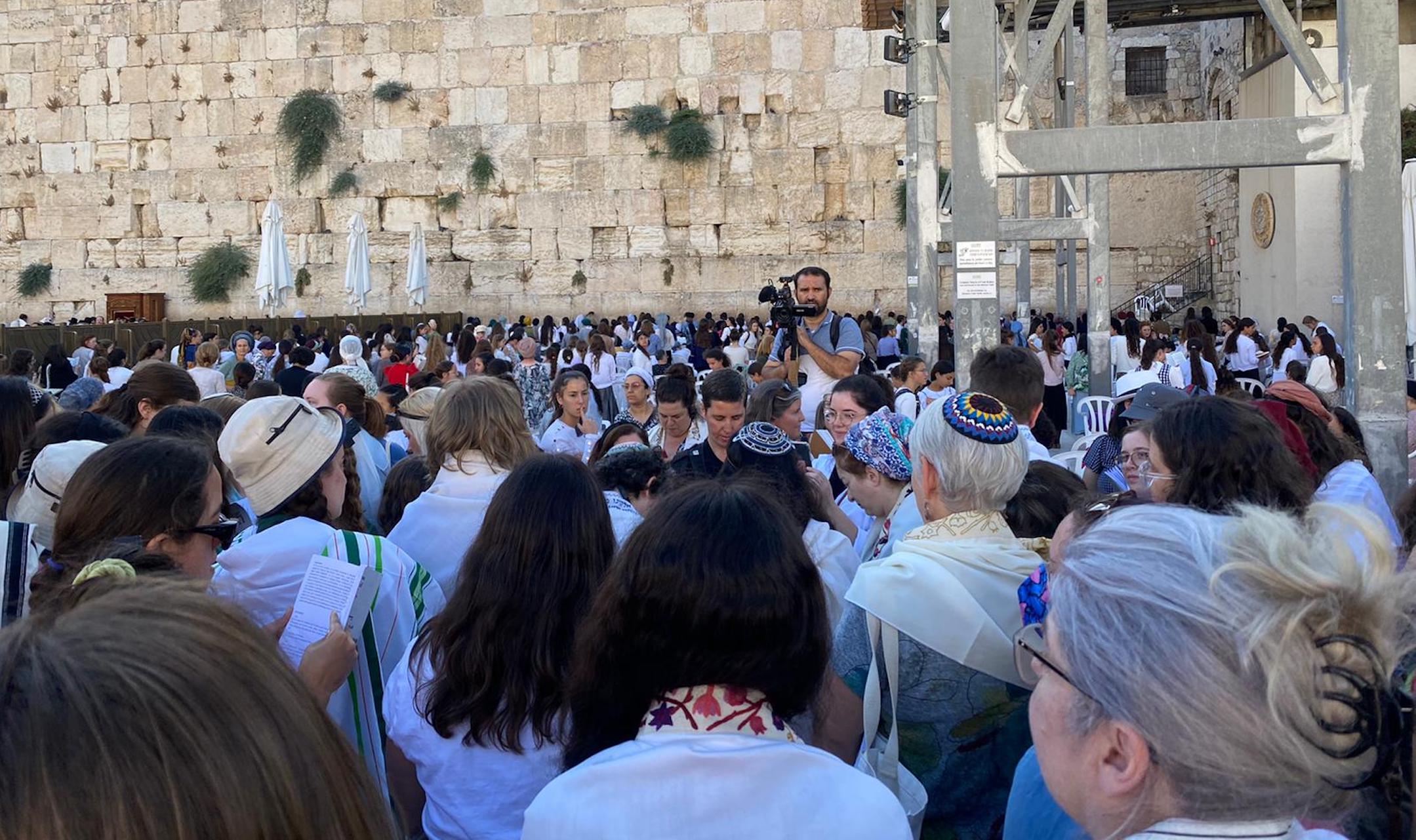
Thousands of protesters gathered around non-Orthodox women, including a bat mitzvah girl and her family, at the Western Wall, July 29, 2022. Photo by Noga Tarnopolsky

Columnist Dan Perry February 22, 2026
Sometimes a single episode reveals much about the big picture. Israeli Prime Minister Benjamin Netanyahu’s decision on Sunday to cancel a ministerial committee vote on legislation that would effectively criminalize egalitarian prayer at the Western Wall is one such moment. He was seeking to avoid friction with U.S. Jews on the day of a virtual appearance at an AIPAC event, but they should not be fooled: His coalition is in conflict with most of them.
The bill was backed by Justice Minister Yariv Levin of Netanyahu’s Likud Party, and its author, far-right coalition member Avi Maoz, is planning to table it for a Knesset vote Wednesday, even without official government backing. Whether or not it passes, it is an accurate window into the essence of the Netanyahu religious-right coalition.
The proposed bill would grant the ultra-Orthodox–controlled Chief Rabbinate exclusive authority to determine what constitutes “desecration” at Jewish holy sites, including the Western Wall, with violations punishable by five to seven years in prison. In practice, this would almost certainly place non-Orthodox streams of Judaism — Reform, Conservative, Reconstructionist — alongside Women of the Wall and other egalitarian prayer groups at legal risk for engaging in forms of worship embraced by millions of Jews worldwide.
Yes: Jews would face imprisonment for praying according to their tradition at Judaism’s most resonant site.
Netanyahu’s intervention, while politically astute, should not reassure anyone. He did not repudiate the legislation nor mobilize his party to bury it, but rather postponed a committee vote that would have bound coalition members to support it. The bill remains alive, capable of advancing through Knesset procedures.
Only days earlier, Israel’s Supreme Court issued a ruling calling on the state and the Jerusalem municipality to act “with the requisite speed and diligence” to advance long-delayed renovations at the egalitarian prayer area known as Robinson’s Arch. The bill is the backlash, and it is the latest flare-up in a legal dispute stretching back nearly a decade, to the Western Wall compromise approved in 2016.
That arrangement was designed to provide non-Orthodox streams with a larger, visible, and accessible prayer space under their own jurisdiction — a framework meant to respect Jewish pluralism and the diversity of Jewish practice around the world. But in 2017, under pressure from ultra-Orthodox coalition partners who do not recognize the legitimacy of Conservative and Reform Judaism, the compromise was scrapped by Netanyahu’s government, triggering a deep rupture with many diaspora Jews.
After the compromise collapsed, petitions from the Reform and Conservative movements and Women of the Wall led the court to repeatedly prod the government to implement the egalitarian plaza upgrades. The state assured the court that renovations would proceed; the work was slated to take ten months. Nearly ten years later, the project sits unfinished.
Against this backdrop, the proposed legislation is a massive escalation that aims to deal a coup-de-grace to the project of bringing Jewish pluralism at the site. Yizhar Hess, vice chairman of the World Zionist Organization and former head of the Conservative-Masorti movement in Israel, called the bill “a declaration of war on world Jewry,” saying that it is “hard to think of a less Zionist, less Jewish and more damaging proposal.”
The Western Wall controversy is not just about prayer arrangements, containing an even larger lesson about what is in store in case of an election victory this year by the Netanyahu regime. (At this point the word “regime” is appropriate, because the coalition is bound to change the character of the country, perhaps decisively.)
First, the consolidation of ultra-Orthodox power will accelerate, pushing Israel closer to a functional theocracy. Religious parties have mastered the leverage that coalition arithmetic grants them, when there is a Likud-based rightist government, extracting concessions vastly disproportionate to their electoral weight. Each bargain yields further privileges: increased budgets for religious institutions, sweeping exemptions, expanded authority for religious courts, and now the potential criminalization of non-Orthodox worship at key sites. A law targeting egalitarian prayer would be a milestone.
Following that, non-Orthodox streams of Judaism — central to Jewish identity in the United States, Latin America, Europe and beyond — will face growing marginalization. Diaspora Jews, most of whom identify with non-Orthodox traditions, understandably view such moves as assaults on their place within the Jewish collective. The damage this will cause Israel-Diaspora relations should be obvious — but many are not awake to the coming storm.
Moreover, this will soon expand into the lives of Israelis, where Orthodoxy (but not ultra-Orthodoxy) indeed holds sway among the roughly half of Jews who are at all observant. The authority of rabbinical courts will expand further into civilian life. Israel already grants religious institutions significant power over personal status issues such as marriage, divorce and burial. Coalition dynamics encourage relentless pressure for broader jurisdiction, deeper enforcement powers and reduced secular oversight. Control over ritual space rarely ends there. It extends into family law, gender norms, educational frameworks, and public behavior. Efforts to enact some public transport and commerce on the Sabbath would be killed.
Another Netanyahu government can be expected to double down on territorial maximalism — especially settlement expansion — with the goal of making Israel’s entanglement with the West Bank irreversible. The likely result is not clean annexation but a de facto indivisible space containing two populations governed by unequal systems. This non-democratic binational reality is not the Jewish democracy envisioned by Israel’s founders and will be condemned by almost the entire world — including many in the United States — as a variant of apartheid. Israel can expect economic sanctions.
Finally, the coalition will see itself vindicated as regards its effort to eviscerate the independence of the court system — a project capped by the proposal to allow the Knesset to overturn court rulings via a simple majority. That effort has been partly put on hold by the mass protests of 2023 and the years of war sparked by the Oct. 7 massacre. Expect it to return with a vengeance, aiming to turn Israel into an elected autocracy in the mold of Recep Tayyip Erdogan’s Turkey or Viktor Orban’s Hungary.
The Western Wall controversy should thus be read not as an isolated skirmish, but as a diagnostic event — a glimpse of a possible future that many Israelis and Jews worldwide would find profoundly troubling, and indeed potentially fatal to any possibility for wide Jewish support for Israel.
World Jewry should call Netanyahu to account on all these outrages.
This is a moment of great uncertainty. Here’s what you can do about it.
We hope you appreciated this article. Before you go, we’d like to ask you to please support the Forward’s independent Jewish news this Passover. All donations are being matched by the Forward Board - up to $100,000.
This is a moment of great uncertainty for the news media, for the Jewish people, and for our sacred democracy. It is a time of confusion and declining trust in public institutions. An era in which we need humans to report facts, conduct investigations that hold power to account, tell stories that matter and share honest discourse on all that divides us.
With no paywall or subscriptions, the Forward is entirely supported by readers like you. Every dollar you give this Passover is invested in the future of the Forward — and telling the American Jewish story fully and fairly.
The Forward doesn’t rely on funding from institutions like governments or your local Jewish federation. There are thousands of readers like you who give us $18 or $36 or $100 each month or year.
Support our mission to tell the Jewish story fully and fairly.