Benjamin Disraeli once saved Britain’s monarchy — the current one may be beyond repair
Today’s crises at Buckingham Palace have created problems that even Britain’s first Jewish prime minister could not have solved
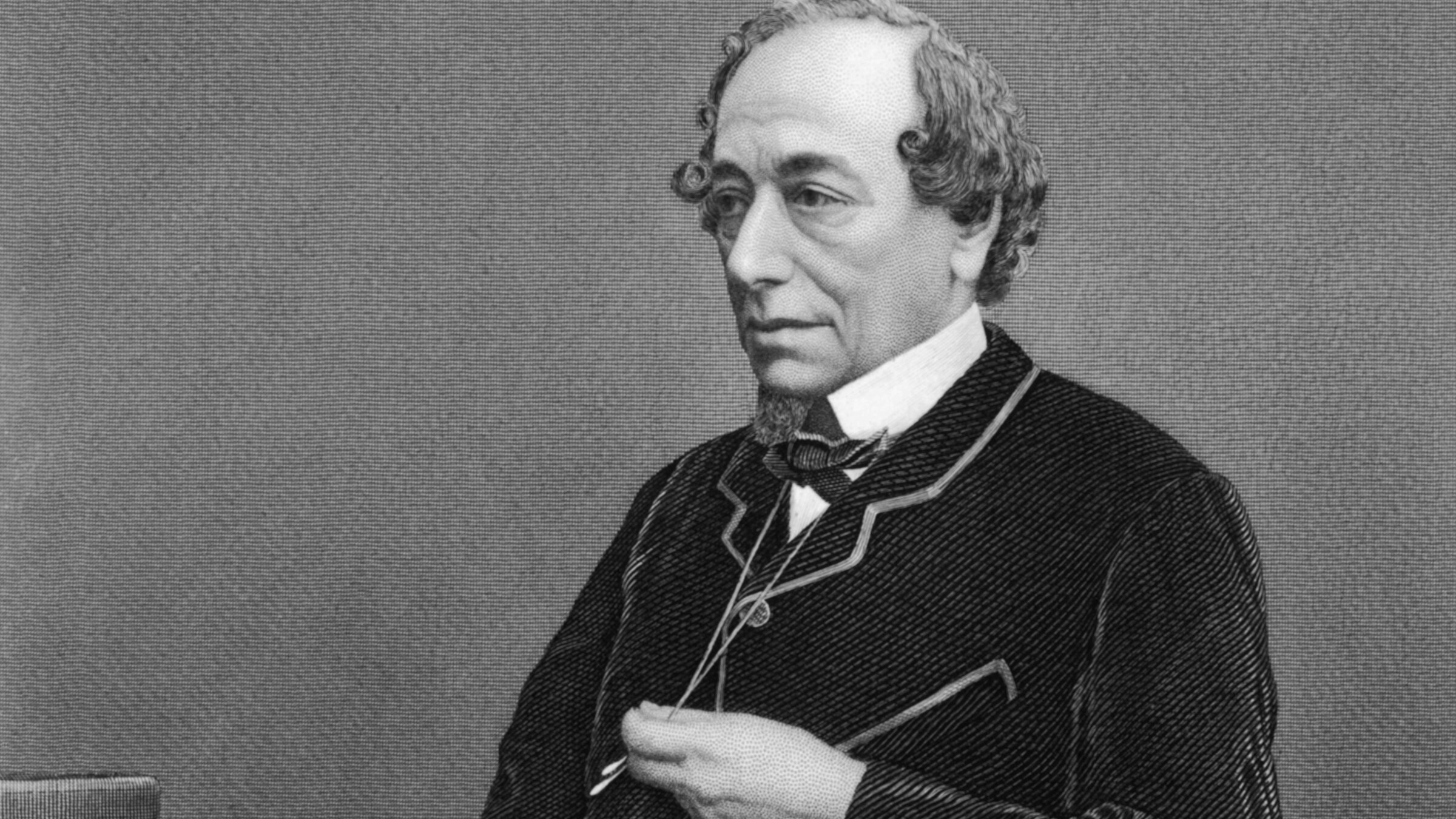
Benjamin Disraeli, Prime Minister of Great Britain, circa 1870. Photo by Underwood Archives/Getty Images

Robert Zaretsky February 23, 2026
How ironic that the crisis confronting the British monarchy, sparked by the former Prince Andrew’s ties to Jeffrey Epstein, has occurred on the 145th anniversary of the death of the man in part responsible for reinventing that same institution: Benjamin Disraeli.
In fact, not only did Disraeli transform the monarchy, but as the first (and last) Jew to serve as Britain’s prime minister, he also transformed his religious background from a political liability into a political plus. And he accomplished both one and the other by bringing “poetry, romance, and chivalry” into the life of the person who uttered those words, Queen Victoria. So much so that, upon his death in 1881, she confessed, “I have lost so many dear and valued friends, but none whose loss will be more keenly felt.”
Not a bad send-off for a commoner whose family’s religion still prevented them from holding political office or attending Oxford or Cambridge up until the second half of the century.
Starting in his early twenties, Disraeli began to write wildly romantic (and self-promoting) novels, several of which star a brilliant and, predictably, mysterious hero named Sidonia, who prides himself, as did his (possibly mistakenly) creator, on his Sephardic ancestry. Disraeli uses Sidonia to turn the era’s racial prejudices inside out, having him wax on the brilliance of his race’s civilization while the ancestors of the British aristocracy were still mucking about as “Baltic pirates” and “tattooed savages.”
Similarly, when the Irish politician Daniel O’Connell made an antisemitic slur against the twenty-something Disraeli, the latter — in a fashion worthy of Sidonia — declared “Yes, I am a Jew. And when the ancestors of the right honorable gentlemen were brutal savages in an unknown island, mine were priests in the temple of Solomon.” He then challenged O’Connell to a duel, which was happily quashed by the police.
With the same alchemical genius that transmuted the alleged dross of Jewishness into the gold of racial superiority, Disraeli launched his political career, making his way to become leader, rather remarkably, of the Tory conservatives rather than the liberal Whigs. He persuaded his party’s mostly well-born and dull-witted members to embrace both political reform — the Torys pushed through the Second Reform Bill of 1867, which dramatically extended voting rights — and progressive social and economic reforms during his second term as prime minister.
But Disraeli’s most remarkable achievement was not a matter of political or social reform but of monarchical reinvention. It was, quite literally, spectacular and starred the woman now known as the “widow of Windsor.” Following the premature death of her beloved Prince Albert, the stricken Victoria withdrew from public life and turned inward. Grieving and always garbed in black, she ignored her ceremonial duties, often seeking refuge in distant Scotland at her Balmoral estate.
In an echo of the British Crown’s current crisis, republican voices in Parliament began to question the immense sums spent on the monarchy while those on the street began to ridicule the queen. On a sign pinned to the gate at Buckingham Palace, one wag had written: “These premises to be let or sold, the late occupant having retired from business.” For the British public, it felt increasingly as if they were paying a lifelong subscription to a show that had permanently closed.
As a result, when Disraeli reached “the top of the greasy pole” upon becoming prime minister in 1868, his overriding concern was to cultivate his ties with the sovereign. As he confided to the poet Mathew Arnold, “everyone likes flattery; and when you come to royalty you should lay it on with a trowel.”
The newly arrived prime minister was as good as his word. As he wrote in his first message to the queen, “Mr. Disraeli with his humble duty to Your Majesty. He ventures to express his sense of Your Majesty’s most gracious kindness to him and of the high honour which Your Majesty has been graciously pleased to confer on him. He can offer only devotion.”
Swept off her feet by such declarations of devotion, Victoria described her new prime minister as “her kind, good, considerate friend.” She allowed her friend unprecedented privileges, such as front row seats for him and his wife for the wedding of the Prince of Wales, and even more shockingly, the permission to sit during their frequent private audiences, though he insisted on standing.
Disraeli continued to lay it on thick over the course of their relationship. “If your Majesty is ill,” he wrote in the third person during a political crisis, “he is sure he will himself break down. All, really, depends upon your Majesty.”
“He lives for Her,” he continued, “works only for Her, and without Her all is lost.”
Okay, even “thick” fails to describe Disraeli’s flattery. But here is the vital point: his conversations and correspondence with Victoria, while over-the-top, were also sincere. He was impressed by her character and her capacity to represent the nation. The future of Great Britain, he believed, depended on a vibrant and visible monarchy, one in which Victoria would of course play the starring role.
Deeply moved by Disraeli’s attention, the queen was drawn out of her shell of mourning. “After the long gloom of her bereavement,” Lytton Strachey wrote in his biography of Victoria, “she expanded to the rays of Disraeli’s devotion like a flower in the sun.” Gradually, this expansion was not just private and emotional, but also political and ceremonial.
In fact, Disraeli did not distinguish between the two. The imperial and spectacle were one and the same. In 1876, this conviction led him, with the Queen’s delighted complicity, to push a bill through Parliament that bestowed upon Victoria the title of Empress of India. Rather than pause her ceremonial ambitions in the years following Disraeli’s death, Victoria doubled down on her mentor’s playbook. She orchestrated her Golden Jubilee in 1887 and then years later, her Diamond Jubilee.
With these earlier spectacles in mind, Victoria’s great-great-granddaughter continued the tradition, with stunning success, not just with the first two jubilees, but adding, shortly before her death, the Platinum Jubilee in 2022. And yet, that triumph was soon followed by Elizabeth’s death and the diminishment if not death of the monarchy, in part thanks to Andrew’s abhorrent antics.
“A man’s fate,” Disraeli once remarked, “is his own temper.” But now, the fate of the very monarchy Disraeli helped build hangs in the balance — a turn of events that perhaps even he could not solve.
This is a moment of great uncertainty. Here’s what you can do about it.
We hope you appreciated this article. Before you go, we’d like to ask you to please support the Forward’s independent Jewish news this Passover. All donations are being matched by the Forward Board - up to $100,000.
This is a moment of great uncertainty for the news media, for the Jewish people, and for our sacred democracy. It is a time of confusion and declining trust in public institutions. An era in which we need humans to report facts, conduct investigations that hold power to account, tell stories that matter and share honest discourse on all that divides us.
With no paywall or subscriptions, the Forward is entirely supported by readers like you. Every dollar you give this Passover is invested in the future of the Forward — and telling the American Jewish story fully and fairly.
The Forward doesn’t rely on funding from institutions like governments or your local Jewish federation. There are thousands of readers like you who give us $18 or $36 or $100 each month or year.
Support our mission to tell the Jewish story fully and fairly.