A two-hour State of the Union with zero vision for Gaza or Iran
A long speech was notably short on details about plans for the future in the Middle East
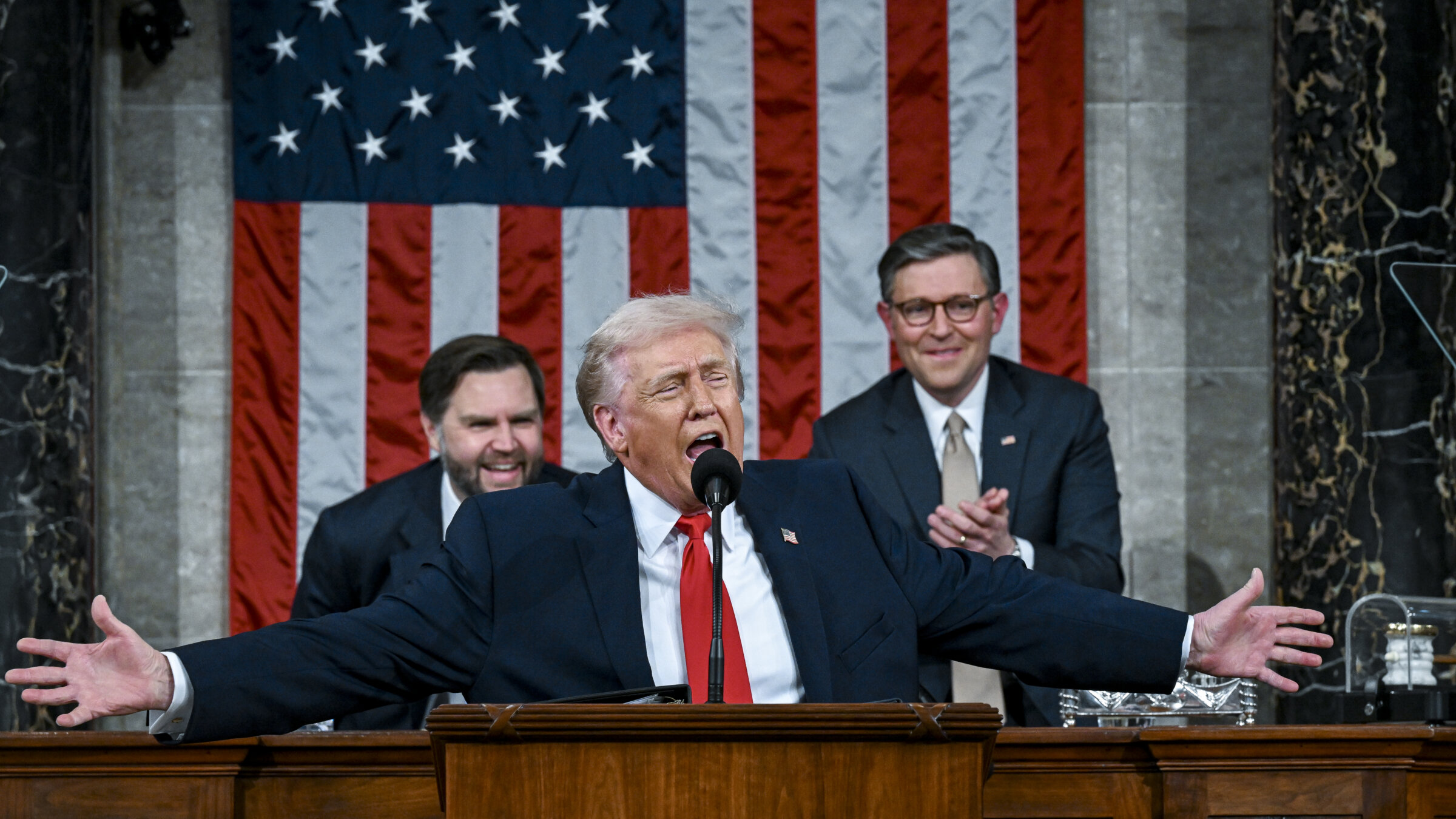
President Donald Trump delivers the State of the Union address during a joint session of Congress in the House Chamber at the Capitol on Feb. 24. Photo by Kenny Holston-Pool/Getty Images

Senior Columnist Rob Eshman February 25, 2026
Buried within the long, maudlin, combative, occasionally moving and never modest verbiage of President Donald Trump’s Tuesday State of the Union address was this uncomfortable truth: Trump has no idea what comes next in the Middle East.
In discussing two conflicts that have drawn intense attention over the past year — those in Gaza and Iran — he offered a downright confusing picture of what the future has to offer.
When the president finally touched on foreign policy, after he had already been speaking for nearly an hour and a half, he credited himself with ending eight wars — a figure that’s worth questioning.
“The war in Gaza, which proceeds at a very low level, it’s just about there,” he said.
The Gaza war is over, maybe
There is no doubt Gaza is closer to peace than it was when Trump took office. The deal he forged between Israel and Hamas is so far the greatest foreign policy accomplishment of his second term.
But “just about there?”
Israel has killed about 600 Palestinians, including many civilians, since the ceasefire. Meanwhile, Hamas has not disarmed, and in fact, according to the Times of Israel, has begun inserting itself in new Trump-backed governing bodies in Gaza.
More than 80% of the structures in the Strip were destroyed in the conflict that began when Hamas attacked Israel on Oct. 7, 2023. Rebuilding will take many years, and billions of dollars. Of the 200,000 temporary housing units humanitarian agencies estimate the enclave needs, only 4,000 have been delivered or on their way.
The much-heralded Trump peace plan, in other words, is on shaky ground.
That explains why Trump thanked Hamas, as he has done in previous speeches this month, for helping to find the bodies of dead hostages.
“Believe it or not, Hamas worked along with Israel,” Trump said, “and they dug and they dug and they dug. It’s a tough, tough thing to do, going through bodies all over, passing up 100 bodies, sometimes for each one that they found.”
Why not mention that Hamas wouldn’t have had to do such hard, noble work if it hadn’t attacked and killed Israelis in the first place? Because the odd compliment — thanking murderers for returning their victims’ bodies — was Trump playing to reality. If his signature diplomatic initiative is to succeed, he needs Hamas and its patrons to go along. So far, the group is stalling when it comes to disarmament. If he can’t persuade them to take that step, his signature peace effort is done for.
An awareness of just how treacherous this situation is explains why Trump’s Gaza comments focused largely on his success at negotiating the return of Israel’s hostages, both living and dead.
“And those parents who had a dead son,” Trump said, “they always told me that boy, they wanted him as much as though he were living.”
Trump didn’t offer a vision, as he has in the past, of a prosperous Gaza; of Saudi Arabia joining the Abraham Accords; and of Israel at peace with its neighbors. He didn’t even mention his pet initiative, the Board of Peace — surprising, given that the body met for the first time just last week. The Middle East has a way of lowering expectations, and in the State of the Union, Trump wasn’t selling anything but the successful return of the dead.
The Iran war that isn’t, yet
On Iran, Trump was, if possible, even more confusing.
The United States has sent its largest military force in decades to the Middle East, which means we are once again — maybe — on the verge of a Middle East war. But Trump’s case for conflict — and explanation of how things got to this point — was lackluster.
He claimed that Operation Midnight Hammer, the June 2025 U.S. strike on Iran’s nuclear facilities, “obliterated Iran’s nuclear weapons program.”
But evidently, a program that was “obliterated” is somehow, less than a year later, an imminent threat. In the very next sentence, Trump said Tehran is now trying to rebuild its nuclear facilities and develop missiles that could reach the United States. (The simpler and more factual explanation: actually, nothing got obliterated in the first place.)
While claiming that the Iranian regime recently killed 32,000 of its own people during nationwide protests — an exact death toll is still elusive — he offered the country a path to survival: give up nuclear weapons.
But what sounds like a clear demand really isn’t. Nuclear diplomacy takes a long time and great delicacy. Trump, who favors swift resolutions, has backed himself into a corner: The military is already there, and the world is waiting with bated breath.
Plus, Americans don’t want to go to war. Some 49% of Americans oppose an attack on Iran, with just 27% in support of one, according to a YouGov poll this month. Independents oppose the idea by 54%, and Republicans support it by only 58%.
What’s a president who has staked his second-term reputation on his ability to win big and make peace supposed to do?
For now, the lack of specificity gives Trump room to waffle on whether or not to go to war — and try to make a case for what specific, achievable aims he would have in doing so.
In a clear sign that he doesn’t yet have answers for those questions, Trump’s language on Tuesday sounded awfully familiar. “I will never allow the world’s number one sponsor of terror to have a nuclear weapon,“ he said. “My preference is to solve this problem through diplomacy.”
Compare that to former President Barack Obama’s 2012 State of the Union.
“Let there be no doubt: America is determined to prevent Iran from getting a nuclear weapon,” Obama said, “and I will take no options off the table to achieve that goal. But a peaceful resolution of this issue is still possible, and far better.”
Maybe Trump has a clear idea of what comes next for Gaza and Iran. Or maybe we’ve just gone back to the future.
This is a moment of great uncertainty. Here’s what you can do about it.
We hope you appreciated this article. Before you go, we’d like to ask you to please support the Forward’s independent Jewish news this Passover. All donations are being matched by the Forward Board - up to $100,000.
This is a moment of great uncertainty for the news media, for the Jewish people, and for our sacred democracy. It is a time of confusion and declining trust in public institutions. An era in which we need humans to report facts, conduct investigations that hold power to account, tell stories that matter and share honest discourse on all that divides us.
With no paywall or subscriptions, the Forward is entirely supported by readers like you. Every dollar you give this Passover is invested in the future of the Forward — and telling the American Jewish story fully and fairly.
The Forward doesn’t rely on funding from institutions like governments or your local Jewish federation. There are thousands of readers like you who give us $18 or $36 or $100 each month or year.
Support our mission to tell the Jewish story fully and fairly.