During WWII, a heroic Jewish lawyer warned against the dangers of a dual state — is it coming true in Trump’s America?
Ernst Fraenkel would have recognized the way our legal system is splintering
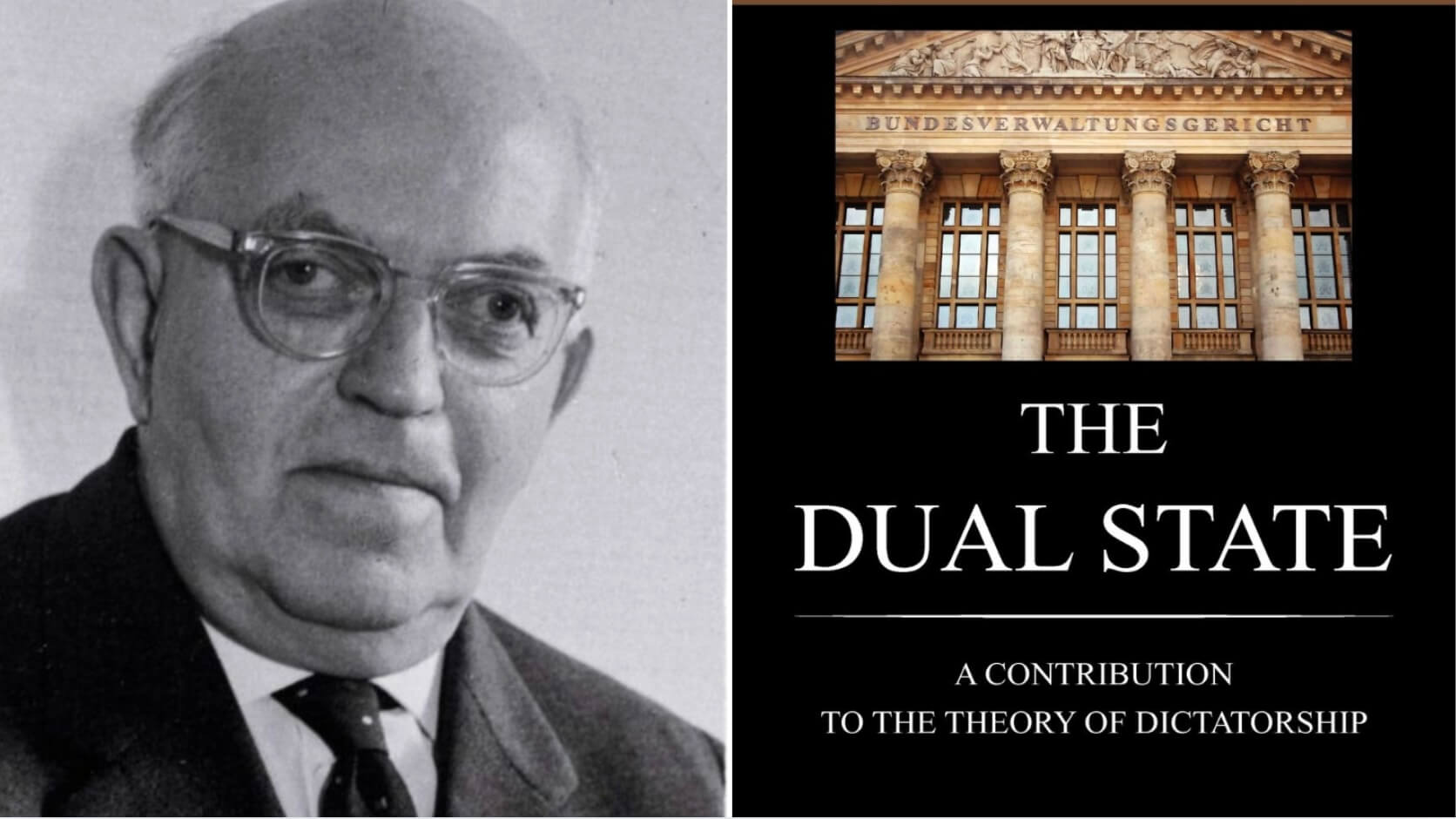
in ‘The Dual State,’ Ernst Fraenkel warned that Germany was living under two systems at once — a functioning legal order and a parallel, lawless realm of political power. Courtesy of Leo Baeck Institute

Terrence Petty March 7, 2026
For five years after Adolf Hitler came to power, attorney Ernst Fraenkel did something almost unimaginable: He stood in German courtrooms defending anti-Nazi dissidents and trade unionists — and sometimes even won. Even more remarkable, Fraenkel was Jewish. The Nazis tolerated him only because he had served in the German army during World War I, a temporary shield he knew would not last. In 1938, after learning from a sympathetic official that he was on a Gestapo arrest list, he fled to the United States.
Three years later, Fraenkel published a book: The Dual State: A Contribution to the Theory of Dictatorship. Many assume that Nazi rule instantly swept aside all “normal” legal standards. Fraenkel showed otherwise. In the early years of the Third Reich, he wrote, Germany lived under two systems at once — a functioning legal order and a parallel, lawless realm of political power.
Lately, a number of legal scholars have been warning that the American legal system under Trump shows troubling similarities to the “dual state” Fraenkel described. They point to federal agents using lethal force against protesters, arrests and detentions of immigrants based on appearance or perceived foreignness, the exclusion of state and local law enforcement from federal investigations, and the use of the Justice Department to pursue Trump’s perceived enemies.
Trump’s massive air assault on Iran has brought more accusations that he has put himself above the law. Rep. Thomas Massie, a Kentucky Republican, called the strikes “acts of war unauthorized by Congress.”
America in 2026 is not Nazi Germany. But Fraenkel’s observations confront us with a question for our times: Can a democracy like ours drift toward a dual system of its own — one legal, one ruled by authoritarian prerogative — without fully realizing it?
A young German Jew, wounded in World War I, returns from fighting for the Kaiser, earns his law degree, becomes a rising figure in the anti-Nazi Social Democratic Party, defends trade unionists as counsel for a metalworkers union, continues representing dissidents after Hitler’s rise, and escapes with his life as the Nazis purge Jewish lawyers and Germany marches toward the Holocaust. It sounds like the outline of an epic film. But it was Ernst Fraenkel’s life.
It is striking that Fraenkel has not been recognized more widely for the hero he was. And it has taken his 1941 book on the legal structures of Nazi Germany — combined with Trump’s assaults on American democracy — for Fraenkel to receive the broader attention he deserves.
“When I first read about him, I thought it was astounding: Here was a Jewish Social Democratic lawyer representing political defendants effectively,” while at the same time anonymously writing anti-Hitler pamphlets, said Douglas G. Morris, a retired criminal defense lawyer for indigent clients and author of Legal Sabotage: Ernst Fraenkel in Hitler’s Germany.
After Hitler came to power, he quickly moved to purge the civil service of employees deemed disloyal or who were Jewish, including attorneys. But the Nazis granted exemptions for Jewish civil servants who had served in World War I — the Frontkämpferprivileg. Fraenkel hadn’t just served; he had been severely injured.
Even as the Nazis rounded up political opponents and sent them to early concentration camps like Dachau, pockets of resistance remained. As a Social Democrat and attorney, Fraenkel had contacts with dissidents and took many on as clients.
He understood something essential about the new regime: To protect his clients — and himself — he had to avoid provoking the Nazis or drawing the attention of the Gestapo. So he presented cases as if the normal legal system still existed — and in some ways it did. This required discipline, given his opposition to the regime. But the strategy worked. If he couldn’t win an acquittal, he could sometimes secure a light prison sentence.
At the same time, Fraenkel was secretly writing pamphlets for the anti-Nazi resistance. He wrote five in total, Morris told me in an interview, including “The Point of Illegal Work,” which argued that Germans should resist the regime through various means. He was also quietly drafting the manuscript that became The Dual State.
Fraenkel knew about the torture and punishments used in the camps. But as brutal as the Nazis were toward their enemies, the regime initially did not view attorneys — Jewish or otherwise — as a significant threat, according to Morris. That blind spot allowed Fraenkel not only to write anti-Nazi pamphlets but also to serve as a conduit for dissidents to exchange information.
From his courtroom experience, Fraenkel observed how the Nazis handled the pre-1933 legal system. They did not abolish it outright. Instead, they created a parallel system to dish out especially harsh punishments to those deemed in violation of the regime’s political edicts. Fraenkel called the pre-Nazi system the “normative state,” and the Nazi-controlled system the “prerogative state.” Thus, a dual state. The two systems were never equal, Morris notes: “The prerogative state — exercising its arbitrary power through intimidation and violence — always maintained control.”
On Sept. 20, 1938, Fraenkel received a warning that he was about to be arrested. He fled Germany, traveling to London, then New York, and finally Chicago. A French diplomat had smuggled his manuscript out of Germany. After arriving in the U.S., Fraenkel earned a law degree from the University of Chicago and published The Dual State. He returned to Germany in 1951, became a professor at the Freie Universität Berlin, and died in 1975.
A growing number of legal analysts argue that the United States is developing its own version of a dual state — one that persecutes, demonizes or sidelines those who oppose MAGA ideology or threaten the fantasies of white-superiority advocates.
On his first day in office, Trump issued a mass pardon to some 1,500 insurrectionists who had stormed the Capitol on Jan. 6, 2021 to try to keep Trump in power despite his election loss. During the following months Trump granted clemency to 100 more convicted criminals, who included prominent business figures, high-profile MAGA supporters, and allies connected to Trump’s political and fundraising networks.
Masked and dressed for combat, ICE and CBP now act like the muscle for a parallel legal state — imprisoning foreigners whose only offense is entering the country illegally, dragging people from their homes in front of their children, and assaulting citizens who try to shield immigrants from unjustified arrest, killing two so far. The administration’s arbitrary decree that immigration agents no longer need judge-signed warrants to force their way into homes is another expression of what Fraenkel called the prerogative state.
Trump’s perceived and real political foes are being swept into a legal system built for his benefit, targeted by a Justice Department that now functions as an instrument of presidential power. In Trump’s America, Democrats, non-MAGA members of the press, and anyone who disagrees with him are denounced as mortal threats to the nation. Administration officials deemed insufficiently loyal are purged from their jobs.
This parallel system is colliding with legal traditions dating to the country’s founding, and courts have so far slowed the slide into full autocracy with rulings blocking Trump’s most aggressive edicts. Trump responds by attacking the judges who rule against him.
The Supreme Court dealt a significant blow to Trump’s parallel legal system when it struck down his tariffs. But this is the same court that nearly two years ago granted presidents broad immunity from criminal prosecution for official acts.
Fraenkel showed how a democracy can lose its bearings long before it loses its laws. As the United States nears its 250th year, the question is no longer whether a dual state can take root here. It is whether we will recognize it in time.
This is a moment of great uncertainty. Here’s what you can do about it.
We hope you appreciated this article. Before you go, we’d like to ask you to please support the Forward’s independent Jewish news this Passover. All donations are being matched by the Forward Board - up to $100,000.
This is a moment of great uncertainty for the news media, for the Jewish people, and for our sacred democracy. It is a time of confusion and declining trust in public institutions. An era in which we need humans to report facts, conduct investigations that hold power to account, tell stories that matter and share honest discourse on all that divides us.
With no paywall or subscriptions, the Forward is entirely supported by readers like you. Every dollar you give this Passover is invested in the future of the Forward — and telling the American Jewish story fully and fairly.
The Forward doesn’t rely on funding from institutions like governments or your local Jewish federation. There are thousands of readers like you who give us $18 or $36 or $100 each month or year.
Support our mission to tell the Jewish story fully and fairly.