Purim gives us an imperative to resist authoritarianism. Here’s how to start
There are practical, concrete ways to embody Mordechai and Queen Esther’s bravery in our modern world
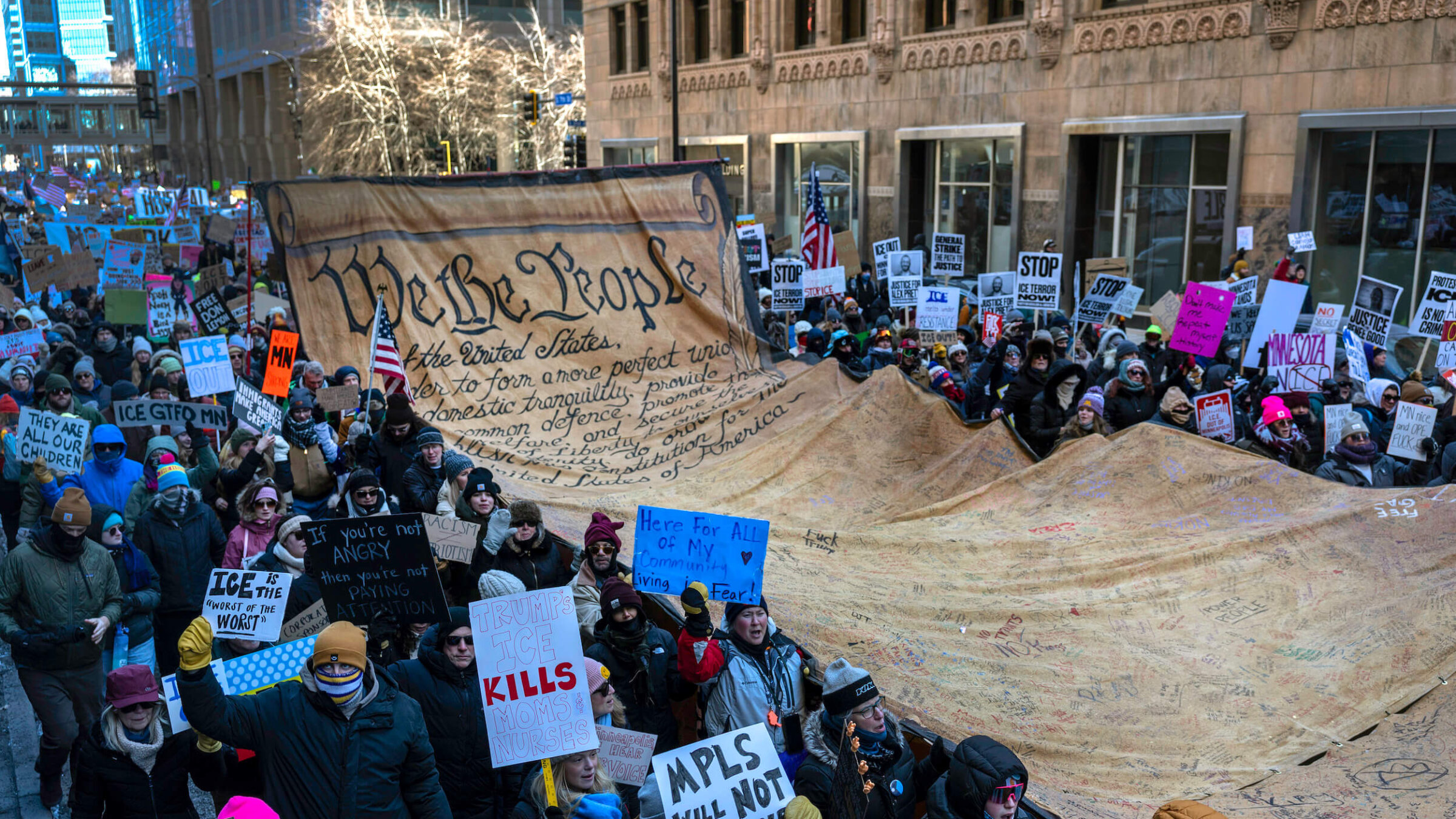
Demonstrators march in protest of ICE in Minnesota on Jan. 30. Photo by John Moore/Getty Images
The fear and spectacle of state violence is a fundamental theme of Purim. Haman’s plan to use his powerful position in the Persian empire to perpetrate official violence against the Jewish people is a reminder of how easily a government can instill terror in those who live under it.
Today, the parallel between this story and the targeting of undocumented communities throughout the United States by President Donald Trump’s administration is obvious. And I have seen the consequences up close.
I am a Venezuelan-born American citizen. My experience with state-based oppression is not theoretical; it shapes my daily life. Living in Central Florida, I have picked up neighbors’ children from school because their parents are afraid to go themselves: Immigration and Customs Enforcement has targeted school pickups as part of detention efforts. I have driven working parents to and from their jobs, so that they don’t risk being stopped and detained by local police working in tandem with ICE. I go grocery shopping for families involved in lawful asylum proceedings who are too fearful to appear in public, because ICE has initiated deportation proceedings against asylum-seekers.
The Book of Esther relates how the Jews of Shushan gathered to defend their lives. But they fought alone; their neighbors did not join them. Purim gives us a mandate to reject the example of those neighbors. When the state threatens vulnerable populations among us, we must respond with solidarity.
I became an activist because I saw pollution and environmental racism afflicting my own community, as those in power targeted the protections that keep us safe. Whether through detention, displacement, or environmental harm, it is always the most vulnerable who bear the consequences first.
In this fearful time, Purim offers a playbook for understanding what is happening in our own lives — and an inspiration to resist the Trump administration’s abuses. For at its heart, Purim is a story of anti-authoritarian resistance.
In the megillah, Queen Esther and Mordechai mobilize at significant personal risk to save their community. They use the mechanisms of power at their disposal to prevent state violence against Jews. Their actions provide a roadmap for how we can think about opposing the Trump administration now.
Like Esther and Mordechai, we must use our moral voice in a moment when it can feel perilous to do so — and when the stakes are immense. That means that we must find opportunities to speak directly to our elected officials, just as Esther and Mordechai spoke to King Ahasuerus. An upcoming No Kings rally, on March 28, is one critical moment when we can do so.
We can also organize within our communities. We might think of the protestors in Minneapolis — who organized against a terrifying ICE occupation by building mutual aid networks, going to rallies, and working with their neighbors to protect those facing the imminent threat of deportation — as following in the mold of our heroes from this holiday. The model developed in Minneapolis — decentralized, grassroots networks committed to keeping others safe — has been replicated in cities and towns across the country. Purim should be an invocation for us to join those efforts now.
Finally, we know that just as Haman is defeated, so too must we prevail against a reckless administration. That means working, in the months to come, to recruit and mobilize voters ahead of the pivotal mid-term elections this November — so that we can begin the process of rebuilding our democracy and protecting our communities.
Purim can sometimes be read as a clean “good-against-evil” narrative, with little room for nuance or ambiguity. “They tried to kill us, they failed, let’s eat hamentaschen!” This may make it an easier holiday to celebrate. But it obscures a fundamental political message of the story: the survival of the Jews depended on individual and collective acts of courage. On a willingness to speak truth to power. On an obligation to use the power and access we do have on behalf of the wider community. And on a responsibility to do what’s right in the face of fear and hate.
So this year, we must read the megillah in all of its depth and contemporary relevance. We must use Purim as a moral call to stand with the most vulnerable amongst us.
This is a moment of great uncertainty. Here’s what you can do about it.
We hope you appreciated this article. Before you go, we’d like to ask you to please support the Forward’s independent Jewish news this Passover. All donations are being matched by the Forward Board - up to $100,000.
This is a moment of great uncertainty for the news media, for the Jewish people, and for our sacred democracy. It is a time of confusion and declining trust in public institutions. An era in which we need humans to report facts, conduct investigations that hold power to account, tell stories that matter and share honest discourse on all that divides us.
With no paywall or subscriptions, the Forward is entirely supported by readers like you. Every dollar you give this Passover is invested in the future of the Forward — and telling the American Jewish story fully and fairly.
The Forward doesn’t rely on funding from institutions like governments or your local Jewish federation. There are thousands of readers like you who give us $18 or $36 or $100 each month or year.
Support our mission to tell the Jewish story fully and fairly.