A war with Israel, not for Israel
The striking significance of the alliance waging war with Iran
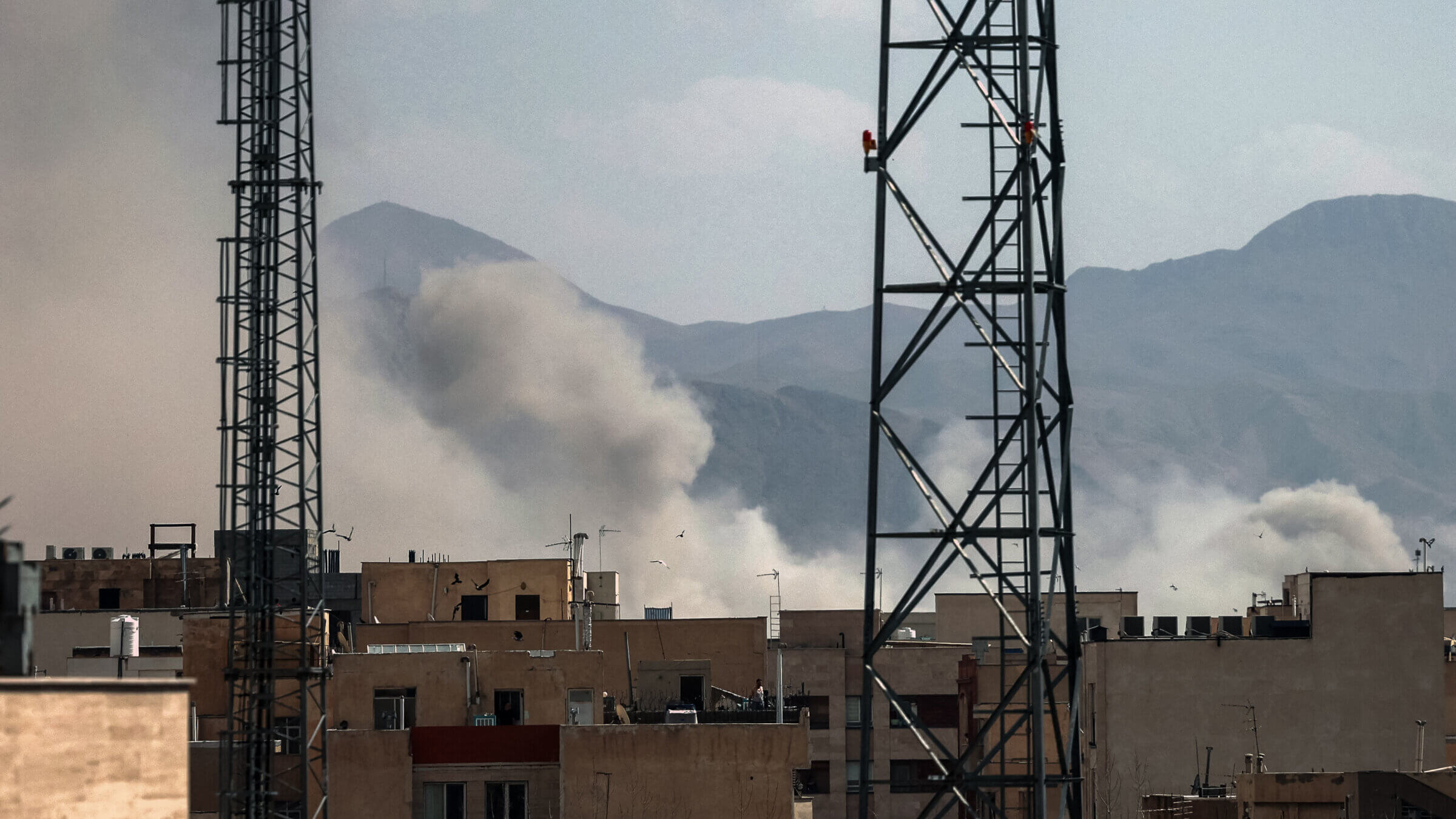
A plume of smoke rises following a reported explosion in Tehran on February 28, 2026. Iran said on February 28 it will “respond decisively” after Israel and the United States launched strikes on the country despite talks underway on Tehran’s nuclear programme. (Photo by AFP via Getty Images) Photo by AFP via Getty Images

Senior Columnist Rob Eshman February 28, 2026
This is the first Arab-Israeli war in history in which the Arabs and the Israelis are on the same side.
This striking, remarkable fact is a hopeful sign for a more peaceful Middle East, and for Jews around the world. The sad story we Jews tell ourselves about ourselves — that we are a people that dwells alone, spurned and unsupported — is playing out much differently on the news, and on the ground.
When Israel and President Donald Trump launched “Operation Epic Fury” on Feb. 28 the Iranian regime responded by launching missiles at the United Arab Emirates, Qatar, Kuwait, Bahrain, Saudi Arabia and Jordan.
The targets were not just U.S. military bases, but civilian areas as well. A missile struck a suburban home in Amman, exploded over Riyadh, Saudi Arabia, and killed an Asian national in the UAE, according to the Christian Science Monitor.
These attacks make clear that this is not Israel’s war alone, though arguably Israel has always been the primary target of the Iranian regime. That regime will lash out at any country threatening its hold on power, and even, or especially, at its own citizens.
Even if these Arab nations don’t officially engage against Iran, they have already been cooperating, opening up airspace to U.S. and Israeli jets, providing intelligence and staging areas. Azerbaijan, a majority Shia country bordering Iran, has been instrumental to Israel’s success against the regime.
That cooperation is not sudden, either. Leaked documents from October 2025 show that even as Arab states were publicly condemning Israel over the Gaza War, some were cooperating with it and the U.S. in creating a “Regional Security Construct” to thwart their common threat, Iran.
The solidity of that construct no doubt encouraged the current attack. Israel knew it wouldn’t have to go it alone. Not only did it have the tacit cooperation of most of its Arab and Gulf neighbors, it had the backing of the United States itself — the most potent military force in history.
A ‘People that dwells alone,’ really?
All of this runs counter to the stubborn story Jews tell themselves that we are without friends and allies in the world, facing terrorists and antisemites on our own. The war broke out just days before Purim, when Jews in ancient Persia — Persia! — faced annihilation at the hands of a vicious antisemite, Haman.
The Purim story frames Jews as anomalous and alone. They are, “a certain people scattered and dispersed among the peoples…whose laws are different from every other people,” Haman tells King Ahasuerus in his pitch to destroy them.
This Shabbat, called Shabbat Zachor, or the Shabbat of Remembrance, only reinforces the theme. The Torah passage in Deuteronomy depicts the evil attacker Amalek as preying on a weak, vulnerable and isolated People of Israel.
“You were faint and weary,” the passage states, “and he did not fear God.”
We have internalized these images, as well as Balaam’s words from the Book of Numbers — “a People that dwells alone” — and weaponized it against reality.
Yes, there are multitudes of real enemies and haters out there. My social media feed has already filled up with posts from the left and right accusing Israel of forcing Trump to fight its war.
“This is Israel’s last chance to blow up Iran with America’s military,” Tucker Carlson, the most insidious of the haters, posted two days ago, ignoring decades of the United States’ own fraught history with Iran. When the war broke out, Carlson called it “absolutely disgusting and evil.”
The far-right influencer Candace Owens announced that she “stands with Iran,” blamed Israel for this war and said that Charlie Kirk was assassinated “for this war.”
But the ferocity of these voices shouldn’t obscure the fact that in this war, Israel is far from alone.
How not to blow it
Of course how things begin is not always how they end. In the immediate aftermath of the Oct. 7, 2023, Hamas attack, which Iran was instrumental in helping fund and plan, many countries voiced support or sympathy for Israel.
As Israel’s retaliatory attack ground on, that support evaporated. It was unclear how the war’s destruction matched its legitimate cause. Allyship is always conditional.
The worst-case scenarios of this war are evident to anyone who remembers the Iraq War: America dragged into a grinding war as Iran implodes into factional violence, with Israel blamed for it all.
In the best-case scenario, Israel and the U.S. narrowly target the regime and its military assets and take them out. Then Israel capitalizes on this military cooperation to seek close diplomatic ties with a new Iranian leadership, along with the Arab states that joined in its defense. That, of course, would entail compromises on the hardline, irredentist dreams of some of Israel’s own leaders.
In other words, how Israel emerges from this war will depend in part on its own actions, during and after the immediate conflict. But for now, the irrefutable truth is, we are not a people that dwells alone.
This is a moment of great uncertainty. Here’s what you can do about it.
We hope you appreciated this article. Before you go, we’d like to ask you to please support the Forward’s independent Jewish news this Passover. All donations are being matched by the Forward Board - up to $100,000.
This is a moment of great uncertainty for the news media, for the Jewish people, and for our sacred democracy. It is a time of confusion and declining trust in public institutions. An era in which we need humans to report facts, conduct investigations that hold power to account, tell stories that matter and share honest discourse on all that divides us.
With no paywall or subscriptions, the Forward is entirely supported by readers like you. Every dollar you give this Passover is invested in the future of the Forward — and telling the American Jewish story fully and fairly.
The Forward doesn’t rely on funding from institutions like governments or your local Jewish federation. There are thousands of readers like you who give us $18 or $36 or $100 each month or year.
Support our mission to tell the Jewish story fully and fairly.