Marco Rubio invoked a medieval antisemitic trope in justifying war with Iran
It’s deceptive and conspiratorial to suggest that Israel forced the US into this conflict
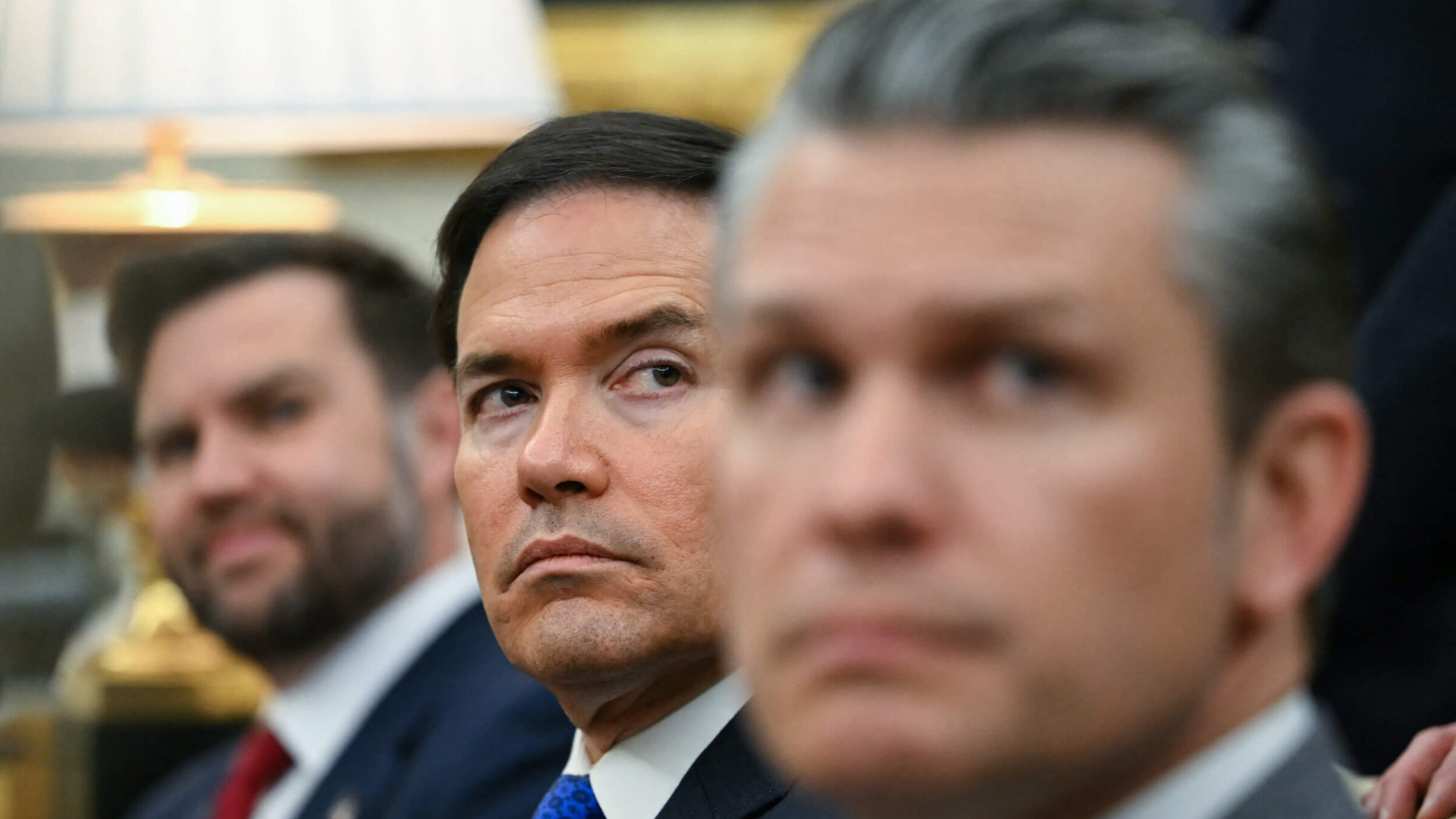
Secretary of State Marco Rubio (center) with Vice President JD Vance (left) and Secretary of Defense Pete Hegseth in the White House on March 3. Photo by Andrew Caballero-Reynolds/AFP/Getty Images

Joel Swanson March 3, 2026
Secretary of State Marco Rubio offered a striking explanation on Monday for why the United States entered its current war with Iran. According to Rubio, the U.S. acted because Israel had decided on its own to strike Iran first, and Washington feared that Tehran would retaliate against American forces in the region.
In other words, Israel’s decision forced President Donald Trump’s hand.
This is not merely an implausible account of how great powers decide to wage war. It is a way for the U.S. government to evade responsibility by outsourcing it to Israel, and, in so doing, potentially endanger Jews worldwide. Rubio is validating an insidious storyline that isolationist populists have been constructing: that Israel, and those people in the U.S. connected to it — read, Jews — distort American priorities.
Why would Rubio do that?
The answer is not hard to find: The war is deeply unpopular. A recent Reuters/Ipsos poll found that only about 1 in 4 Americans supports U.S. strikes against Iran. Many believe the president is too quick to use military force.
In that context, it is politically convenient to imply that the U.S. did not truly choose this war, that it was instead forced upon us by an ally acting independently. (Rubio later added that an attack on Iran “had to happen no matter what,” because of the pace of Iran’s military development.)
Jews are all too accustomed to being forced into this narrative. For centuries, Jews in Europe were cast in an impossible role: useful when prosperous times prevailed, treacherous when crisis struck. The archetypical “court Jew,” a prime example, was granted access to power yet never fully trusted. His proximity to the throne made him both envied and vulnerable. When famine hit, when taxes rose, when wars failed, the ruler could redirect popular anger toward the Jew who supposedly whispered in his ear.
For the ruler who wanted to evade responsibility, the narrative was simple: We did not fail; we were failed by our perfidious advisers.
That’s the narrative that Rubio invoked with his Monday comments.
Of course, the idea that Israel could compel the U.S. to fight a war is nonsensical. The U.S. is the world’s most powerful military and economic actor. It provides Israel with diplomatic backing, military aid and strategic coordination — not the other way around. Israel does not command American aircraft carriers. It does not deploy U.S. troops. It does not dictate U.S. foreign policy.
What makes this moment particularly combustible is that anti-interventionist sentiment is no longer confined to the progressive left. It is also rising sharply on the American right.
Figures such as Tucker Carlson have spent years arguing against “forever wars” and warning that foreign entanglements betray American interests. Leaders like former Rep. Marjorie Taylor Greene have echoed that rhetoric, fusing populist nationalism with skepticism toward overseas military commitments.
As a result, younger conservative voters are more suspicious of foreign aid, more hostile to global alliances, and more inclined to see U.S. involvement abroad as elite-driven folly. In that environment, suggesting that Israel’s independent action forced Washington into war is not a neutral explanation; it is political tinder. It aligns seamlessly with a narrative already circulating in right-wing populist circles: that American blood and treasure are being sacrificed for someone else’s agenda.
That logic echoes one of the most persistent antisemitic tropes in modern political culture: that Jews — or the Jewish state — wield hidden, disproportionate power over governments, steering them into conflicts that do not serve their own citizens.
This trope has never been confined to one side of the political spectrum. On the far right, it appears as conspiracies about globalist cabals and dual loyalty. On parts of the far left, it emerges in claims that American foreign policy is “bought and paid for.” Increasingly, we see anti-Israel sentiment fusing with broader suspicion about Jewish influence in politics.
When leaders imply that Israel’s initiative was the trigger for an unpopular war, the next step is predictable. If American casualties mount, if oil prices spike, if the conflict drags on, the public will ask who got us into this mess. And if they have been primed to believe that Israel forced America’s hand, some will leap from “Israel” to “the Jews.”
History teaches us how easily that slide occurs. The “court Jew” was always in danger because his position depended on royal favor and public patience. The moment his usefulness was questioned, he became expendable. The psychological mechanism of scapegoating remains the same in our modern world. When complex geopolitical decisions are reduced to the idea that a Jewish state pulled the strings, conspiratorial resentment against all Jews follows.
The truth is that the decision to attack Iran was made by Trump and his administration. The buck stops with them.
If they genuinely believe this war is a wise idea, Trump and Rubio should defend it on its merits. If they see it as necessary, they should be able to explain their national security rationale clearly to the American people.
Instead, in a moment when antisemitism is already rising on both right and left — when Jewish institutions require increased security, when online rhetoric grows more virulent, when anti-Israel activism sometimes spills into harassment of Jews — they’ve chosen to frame the choice to go to war in this reckless, deceptive way.
There are many legitimate reasons to criticize the State of Israel. But the U.S. government chose this war freely. If it comes to be seen as a success, the Trump administration will no doubt claim the victory. If it fails, we must not allow them to outsource the blame.
This is a moment of great uncertainty. Here’s what you can do about it.
We hope you appreciated this article. Before you go, we’d like to ask you to please support the Forward’s independent Jewish news this Passover. All donations are being matched by the Forward Board - up to $100,000.
This is a moment of great uncertainty for the news media, for the Jewish people, and for our sacred democracy. It is a time of confusion and declining trust in public institutions. An era in which we need humans to report facts, conduct investigations that hold power to account, tell stories that matter and share honest discourse on all that divides us.
With no paywall or subscriptions, the Forward is entirely supported by readers like you. Every dollar you give this Passover is invested in the future of the Forward — and telling the American Jewish story fully and fairly.
The Forward doesn’t rely on funding from institutions like governments or your local Jewish federation. There are thousands of readers like you who give us $18 or $36 or $100 each month or year.
Support our mission to tell the Jewish story fully and fairly.