Can the US really bring Iranians democracy?
While some yearn for a return to the days of the shah, that solution carries its own risks
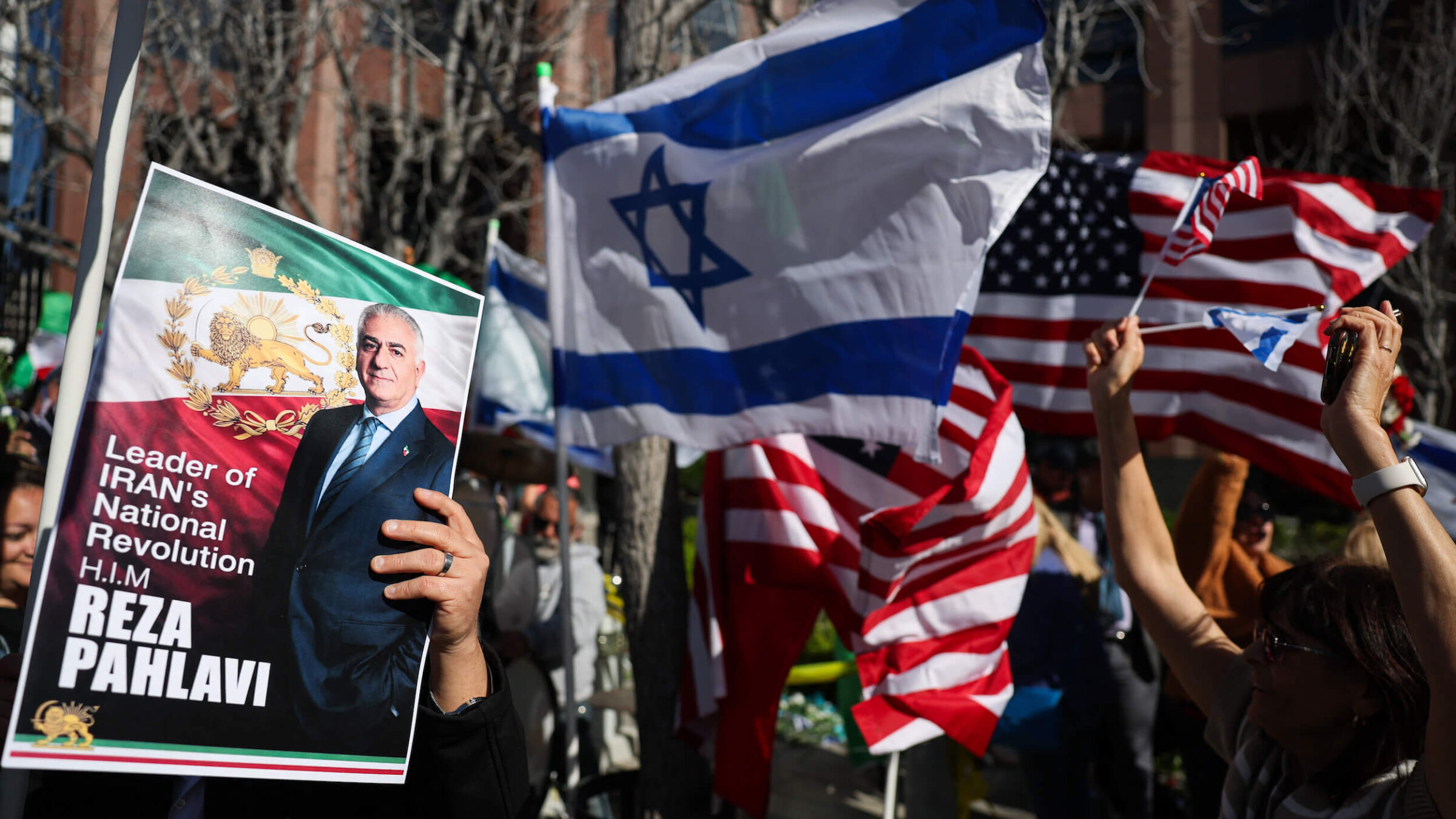
People hold signs in support of Reza Pahlavi, son of the last shah of Iran, during a gathering of Iranian community members showing support for Israel and the United States, outside the Consulate General of Israel in Los Angeles, on March 5. Photo by Patrick T. Fallon / AFP / Getty Images

Larry Cohler-Esses March 10, 2026
The protesters at a January rally I attended in New York City’s Washington Square Park were loud and raw throated as they denounced the brutal Islamist regime in Tehran, then in the midst of slaughtering thousands of their comrades in Iran. A crowd of more than 1,500 called on the United States to make good on President Donald Trump’s all-caps promise that “HELP IS ON ITS WAY.”
I turned to an Iranian friend next to me who was lustily joining cheers calling for the tyrants’ overthrow. Like most of the rest of the protesters, she was also cheering the demonstration’s other prominent images: Israeli flags, the images of President Donald Trump and photos of Reza Pahlavi, the son and self-declared heir of the autocratic monarch Iranians ousted in 1979.
My friend’s parents had once been members of Iran’s leftist Tudeh Party, the country’s official communist faction, which was among the staunchest opponents of Pahlavi’s father. Recalling my own 20-month stay in Iran toward the end of his rule, I asked my friend if she understood the rampant corruption and repression under which Iranians lived during that time.
Was she aware of the role the U.S. played in installing the shah in power, and the torture of dissidents by SAVAK, the shah’s secret police, with support from Israel’s intelligence agency, the Mossad — a record Pahlavi has never acknowledged?
My dear friend fixed me in her gaze with clear eyes, devoid of illusion.
“Yes,” she said simply. “And it would be better.”
Lowered expectations
Whether the bombs and missiles the U.S. is now raining down on Iran will fulfill the promise Trump held out for protesters remains an open question. But In New York City, back in January, there was no mistaking their desperate faith in him — or the irony of that faith.
It was the U.S., after all, that joined with Great Britain in 1953 to overturn the democracy Iran enjoyed 73 years ago. Twenty-six years of U.S. support ensued for the autocracy that followed.
During the Iran-Iraq war from 1980 to 1988, it was the U.S. that also supplied Iraq’s president, Saddam Hussein, with critical intelligence and precursor chemicals that enabled him to manufacture and deploy outlawed chemical weapons against Iranian troops and civilians, asphyxiating thousands.
Given this history and the woeful fates that befell Iraq and Libya after U.S. intervention, many liberals voice grave doubt that any U.S.-forced regime change could restore democracy to the country. But they may be missing an important point: the extent to which crushing U.S. economic sanctions and the Iranian government’s own brutal repression, corruption and incompetence, have produced economic and political desperation among many Iranians, which radically lowers the bar.
The redemption of ‘Big Satan’
Opponents of Trump can recite a litany of his political and personal depravities, his affronts to democracy here at home, and his unreliability as an international partner in support of human rights and democracy abroad.
But I’ve noticed, anecdotally, that such recitations fall on deaf ears with many Iranians.
Two reasons rise to the top, in my mind, that explain this.
The first is the enormous credibility that Trump and the U.S. have derived from being among the primary hate targets of Iran’s despotic regime. This effect has also benefited Israel, the partner of the U.S. in waging this war. Decades of demonization of “the Big Satan” — and Israel, “the Little Satan” — from leaders so many Iranians despise have performed a miracle of reputational resurrection.
Today, this relentless drumbeat of vitriol has rendered the CIA’s subversion of Iran’s mid-20th century democracy — and Israel’s help in setting up SAVAK — a distant memory. This theocratic regime is the present danger.
Secondly, as a famous saying in Washington goes, “You can’t beat something with nothing.” That appears to be why many Iranians, for now, are turning to Trump. In Iran, the protesters’ own lack of leadership and resistance infrastructure plays into this. There is no Charles de Gaulle or Nelson Mandela waiting in the wings to take charge, with highly disciplined and battle-tested resistance groups to support them.
Another important factor may be the American left’s inability to offer Iranians a compelling alternative vision.
Several liberal members of Congress, including Rep. Alexandria Ocasio Cortez and Senator Bernie Sanders, have consistently praised the bravery of the protesters and their cause. But they have not proposed any way to hold their killers accountable, and have opposed Trump’s war as the way to do so. Their approach, diplomacy and international law, produced President Barack Obama’s Joint Comprehensive Plan of Action in 2016, which radically constrained Iran’s nuclear weapons development.
Based on my reporting from Iran for the Forward back then, I can attest that vast numbers of Iranians strongly supported this at the time. They saw the JCPOA as a way to open Iran up to greater Western influence over time — the greatest fear of the country’s hardline ayatollahs.
But Trump tossed that achievement into the rubbish heap of history in his first term. And the left’s toolbox has been useless since. In the meantime, outside of government, some on the left have played down or ignored the Iranian government’s killings and abuses — or even attributed January’s protests in whole or part to Mossad agents embedded in Iran.
‘Striving for democracy’
Another friend, still living in Iran, told me recently that his grandson had left him feeling shamed. How is it, his grandson asked, that his generation had allowed the shah to be overthrown and replaced by this cohort of theocratic thugs?
My friend in Tehran had no answer.
My friend’s parents had been ardent supporters of Prime Minister Mohammed Mossadegh, the fiercely nationalistic Iranian leader ousted by Britain and the U.S. in 1953. But now, the prospect of a return by the shah’s son as a U.S.-backed autocrat with strong ties to right-wing Israelis didn’t phase him at all.
For his part, Pahlavi has publicly espoused a commitment to secular liberal democracy. But just last month his main support group, the National Union for Democracy in Iran, proposed that Pahlavi should serve as the unambiguous “Leader of the National Uprising” who will be empowered to issue official decrees, install hand-picked executive officials during a “transition to freedom and stability” and act as commander-in-chief of Iran’s military forces.
His supporters, meanwhile, have been widely accused of harassing and viciously threatening opponents who do not accept him in this role.
Would a secular, hopefully more competent, authoritarian dictatorship, whether led by Pahlavi or someone else with U.S. backing, be an improvement, I asked my friend in Tehran?
Even as bombs were falling from the sky onto his city last week, he texted back: “Yes sure!”
“I think this can be a phase towards a better situation for striving for democracy,” he added.
To be honest, I fear he and other like-minded Iranians are betting on moonbeams. But even after Israel bombed Tehran’s oil storage facilities over the weekend, engulfing the city in a poisonous black cloud, he texted me poetry.
“Under the black smoke…I saw trees that were hosting a multitude of blossoms with their thin bodies,” he wrote. “It seemed like they were supposed to remind us of spring….To us, who have been stuck in a rut for years? The ideological Mafia rule of the Islamic Republic of Iran has stolen 47 springs from us.”
This is a moment of great uncertainty. Here’s what you can do about it.
We hope you appreciated this article. Before you go, we’d like to ask you to please support the Forward’s independent Jewish news this Passover. All donations are being matched by the Forward Board - up to $100,000.
This is a moment of great uncertainty for the news media, for the Jewish people, and for our sacred democracy. It is a time of confusion and declining trust in public institutions. An era in which we need humans to report facts, conduct investigations that hold power to account, tell stories that matter and share honest discourse on all that divides us.
With no paywall or subscriptions, the Forward is entirely supported by readers like you. Every dollar you give this Passover is invested in the future of the Forward — and telling the American Jewish story fully and fairly.
The Forward doesn’t rely on funding from institutions like governments or your local Jewish federation. There are thousands of readers like you who give us $18 or $36 or $100 each month or year.
Support our mission to tell the Jewish story fully and fairly.