Trump’s Iran dithering puts Israel in an unprecedented position
Israel is fighting a war in Iran over which it lacks fundamental control
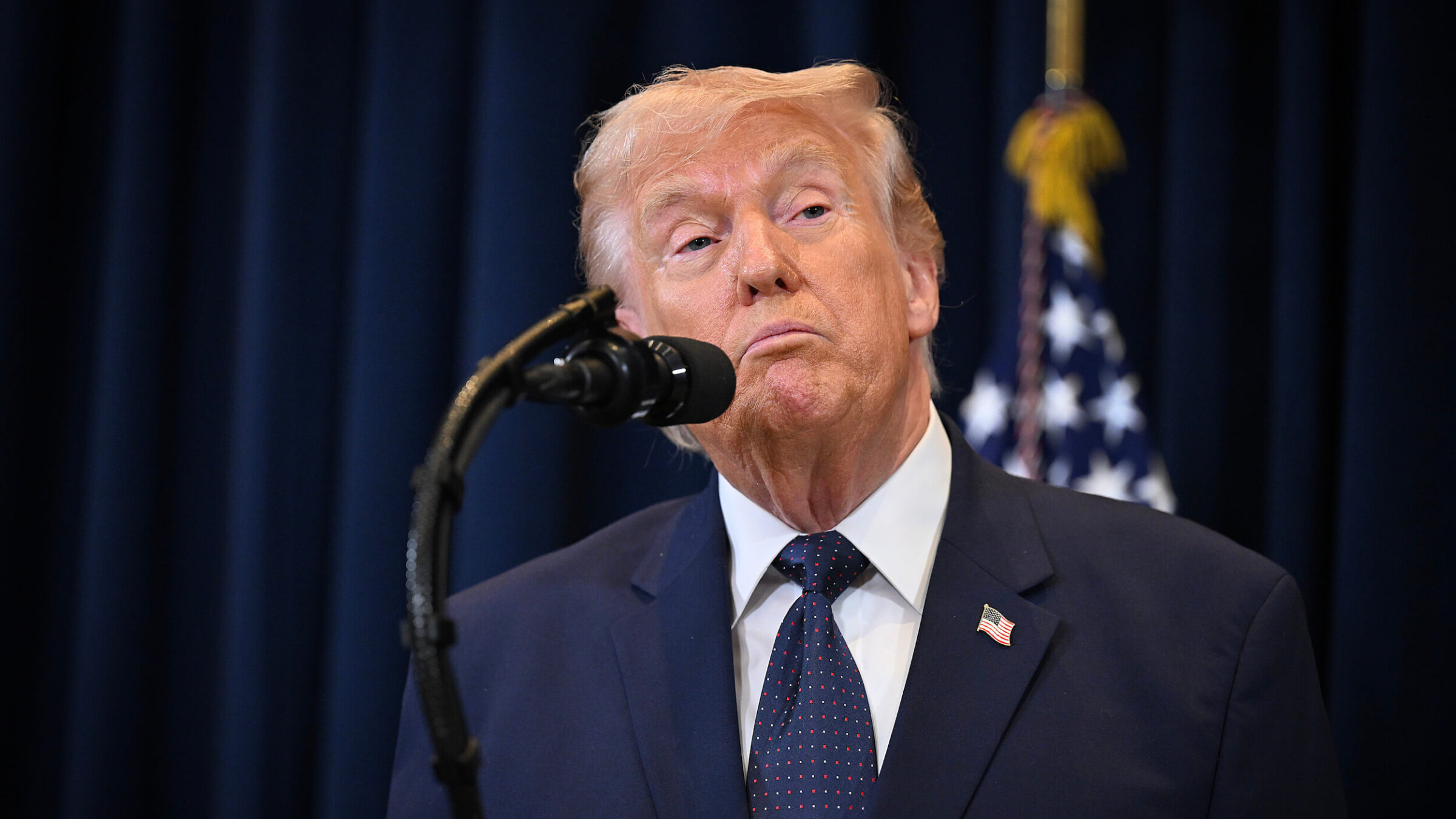
President Donald Trump speaks at Trump National Doral Miami on March 9. Photo by Roberto Schmidt/Getty Images

Columnist Dan Perry March 10, 2026
Israel today finds itself in an unusual strategic position: It’s fighting a war that could last for weeks — or end almost instantly. And someone else will decide which way things go.
Down one path lies a prolonged campaign against Iran, with the possibility of regime change. Israel’s leaders openly hope that the campaign will enable the Iranian people to overthrow their rulers. Prime Minister Benjamin Netanyahu recently put it bluntly: “Our aspiration is to enable the Iranian people to cast off the yoke of tyranny.”
Down the other is a rapid cessation of the conflict, with incomplete results. President Donald Trump has already suggested that the conflict may be nearing completion. In a Monday interview with CBS News, Trump said bluntly, “The war is very complete, pretty much.”
Yet in the very same news cycle, Trump offered a strikingly different message. When asked whether the war was essentially over or just beginning, he replied, “I think you could say both.” He suggested he was considering the possibility of taking control of the Strait of Hormuz, the critical global oil chokepoint, and warned on social media that if Iran interfered with shipping there, the United States would strike it “20 times harder than they have been hit thus far.”
Those contradictory statements capture the extraordinary ambiguity surrounding the conflict. And that ambiguity has left Israel in a profoundly complicated position. Now, it must be prepared simultaneously for two radically different scenarios: a prolonged war whose outcome could reshape the Middle East, or a sudden declaration that the conflict is over.
A successful start, and mixed outlook
So far, Israeli and American forces have struck deep inside Iran, decapitating the regime and crippling major parts of military infrastructure. Iran has retaliated with missile and drone attacks against Israel, most of which have been intercepted by Israel’s air defenses, but some of which have brought tragedy.
In recent days, Tehran has picked a new supreme leader: Mojtaba Khamenei, a hard-liner and the son of the longtime despot killed on the first day of the war.
If the conflict continues on this trajectory, the implications could be enormous. Sustained pressure on Iran could destabilize the regime. Even without that best-case scenario outcome, a prolonged campaign could dramatically weaken the Islamic Republic.
But a long war carries real dangers. Iran still possesses missiles capable of reaching Israel, and has been firing them daily. Israel’s multilayered defense system intercepts most of them, but not all. A cluster missile strike on Monday killed two; if the war continues, more deaths are likely to follow. And the longer the war lasts, the greater the statistical likelihood that one missile will slip through and cause a true catastrophe.
Even without a disaster, the cumulative strain on Israeli society is unmistakable. The acquisition of weapons and call-up of reserve troops is further disrupting an economy that has been in various states of disruption since Oct. 7, 2023. It is also measured in the unquantifiable damage that the stress is causing pretty much every person in the country.
Many businesses are closed, and public life is minimal. Missile alerts — often in the middle of the night — repeatedly send millions of civilians into shelters (and, for a privileged minority, reinforced “safe rooms” in their home). Many offices are half empty. Parents struggle to work while caring for children who are afraid to leave the house.
With ordinary life on hold, a prolonged war could therefore become a grinding economic and psychological burden, even if Israel continues to win militarily.
Yet Israelis broadly support the war. A poll last week found that 93% of the populace backs the operation.
How will they respond if Trump abruptly pulls the plug?
War by whim
To a degree that is profoundly unusual in the history of democratic countries, the trajectory of the war depends largely on one person.
Trump has shown himself to be prone to making unilateral decisions with enormous consequences for the international order without undergoing any of the standard processes.
He launched sweeping tariff wars that upended decades of bipartisan policy on the benefits of relatively free trade. He revived the idea that the U.S. should acquire Greenland — and for weeks refused to rule out using force against Denmark, a NATO ally, to achieve that end. Earlier this year, American forces kidnapped Venezuela’s president, after which Trump openly stated that the U.S. needs “access” to the country’s oil resources.
Even the rhetoric surrounding the Iran campaign is sui generis. In recounting why American forces had sunk Iranian naval vessels rather than capturing them, he approvingly relayed that he was supposedly told by commanders that it was simply “more fun to sink them.”
If Trump decides he is done, and the Islamic Republic limps on, Israelis will be left with the frustrating sense of having missed a huge opportunity to fundamentally alter an unacceptable situation in which Iran is constantly scheming to cause harm.
Iran has been, essentially, a fly the size of an elephant buzzing in Israel’s ear. Yes, the war will be spun as victory either way — but if it ends tomorrow, it will end without achieving all it could. And the current state of affairs, in which Israel effectively has a green light from a U.S. president as indifferent to convention as Trump, may not return.
A reopened Lebanon front
One complication that could outlast either of these scenarios is Hezbollah. The Lebanon-based militia, a regional proxy for Iran, joined the fighting almost immediately, launching rockets and drones toward northern Israel. That intervention may give Israel a strategic opportunity to address a problem that has festered since post-Oct. 7 fighting ended on the Lebanon front in November 2024.
When that conflict concluded, the Lebanese government pledged that it would dismantle and disarm Hezbollah, finally restoring the state’s monopoly on force. In practice, little changed. Hezbollah remained entrenched in parts of central Lebanon, albeit no longer along Israel’s border.
Israeli patience with this renewed status quo has steadily eroded. But the devastation of the Gaza war had badly damaged Israel’s international standing, making Jerusalem see a renewed Lebanon campaign as diplomatically difficult.
Now, the regional picture has shifted. Lebanese officials — including the country’s president — have increasingly signaled that Hezbollah’s continued militarization is unsustainable. Beirut has in recent days already taken steps to curb Iranian influence, including by restricting activity by the Islamic Revolutionary Guard Corps. Senior figures have made clear that Hezbollah’s role as an armed “state within a state” cannot continue indefinitely.
Elements of Lebanon’s government clearly hope Israel might finish a task they cannot accomplish themselves — the decisive debilitation of Hezbollah — though preferably without bringing another devastating war onto Lebanese soil.
What this means: Israel is likely to be at war, in some way or another, for some time to come. Trump may call time on the war with Iran; he has no such power when it comes to Israel’s own border conflicts.
But the biggest challenges, and biggest changes, facing Israel belong with the Iran war, which has the potential to truly redefine the region. Netanyahu may wield some influence over Trump, but the decision rests with the White House.
This is an unprecedented state of affairs in Israel’s history: a perilous war of aggression, conducted without real Israeli control. The cost of this is whiplash, as the country has no choice but to live with both possibilities at once: a long war that could reshape the region — or a sudden declaration that the war has been won. Netanyahu may be able to influence Trump one way or the other, but he won’t make the call.
For Israelis, that is the rub in the hyperalliance with Trump’s U.S. Next month, as Israel celebrates its 78th Independence Day, that independence will feel a tad fictitious. An extreme dependency lies bare for all to see, and it will outlive Trump. His successor may not be as munificent.
This is a moment of great uncertainty. Here’s what you can do about it.
We hope you appreciated this article. Before you go, we’d like to ask you to please support the Forward’s independent Jewish news this Passover. All donations are being matched by the Forward Board - up to $100,000.
This is a moment of great uncertainty for the news media, for the Jewish people, and for our sacred democracy. It is a time of confusion and declining trust in public institutions. An era in which we need humans to report facts, conduct investigations that hold power to account, tell stories that matter and share honest discourse on all that divides us.
With no paywall or subscriptions, the Forward is entirely supported by readers like you. Every dollar you give this Passover is invested in the future of the Forward — and telling the American Jewish story fully and fairly.
The Forward doesn’t rely on funding from institutions like governments or your local Jewish federation. There are thousands of readers like you who give us $18 or $36 or $100 each month or year.
Support our mission to tell the Jewish story fully and fairly.