The one crucial domain in which Iran outwitted Israel
The ayatollahs have helped to shape popular perceptions of Israel on the left — whether or not the left knows it
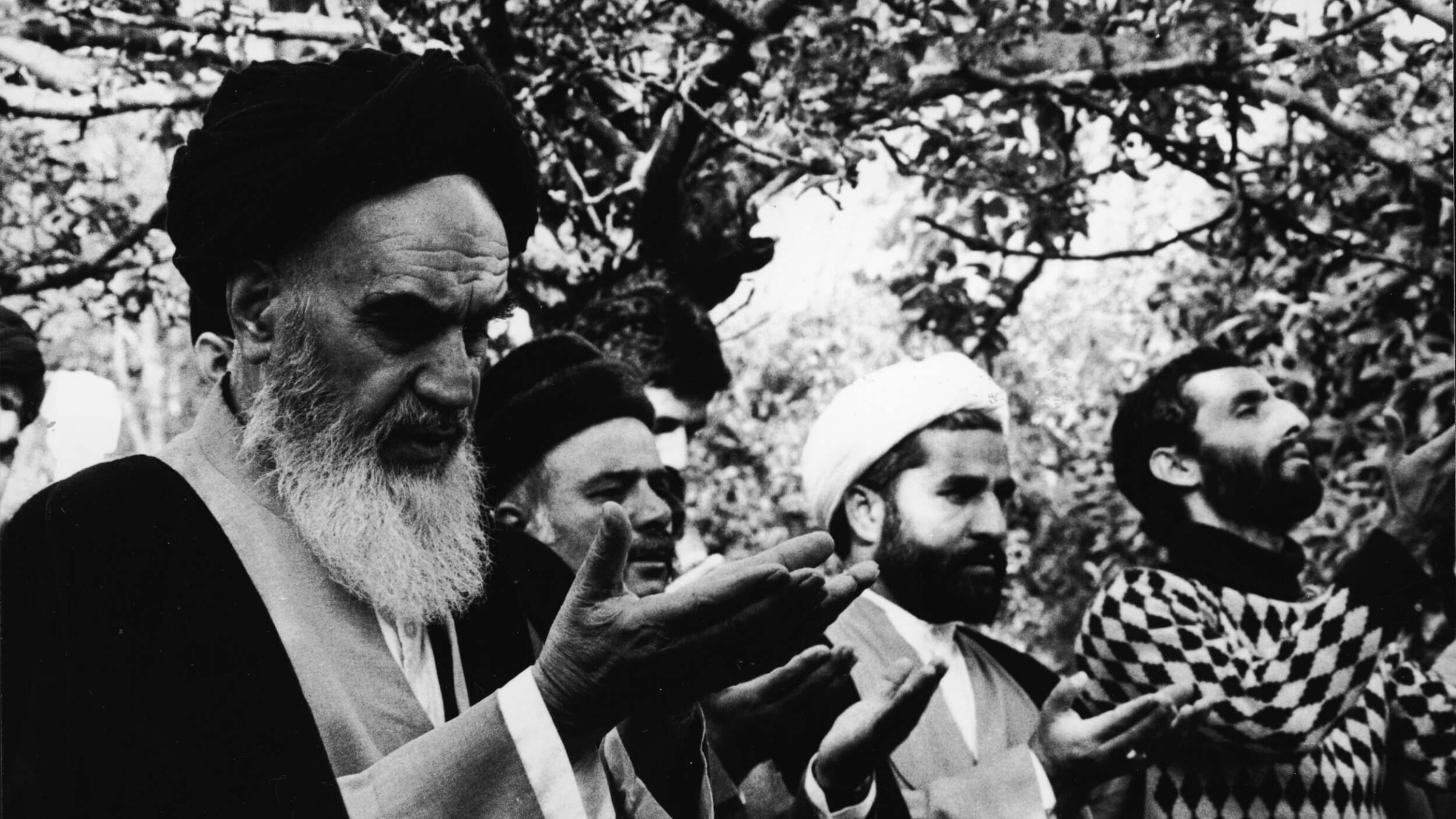
Ayatollah Ruhollah Khomeini, left, near Paris in 1978. Photo by Agence France Presse/Getty Images
Last summer, a 21-year-old far-left activist named Calla Walsh traveled to Iran for its International Memorial for the Media Martyrs of the Struggle Against the Zionist Regime.
Addressing the crowd in Tehran, Walsh said: “We all have a duty, when we go back to the countries we came from, to share the truth we saw here and to struggle against Zionism and imperialism.”
“Glory to all the martyrs. Glory to the axis of resistance,” she added, also saying, “Death to America. Death to Israel.”
Not every leftist American activist is jetting to Tehran to spout propaganda. But the language that Walsh — who supported Sen. Ed Markey’s 2020 campaign, which I worked on — used should be familiar to anyone tracking anti-Israel sentiment in the United States.
What may be less familiar: It’s language that the Islamic Republic of Iran has been key to spreading.
In the current war and in recent years, Israel has proven far more capable in degrading the Islamic Republic as a military actor than in undercutting the influence of the ayatollahs’ ideas, in which anti-Zionism, antisemitism and anti-imperialism are melded into a single ideology. This framework becomes all the more potent when Israel’s government hands its critics ammunition: settlement expansion, the killing of Palestinian civilians and a rightward lurch have combined to make caricatures of Zionism feel, to many, like a good enough approximation of the truth.
But what the ayatollahs demonstrated better than anyone is that criticism of Israel rooted in anti-imperialism is often just a vehicle for antisemitism.
The bait and switch
Ayatollah Ruhollah Khomeini, the Islamic Republic’s hard-line founder, pitched the Iranian revolution as one of social justice.
In 1963, Khomeini declared that the “great aim of Islam” was “to prevent oppression, arbitrary rule, and the violation of the law” — abuses heavily associated with Iran’s repressive government under the Shah. He spoke to the Iranian public in terms with clear parallels to the liberal canon of the American founders, promising citizens a “government that will assure their happiness and allow them to live lives worthy of human beings.”
As Abbas Milani, with whom I studied at Stanford University, recently wrote in The New York Times, this was a bait and switch: a liberal mirage used as a tactic to consolidate support for the revolution. Khomeini cast those principles aside the moment he entered power.
But even before the revolution, Khomeini’s pronouncements about Jews foreshadowed the illiberal oppression that was to come.
“We see today that the Jews (may God curse them) have meddled with the text of the Quran,” Khomeini declared in a series of lectures on Islamic governance in 1970. “We must protest and make the people aware that the Jews and their foreign backers are opposed to the very foundations of Islam and wish to establish Jewish domination throughout the world.”
“Since they are a cunning and resourceful group of people, I fear that — God forbid! — they may one day achieve their goal, and the apathy shown by some of us may allow a Jew to rule over us one day.”
Khomeini’s Jew-hatred appeared to be a genuine ideological commitment, rather than just a political maneuver. In 1977, on the eve of the revolution, he said that “The Jews have grasped the world with both hands and still they are not satisfied.”
Anti-Judaism to anti-Zionism
Israel became the central focus of Khomeini’s conspiratorial belief in Jewish subversion. As such, his objections to Israel often emphasized its Jewish nature rather than its policies.
In 1970, Khomeini lambasted the Shah for extending “his recognition to a government of unbelievers — of Jews, at that — thereby affronting Islam, the Quran, the Muslim governments, and all the Muslim people.” (The Shah never formally recognized Israel, but did have unofficial representation in Tel Aviv. One Iranian official at the time described it as “relations of love without a marriage contract.”)
In 1971, Khomeini called attention to “Israel, that stubborn enemy of Islam and the Quran, which a few years ago attempted to corrupt the text of the Quran.” Replace “Israel” with “Jews” and that statement is all but identical to his earlier accusation that Jews had altered a holy text.
From theology, Khomeini turned to pathology. Eight years after the revolution, he spoke of Israel as a “prevalent, festering, and cancerous Zionist tumor.” Israel must be destroyed, he said, to keep Muslim countries “safe from the evil of this unclean enemy” and the “unclean presence of the Zionists” — taking issue not with Israeli political actions but with the cleanliness of its people, a classic antisemitic trope.
Khomeini referred to imperialism, too, as a cancer. In a 1972 letter to students in North America, he wrote that “Israel was born out of the collusion and agreement of the imperialist states.” Khomeini had previously referred to Jews as the “servants of imperialism,” and framed Islam as “the school of those who struggle against imperialism.”
Colonialism’s pernicious legacy and antisemitic tropes of Jewish domination made it easy for Khomeini to package opposition to colonial rule with opposition to Israel. Muslims, Khomeini said, needed to “stop colonialism and Zionism” on the basis of “human duty, brotherhood, and rational and Islamic standards.”
Khomeini’s vision was clear: resistance to imperialism, opposition to Israel, and hatred of Jews were all the same cause.
Khamenei exports revolution
Ayatollah Ali Khamenei, who succeeded Khomeini as supreme leader in 1989, committed himself to spreading that vision. His English-language account on X amassed more than 2 million followers, and issued pronouncements such as “the long-lasting virus of Zionism will be uprooted thanks to the determination and faith of the youth.” In 2022, he spoke of “Zionist capitalists” as “a plague for the whole world.”
After the Oct. 7, 2023, Hamas attack on Israel , Khamenei addressed American campus protesters, telling them, “You have now formed a branch of the Resistance Front.” He invoked, in that address, “the global Zionist elite” that “owns most U.S. and European media corporations.” He repeatedly refused to call Israel by its name, referring to it instead as the “Zionist regime” or “Zionist entity.”
That wasn’t the first time he explicitly appealed to Western, left-leaning youth. A 2015 letter he issued after Islamist gunmen attacked the offices of the satirical magazine Charlie Hebdo in Paris explicitly addressed “the youth in Europe and North America.” The letter referenced slavery and colonialism, and encouraged young Westerners to study Islam for themselves rather than let it be defined by the West, who “hypocritically introduce their own recruited terrorists as representatives of Islam.” Khamenei notably did not condemn the act of terror itself.
The letter did not specifically engage with issues surrounding Israel, but it marked a notable moment in Khamenei’s efforts to establish connections with young Westerners. And alarmingly, the considerable energy he and the Islamic Republic spent in translating their ideology to Western, English-speaking, progressive audiences worked.
The echo chamber
Calla Walsh’s pronouncements in Tehran were extreme. But they still pointed to an escalating tenor of activist discourse that is increasingly shaping the public’s attitudes toward Israel.
Democratic Socialists of America chapters across the country have passed resolutions defining Zionism as “a racist, imperialist, settler-colonial project,” with some insisting on the need to oppose it “by any means necessary.”
On TikTok, video after video uses Khamenei’s framing of Israel as a “Zionist entity,” from a clip saying that “the American public has woken up to the Zionist entity known as Israel” to another decrying “the cowardly Arabs who normalize relations with the Zionist entity.” A coordinator of the sham charity Samidoun, which conducted fundraising for the Popular Front for the Liberation of Palestine in North America and Europe, stated in October 2022 that “we all have a right and a duty to resist the murderous Zionist entity.”
Most of the echoes between activists and the ayatollahs represent rhetorical alignment, rather than literal coordination. But that alignment has had profound consequences for how the world thinks about Israel, and about Jews.
The road ahead
We do not know how this military campaign ends. But no matter what happens, the ideology of the ayatollahs has already outlasted Khamenei.
Even the reactions to his death prove it: Some leftist organizers have put together vigils for the slain dictator. One coalition of activist groups in New York wrote that “we stand with Ayatollah Khamenei because he stood for us” and lauded him for speaking “about the shared struggle of oppressed people.”
The confluence of anti-imperialism, anti-Zionism, and antisemitism didn’t originate solely with the ayatollahs. Many other forces, including some academic theorists at American institutions such as Edward Said and Judith Butler, played a role.
And many protesters opposing Israel, or the current war, may have no idea that some of the rhetoric they use has ties to the oppressive regime in Tehran. The genuine horror of the war in Gaza, ongoing crackdowns in the West Bank, the sense that the U.S. has enabled these abuses, and a wariness of American adventurism in the Middle East can do a lot to explain public opinion.
But the rhetorical ties are there all the same. And while this war may determine crucial aspects of the future of the Middle East, it will not undo the damage the ayatollahs’ ideas have already wrought.
Khomeini insisted he distinguished between Jews and Zionists, even as he cursed Jews in one breath and condemned Zionists in the next. When today’s activists make that same claim, we should ask whether the distinction they draw is any more meaningful than his was.
This is a moment of great uncertainty. Here’s what you can do about it.
We hope you appreciated this article. Before you go, we’d like to ask you to please support the Forward’s independent Jewish news this Passover. All donations are being matched by the Forward Board - up to $100,000.
This is a moment of great uncertainty for the news media, for the Jewish people, and for our sacred democracy. It is a time of confusion and declining trust in public institutions. An era in which we need humans to report facts, conduct investigations that hold power to account, tell stories that matter and share honest discourse on all that divides us.
With no paywall or subscriptions, the Forward is entirely supported by readers like you. Every dollar you give this Passover is invested in the future of the Forward — and telling the American Jewish story fully and fairly.
The Forward doesn’t rely on funding from institutions like governments or your local Jewish federation. There are thousands of readers like you who give us $18 or $36 or $100 each month or year.
Support our mission to tell the Jewish story fully and fairly.